by Ralf Tenbrink | 20, May 2026 | Costa Blanca Bike Shops, Costa Blanca News
Bike Shops in Jávea: Where Cyclists Rent, Repair & Ride
Jávea — Xàbia in Valencian — sits where the Montgó massif meets the Mediterranean, and that geography defines everything about cycling here. You have short, punchy climbs on your doorstep, fast coastal roads toward the Cap de la Nau lighthouse, and access to the broader Marina Alta network of inland routes without needing to drive anywhere. For visiting and resident cyclists alike, the question is rarely whether to ride — it’s which direction to point the wheel, and who to call when the bike needs attention.
This guide covers the real bike shops in Jávea: what they offer, where they are, who they’re best suited to, and what to expect when you arrive. It also covers rental pricing, repair expectations, the key climbs, and a few things it takes a season or two of riding here to learn.
Why Jávea Is a Cycling Hub
Jávea’s appeal to riders is structural rather than incidental. The town sits at the tip of the Marina Alta, a comarca that gives you direct access to the Montgó natural park to the north, the Cap de la Nau road circling south toward Granadella, and the Jalón valley climbing inland toward the Coll de Rates — one of the most ridden climbs on the Costa Blanca. From a single base in Jávea, a cyclist with a week can ride five or six completely different routes without covering the same road twice.
The Montgó itself offers two distinct cycling experiences. The Jávea-side approach is 2.2 km at an average gradient of 6.7%, with a steepest segment hitting 9.2% — a 4th-category climb that’s short enough to repeat as intervals but demanding enough to leave an impression. The longer Dénia-side approach runs 4.8 km at 4.3% average, making it more accessible for riders building fitness. Both routes finish at the same viewpoint above 200 m, with clear visibility across the bay on most days.
The Cap de la Nau circuit adds a different character entirely — 42 km with around 550 m of elevation, with the road narrowing as it follows the cliffs south and eventually opening out to the lighthouse. This is exposed riding: the coastal headland catches crosswinds that don’t show on any weather app, particularly in spring and after front passages. It’s one of those roads where you want tyres pumped firm and hands not too tight on the bars.
For harder days, Cumbre del Sol is the headline climb from Jávea — gradients hitting 19% in sections, manageable on a compact chainset but honest work regardless. The full loop from Calpe runs around 110 km, but plenty of riders do the climb from Jávea as a standalone effort and come back along the coast.
The climate extends the season in a way that matters commercially. According to Turisme Comunitat Valenciana, the Marina Alta records over 300 days of sunshine per year, with average winter temperatures that allow comfortable riding from November through February. That makes Jávea a year-round destination rather than a March-to-October one, and it sustains bike shops and rental operations through periods when comparable towns in northern Europe are closed.
A permanent expat community — predominantly British, German, and Dutch — provides a stable year-round base of cycling customers. Combine that with training camp groups from February onward and the broader cycling tourist market, and you have enough volume to support several proper bike businesses in a town of roughly 34,000 people.
Featured Bike Shops in Jávea
Xabia’s Bike — Port & Town Centre
Best for: All-round cycling needs, road bike retail, rentals, guided rides, local knowledge
Xabia’s Bike is the town’s longest-established cycling operation, with over 25 years trading from its main store on Avenida de Lepanto in the port area. The team — multilingual in Spanish, Valencian, English, and German — serves both the local expat community and visiting cyclists. They stock mountain bikes, road bikes, and electric bicycles for all ages and abilities, with a full repair workshop and rental service alongside the retail offer. The workshop has been renovated and expanded in recent years; it’s a proper mechanical operation rather than an afterthought at the back of a shop.
The technical side is handled by experienced mechanics including Alex Chacón, and the shop offers all-life free revisions and labour for bikes purchased there — a notable commitment that explains the loyal local following. They also organise guided road and MTB rides into the Marina Alta, which is useful if you want to ride with locals who know which stretches of the Montgó road get slippery after humidity and which cafés are worth stopping at.
Address: Avenida de Lepanto, 5, Jávea (Port area) Phone: 96 646 11 50 Website: xabiasbike.com Services: Retail sales · Bike rental (road, MTB, e-bike, children’s) · Repairs & workshop · Guided tours Languages: Spanish, English, German, Valencian
Elite Bikes Jávea — Arenal Area
Best for: Repair workshop, e-bike rental, second-hand bikes, guided weekly rides
Elite Bikes describes itself as a team of passionate riders and experienced mechanics who understand the demands of cycling in and around Jávea. From performance road bikes to trail-ready mountain bikes, they offer expert repairs, precision tuning, and upgrades, plus flexible bike rental options to suit every type of rider.
The shop is located on Avenida de la Fontana in the Arenal area. They’re known for fast repairs — same-day service is available for many common jobs — which makes them a practical first stop for visiting cyclists who arrive with a problem and want to get back out the same afternoon.
Elite Bikes carries official e-bike service authorisations for Bosch, Shimano, Fazua, SRAM, Fox, and RockShox — a level of technical capability that matters if you’re riding a modern e-MTB or an electronic road groupset. For casual rental, they offer city bikes, e-city bikes, and e-MTBs. They also run free weekly guided cycling tours open to everyone, whether you rent from the shop or bring your own bike — a genuine local resource that’s worth knowing about if you’re new to the area.
Address: Avenida de la Fontana, Jávea (Arenal area) Phone: +34 965 047 170 · WhatsApp: +34 605 857 784 Website: elite-bikes.com Services: Road/MTB/e-bike repair · Rental (city bikes, e-MTB, e-city) · Second-hand bike sales · Electronic groupset diagnostics · Free weekly guided rides Rental from: ~€15/day
Is your bike shop missing from this list? Register your business on Bikes Costa Blanca and reach thousands of cyclists searching Jávea for services.
Types of Bike Shops in Jávea: Quick Overview
| Shop Type | What It Covers | Best For |
|---|
| Full-service retailer | Sales, hire, repairs, accessories | Visiting and resident cyclists, all needs |
| Repair workshop | Mechanical service, diagnostics | Riders with mechanical issues, mid-trip repairs |
| E-bike specialist | E-bike hire and authorised servicing | E-MTB riders, leisure tourists, non-cyclists |
| Guided ride operator | Route guidance, bike hire combined | First-time visitors, group trips |
Most shops in Jávea cross categories — Xabia’s Bike and Elite Bikes both handle retail, rental, repairs, and guided rides. Jávea does not currently have a dedicated high-end road bike fitting studio in the manner of larger Costa Blanca cycling hubs like Calpe or Benidorm, so riders requiring precision bike fitting should check availability directly before visiting.
Bike Rentals in Jávea
Bike rental in Jávea is well established for road bikes, e-bikes, and leisure bikes. Both main shops offer daily and weekly rates, with meaningful savings on weekly bookings. The table below reflects typical 2025–2026 pricing:
| Bike Type | Daily Rate | Weekly Rate (approx.) | Notes |
|---|
| City / hybrid bike | €15–20 | €80–100 | Good for coastal roads, port area |
| Road bike (aluminium) | €20–30 | €110–150 | Entry-level, compact gearing available |
| Road bike (carbon, 105/Ultegra) | €35–55 | €180–260 | Book ahead in peak season |
| E-bike (city) | €30–45 | €160–220 | Arenal and coastal riding |
| E-MTB | €40–65 | €200–320 | Montgó trails, inland routes |
| MTB (hardtail) | €25–35 | €130–180 | Off-road trails around Montgó |
Helmet and lock are typically included. Pedal type (flat or SPD-SL/Look Keo) should be specified at booking. Frame size availability varies — if you need a specific size, confirm at least a week ahead during busy periods.
Hotel and villa delivery is available from both main shops, which matters in Jávea where plenty of accommodation sits on the Montgó slopes or in the residential areas east of the Arenal. Confirm the coverage area and any surcharge when booking.
Our dedicated Rent a Bike on the Costa Blanca guide covers the full process — what to check before you sign, how to handle a mechanical on the road, and what’s typically included in a good rental package. If you’re coming as a group or family, see also Bike Rentals for Groups and Families for fleet availability and logistics.
When to book: Peak demand runs March–May and September–October, when training camps and cycling holiday groups fill the calendar. If you’re visiting during these windows and want a specific bike — particularly a carbon road bike in a popular frame size (M/L) — book seven to ten days ahead. July–August is quieter for road bike hire but busy for e-bikes and city bikes as the leisure tourist market peaks.
Bike Repairs & Emergency Services in Jávea
Both main bike shops in Jávea run proper mechanical workshops. For common repairs — puncture, brake adjustment, cable replacement, derailleur indexing — same-day service is realistic if you bring the bike in before noon. More involved work (wheel builds, bottom bracket, electronic groupset calibration, suspension service) may require leaving the bike overnight.
What to expect:
| Job Type | Typical Turnaround | Typical Cost |
|---|
| Tube replacement | 15–30 minutes | €8–15 |
| Brake pad / cable replacement | 1–2 hours | €15–35 |
| Full service (cables, brake, gears) | Same or next day | €50–90 |
| Wheel true | 1–2 hours | €15–25 |
| Electronic groupset diagnostics | Same or next day | Varies |
| E-bike motor / battery service | 1–3 days | Varies by fault |
Mobile repair provision in Jávea is less structured than in larger towns. If you’re staying at a villa remote from the town centre, calling ahead to confirm a mechanic can reach you is worth doing before you assume it’s possible. Some rental packages include basic roadside assistance — ask when collecting the bike.
For broader repair coverage across the region, the Bike Repair Costa Blanca directory lists workshops by area. For organised groups needing vehicle support on longer rides, Bike Support Services Costa Blanca covers the neutral service options available.
Key Cycling Routes from Jávea: What to Know Before You Ride
Understanding the local terrain helps you choose the right bike and gear from any shop in town. These are the routes that come up in almost every conversation at the counter:
Top Climbs & Routes from Jávea
| Route / Climb | Distance | Elevation | Difficulty | Bike Type |
|---|
| Montgó (Jávea side) | 2.2 km | 144 m | Cat. 4, avg 6.7%, max 9.2% | Road, e-bike |
| Montgó (Dénia side) | 4.8 km | 205 m | Cat. 4, avg 4.3%, max 8.7% | Road, e-bike |
| Cap de la Nau circuit | ~42 km | ~550 m | Moderate, exposed headland | Road, gravel, e-bike |
| Cumbre del Sol (from Jávea) | ~35 km loop | ~600 m | Hard, max gradient 19% | Road (compact gearing) |
| Montgó MTB loop | ~28 km | Moderate | Medium off-road | MTB, e-MTB |
| Arenal to Granadella coast | ~15 km | Easy | Beginner-friendly | City, e-bike, gravel |
| Montgó circuit via Jesús Pobre | ~26.5 km | Low | Easy, low traffic | Road, touring, e-bike |
The Jávea to Cumbre del Sol Route guide on this site gives a detailed stage-by-stage breakdown, including the 19% gradient sections. The Jávea Mountain Biking Route covers the Montgó off-road loop.
Where to Find Bike Shops in Jávea
Jávea has three distinct zones and the bike services split naturally between them:
El Port (The Port) — Xabia’s Bike’s main location sits here, on Avenida de Lepanto close to the marina. This is the most convenient zone for cyclists staying in port-area accommodation or those heading out on coastal road rides. Parking is easier early morning.
El Arenal — The beach strip south of the port. Elite Bikes operates from Avenida de la Fontana here, making it convenient for those staying near the beach or heading out on the Granadella coastal route. The Arenal is busier in summer but accessible.
Jávea Pueblo — The inland old town, largely residential. No major cycling-specific retail as of 2026, though smaller repair operations may exist. For anything beyond a basic fix, the port or Arenal shops are a better bet.
If you need to transport a bike with a fault, note that parking near both main shops can be tight mid-morning in summer. Early arrival avoids the worst of it.
Insider Tips for Cyclists in Jávea
The Cap de la Nau road catches crosswinds. The headland south of Jávea is exposed in a way the town itself is not. Spring thermals and post-frontal north winds create lateral gusts on the descent back from the lighthouse. If it’s been a windy night, the road surface may also have fine debris on it — worth bearing in mind on a carbon bike at speed.
The Montgó descent road gets slippery after overnight humidity. The moisture that collects in the park during cool nights leaves a light film on the road surface that burns off by mid-morning. Early starters in autumn and spring should treat the first descents gently until the sun has been on the road for an hour.
Cumbre del Sol is the climb worth the suffering. The gradient hits 19% and it’s not a short section. Ask the shop for a bike with at least a 32-tooth cassette if that’s in your itinerary — most shops in Jávea carry rentals geared for this kind of terrain, but confirm when booking.
Water points are limited on the longer routes. The Cap de la Nau circuit and the Montgó loop via Jesús Pobre have very limited water access once you leave town. A small café operates seasonally at the Cap de la Nau lighthouse, but don’t count on it being open. Two bottles minimum; three in summer.
Book early for training camp season. March and April are peak for organised groups. The bike shops know this — if you arrive expecting same-day rental of a specific road bike in a popular size without a reservation, you may be disappointed. A week’s notice is realistic; two weeks is better.
Ride early, finish early in July and August. Jávea’s coastal position keeps temperatures marginally more manageable than inland towns, but the Cap de la Nau road offers zero shade. Start before 8am in high summer and be off the exposed sections by 10:30am.
Ask about current road conditions when you collect your bike. The Montgó approach roads and some Granadella tracks are first to suffer after winter storms or heavy rain. Both main shops in Jávea track current conditions as a matter of routine — it’s a quick conversation and worth having.
For more preparation guidance, the Best Apps for Route Navigation article covers what to download before heading out, and the Complete Packing List for Self-Guided Tours is useful if you’re doing multi-day rides.
Cycling Lifestyle in Jávea: Why Riders Stay
Jávea has become one of those places where cyclists arrive for a week and start having longer conversations about what it would take to stay. The practical reasons are straightforward: year-round riding weather, multiple route profiles from a single base, a functioning expat community that already rides, and a cost of living that compares favourably to equivalent locations in France or Italy.
The cycling culture here is genuine rather than manufactured. The cafés on the port promenade fill with riders on Saturday mornings between 10am and noon — they’re the ones who left at 7am and have earned their coffee. Local riders tend to know each other, and if you’re a competent cyclist at a bike shop asking for a route recommendation, you’re as likely to get an invitation to join someone’s Sunday group as you are a printed map.
For cyclists who cycle seriously and are also thinking about where to live or invest on the Costa Blanca, the connectivity is worth noting. Jávea sits roughly equidistant from Dénia to the north and Calpe to the south — both covered in our Coastal Loop from Calpe to Dénia route guide — and within an hour’s drive of the Guadalest valley and the Sierra de Aitana, where more serious mountain riding is available.
If you’re considering accommodation for a cycling holiday or longer stay, the Cycling-Friendly Accommodation Costa Blanca directory lists properties across the region vetted for cyclist-specific needs: secure bike storage, workshop space, hose access, early breakfast options.
Related Cycling Resources on Bikes Costa Blanca
FAQ: Bike Shops in Jávea
Can I rent a road bike in Jávea? Yes. Both Xabia’s Bike and Elite Bikes offer road bike hire, from entry-level aluminium to carbon-frame options. SPD-SL and Look Keo pedal systems are typically available. Book at least a week ahead during March–May and September–October when demand peaks from training groups.
Are there bike repair shops in Jávea? Yes — both main shops run full mechanical workshops. Same-day service is realistic for common repairs if you arrive in the morning. Elite Bikes holds official service authorisations for Bosch, Shimano, Fazua, SRAM, Fox, and RockShox, making them the practical choice for e-bike and electronic groupset issues.
Do bike shops in Jávea deliver bikes to hotels and villas? Many rental providers offer delivery to accommodation in and around Jávea, including properties on the Montgó slopes and Arenal area. Confirm coverage and any delivery charge when booking — it varies by location and provider.
Is Jávea good for a cycling holiday? It’s one of the better-positioned cycling bases on the northern Costa Blanca. Direct access to the Montgó climbs, the Cap de la Nau coastal circuit, and the Cumbre del Sol, combined with year-round mild weather and a solid local bike services infrastructure, makes it practical for both leisure and training-focused trips.
What bikes can I hire in Jávea? Road bikes (compact and standard gearing), e-bikes (city and MTB), hardtail MTBs, city/hybrid bikes, and children’s bikes are all available. Full-suspension MTB hire is less widely offered — confirm availability with the shop if that’s a requirement.
What are the best bike rental prices in Jávea? City bikes from around €15/day. Aluminium road bikes €20–30/day. Carbon road bikes €35–55/day. E-bikes and e-MTBs €40–65/day. Weekly rates offer 20–30% savings over daily pricing. Prices vary by shop and season.
Is there cheap bike hire in Jávea? City bikes and basic MTBs are available from around €15/day at Elite Bikes, and second-hand bikes can be purchased at lower price points if you’re staying for a longer period. For the most affordable road bike options across the region, see our Affordable MTB Rental Providers guide.
When is the best time to cycle in Jávea? March through May and September through October offer the best combination of temperature, road conditions, and daylight. Winter riding (November–February) is feasible, uncrowded, and often underrated. July–August requires very early starts — the Cap de la Nau road offers no shade and the sun is strong by 9am.
Are there cycling cafés in Jávea? The port promenade has several cafés that have become de facto rider meeting points on weekend mornings. Caffee Cadanz, based slightly further south toward Calpe, is a well-known cycling-specific café and is frequently mentioned as a turnaround or rest point on longer routes. For routes that pass through, the Cap de la Nau lighthouse café is open seasonally and worth timing a stop around.
Can I join a guided cycling ride in Jávea? Yes. Elite Bikes runs free weekly guided rides open to anyone, whether you rent from them or bring your own bike. Xabia’s Bike also organises guided road and MTB outings into the Marina Alta. Both are low-pressure, practically useful ways to ride with locals and learn the roads.
by Ralf Tenbrink | 15, May 2026 | Costa Blanca News, Newsletter
MAY 2026 · REGION SPECIAL
May in the Marina Alta: Perfect Temps and Blooming Landscapes
The vineyards are in leaf, the almond groves are green, and the roads through the Marina Alta interior are at their absolute finest.
20–26°C Daytime temps | 320 Sunshine days/yr | WHO Healthiest habitat in Europe | Calm May winds |
The Marina Alta is one of the most beautiful corners of the Spanish Mediterranean — and in May, it’s at its undeniable best. The temperature sits in a perfect 20–26°C window, the Jalón Valley vineyards have leafed out in deep green, and the roads that thread through the interior — past white villages, terraced orange groves and limestone ridges — carry almost no traffic at all. This is slow cycling at its finest, and also some of the most scenically rewarding riding you’ll find anywhere in Europe.
Whether you’re based in Calpe, Jávea, Dénia or the Jalón Valley itself, the Marina Alta in May offers something for every kind of rider — from explorers ticking off quiet inland villages to serious climbers using the region as a training ground ahead of the V Aitana Tour on May 31st.
Why May is the Marina Alta’s Finest Month
| 🌿 The Landscape at Peak Green The Jalón Valley — the beating heart of the Marina Alta — is famous for its almond blossom in February. But May is when the valley reaches its lushest, most vivid state. The vineyards that produce Moscatel grapes are in full, deep green leaf. Orange and lemon groves fill the lower valley floors. Wild rosemary and thyme colour the hillsides above. On a clear May morning, the scent alone makes the ride worthwhile. |
| ☀️ Temperatures Made for Long Days May delivers the perfect cycling temperature: warm enough to ride in shorts from the first kilometre, cool enough to sustain effort on the longer climbs. The Marina Alta has been designated by the World Health Organization as the healthiest habitat in Europe — 320 days of sunshine a year, low humidity, and consistently clean air off the Mediterranean. In May, all of that comes together perfectly. |
| 🛣️ The Quietest Roads of the Year May sits in the sweet spot between the Easter rush and the summer influx. The inland routes — the Jalón Valley, the villages around Pego and Orba, the roads toward Castell de Castells and Benigembla — are as quiet as they get. You can ride for an hour without seeing another vehicle on some of these roads. That is not an exaggeration. |
“The road through the Jalón Valley on a May morning — vineyards either side, Coll de Rates on the horizon, not a car in sight — is one of those rides that makes you feel genuinely lucky to be here.” |
Four Areas to Explore This Month
| JALÓN VALLEY The Valley at the Heart of Everything Base: Xaló / Jalón · All levels · 40–120 km The Jalón Valley is the natural hub of Marina Alta cycling. Sitting at the crossroads of routes north to Dénia, south to Calpe, east to the coast and west toward Coll de Rates, it puts everything within reach. In May, the valley floor is a vivid patchwork of vineyard green and citrus gold. The café in Xaló village — a favourite of the winter pro peloton — fills with cyclists from first light. The valley is also the launchpad for Coll de Rates via Parcent and Alcalalí: in May conditions, this is the benchmark climb at its absolute best. |
| JÁVEA / XÀBIA Coast, Cliff and the Montgó Natural Park Base: Jávea · Road & MTB · 30–90 km Jávea sits at the foot of the Montgó massif — the 753m natural park that dominates the northern Marina Alta coast. May is the ideal month to tackle the Montgó climbing routes before the summer heat makes them punishing. From the seafront, roads roll out through residential areas before hitting genuinely wild terrain on the natural park trails and mirador climbs. The views from the top back across the bay toward Dénia are extraordinary. Combine a Montgó loop with the coastal road south toward Moraira for a perfect half-day. |
| DÉNIA & PEGO Flat Coastal Riding and the Hidden Interior Base: Dénia · Leisure & e-bike · 25–70 km Dénia is the largest town in the Marina Alta and the ideal base for flatter riding and leisure exploration. The coastal road south toward Jávea is a beautiful May morning ride — calm sea, low traffic, orange blossom in the air. Head inland and the roads climb gently toward Pego and the rice fields and orange groves of the Vall de Gallinera. It’s less dramatic than the mountain routes further south, but on a bright May morning it has a quiet, unhurried beauty that is hard to match. Also outstanding for e-bike exploration. |
| INLAND VILLAGES Castell de Castells, Benigembla & Beyond Base: Any Marina Alta town · Road explorers · 60–110 km For riders who want to go deeper, the roads north of the Jalón Valley toward Castell de Castells, Benigembla and Tárbena take you into a part of the Marina Alta that few visitors ever reach. White villages perched on hillsides, terraced fields of almonds and olives, the occasional bar with a hand-written menu and very cold beer. These are the roads the pros use for recovery rides — quiet, beautiful, and utterly restorative. May’s long daylight hours give you the time to explore properly. |
Essential Café Stops
The Marina Alta has a strong café culture built around cycling. These four stops are institutions.
| ☕ Xaló Village Café — Jalón Valley The cycling café in the Jalón Valley. Natural midpoint of Coll de Rates, Val d’Ebo and Guadalest routes. Known to every pro who has trained here. Good coffee, home cooking, cyclist-friendly terrace. |
| ☕ Cycling Café — Dénia On the Marina road at the edge of Dénia. Great coffee and energy snacks. Ideal start or finish point for coastal Marina Alta loops. |
| ☕ Bar at the foot of Val d’Ebo A village bar tucked into the valley before the climb begins. Simple food, cold drinks, almost always a few bikes outside. The kind of place that keeps these routes worth riding. |
| ☕ Coll de Rates Summit Restaurant — Tárbena At the top of the most famous climb on the Costa Blanca. Beautiful terrace, views across the valley. The perfect excuse to make the ascent every ride. |
| 💡 MAY LOCAL TIPS ● Start from the valley, not the coast. Basing yourself in Xaló or Jalón puts you within minutes of the best roads with none of the coastal resort traffic to navigate first. ● The afternoon sea breeze arrives around 2pm. In May it’s gentle and cooling rather than disruptive — perfect timing for a post-lunch spin back toward the coast. ● Muscatel wine at the end of the day. The Jalón Valley produces one of the finest Muscatel wines in Spain. After a long May ride, a chilled glass on a terrace is entirely justified. |
🏃 Using the Marina Alta to Prepare for Aitana Tour The Marina Alta is the perfect training ground for the V Aitana Tour on May 31st. Coll de Rates, Val d’Ebo and the Jalón Valley loops give you race-specific climbing in the most beautiful setting imaginable. Ride the landscape you love — and arrive at the start line ready. → bikescostablanca.com/aitana-prep |
| 📅 Also in May Coming up: our Triathlon Fever guide for the Mediterránea Triatlón Alicante (16–17 May). And in June we’ll be covering San Juan night rides, early morning heat-beaters and the best beach stops along the coast. |
Sign up to our newsletter and get informed every time we publish new posts.
by Ralf Tenbrink | 12, May 2026 | Costa Blanca Bike Shops, Costa Blanca News
Bike Shops in Dénia: Where Cyclists Rent, Repair & Ride
Whether you are arriving for a week-long cycling camp, picking up after a winter break, or simply need a tube replaced before a morning ride, finding the right bike shop in Dénia matters. The town sits at the northern tip of the Costa Blanca, at the foot of the Montgó massif and within a short pedal of some of the most varied cycling terrain in the Valencia region. That combination of geography, climate, and a well-established cycling community makes Dénia one of the busiest hubs for bike services on the entire coastline.
Why Dénia is a Cycling Hub
Dénia has a character that sets it apart from the resort towns further south. The old port, the Moorish castle on the rock, and the weekly farmers market attract a different kind of visitor — one who tends to be curious, active, and inclined to explore beyond the beach. Cyclists fit naturally into that picture.
The Montgó Natural Park rises directly above the town to 753 metres and offers punishing climbs that attract serious road riders and mountain bikers alike. From Dénia you can also reach the Coll de Rates — one of the most iconic climbs in the region, immortalised for many riders by its regular appearances in training camp routes — with around 30 km of pedalling inland. The coastal loop from Calpe to Dénia is a favourite for those who want distance with sea views, while the Jávea direction opens up routes toward the Cabo de la Nau headland with its technical descents and dramatic scenery.
The Dénia tourism area is also covered under Spain’s broader cycling promotion efforts. The Comunitat Valenciana has invested in cycling infrastructure and cycling-friendly signage across the Marina Alta comarca, of which Dénia is the capital. The town itself has a flat seafront promenade ideal for leisure riding and e-bike tours, which brings in a completely different clientele from the lycra-clad road riders who head straight for the hills.
Dénia even has international cycling credibility. In 2025 the town hosted a world-record cycling spectacle by the Mediterranean, underlining its status as a destination that takes the sport seriously. The 2020 Vuelta a España Stage 8 from Dénia to Xorret de Catí brought professional racing through the town, and the local cycling community has not looked back since.
The Marina Alta comarca, of which Dénia (postcode 03700) is the administrative capital, has seen a steady rise in cycling club activity over the past decade, driven in part by the growing popularity of the Costa Blanca among northern European training camps and cycling tourists. The Federació de Ciclisme de la Comunitat Valenciana oversees racing and club activities across the province and maintains a list of registered clubs in the area for riders looking to join a local group ride.
Types of Bike Shops in Dénia
Every cycling shop in Dénia has its own speciality, so it pays to know what type of business you are looking for before you walk in. The overall offer covers most needs, though the range is more focused than what you would find in Benidorm or Calpe.
Rental-focused shops are the most visible category, primarily targeting the steady flow of tourists arriving from March through October. These shops maintain fleets of road bikes, e-bikes, hybrid city bikes, and in some cases mountain bikes, with daily or weekly pricing structures and the option to include helmets, locks, and basic tool kits.
Repair workshops range from small independent mechanics working from a side-street unit to full-service shops attached to rental operations. Quality varies, so it pays to ask about certified mechanics and turnaround times before leaving your bike.
E-bike specialists have grown significantly in the Dénia area over the past few years, reflecting the town’s strong appeal to leisure riders and older visitors who want to cover the flat coastal paths or the gentler inland routes without turning it into a physical challenge.
Road bike specialists tend to sit further inland toward Ondara or Pedreguer for high-end retail, but several shops in and around Dénia carry a solid range of components and can handle workshop services for performance bikes.
Bike Rentals in Dénia
Bike rental — or bicycle hire as many UK visitors call it — in Dénia works well for almost any cyclist profile. Visitors arriving without a bike — whether by car, ferry from Ibiza or Mallorca, or the regional Cercanías train line — can be on the road within an hour of arrival.
The most common rental fleet items are:
- Road bikes — typically aluminium or entry-level carbon, in a range of frame sizes, with clip-on pedal options
- E-bikes — growing fast in availability, popular for coastal riding and the flatter inland routes
- Hybrid/city bikes — suited to the seafront promenade, the port area, and trips into the town centre
- Mountain bikes (hardtail) — available at shops catering to the Montgó and the trails heading northwest
Most shops offer daily, weekend, and weekly rates. Hotels and holiday villas in the Marina Alta area are accustomed to bike deliveries; if you book in advance, several rental providers will drop a bike directly to your accommodation and collect it at the end of your stay, which is particularly useful if you are based outside the town centre.
Peak season runs from mid-March through June and again in September and October. Spring is peak season for serious cyclists; the better rental shops fill up fast, so book at least two weeks ahead if you are visiting for a training camp. July and August are busier for leisure rentals but less suitable for long mountain rides.
→ Compare rental providers in Dénia and the northern Costa Blanca
For a broader overview of what to expect before you arrive, the complete guide to renting a bike on the Costa Blanca covers the key questions in detail, and the bike rentals for groups and families page is useful if you are travelling with children or in a larger party.
Bike Repairs & Emergency Services in Dénia
A mechanical in the middle of a long ride is an unpleasant situation anywhere, but on the Costa Blanca the distances between towns and the occasional lack of mobile signal in the sierras make preparation more important than at home.
Dénia shops that carry out repairs generally handle the most common issues — punctures, brake cable replacement, derailleur adjustment, cleats, broken spokes — on a same-day or next-morning basis depending on how early you get there. For more serious work (bottom brackets, wheel building, suspension servicing on full-suspension MTB) you may need to wait a day or plan around workshop schedules.
Mobile repair services have become more common across the Costa Blanca in recent years. If you are staying at a villa or hotel outside Dénia’s centre, it is worth asking your rental provider whether they also cover roadside callouts, or checking the bike support services listings on Bikes Costa Blanca.
One practical tip: carry a basic spares kit regardless of where you are staying. A couple of inner tubes, a CO2 inflator or mini pump, tyre levers, and a multi-tool will handle the most common roadside problems and save you a long walk back to town.
→ Find a verified bike repair workshop near Dénia
Where to Find Bike Shops in Dénia
The main concentration of bike-related businesses in Dénia sits in three areas:
The town centre and Marqués de Campo boulevard — the main commercial street has general sports shops and at least one established bike retailer. Parking can be awkward in high season; arriving early is advisable.
The port and seafront area — rental shops targeting tourist traffic tend to cluster here, benefiting from the foot traffic of ferry arrivals and the beachfront hotels. These shops prioritise leisure bikes and e-bikes.
The northern exit toward Ondara (N-332 corridor) — larger workshop operations and shops with more technical stock tend to be located on the fringes of town or in the light industrial areas along the main road, where premises are more affordable and van access for deliveries is easier.
If you are driving in, the N-332 approach from the south and the AP-7 autopista exit at Ondara both give easy access to the outskirts. Cyclists arriving on two wheels will find most of the town flat and very navigable.
Prices & What to Expect in Dénia
Rental pricing in Dénia — known locally as alquiler de bicicletas en Dénia — is broadly in line with the rest of the Costa Blanca northern zone:
| Type | Per Day | Per Week |
|---|
| City / hybrid bike | €10–15 | €50–70 |
| Road bike (aluminium) | €20–30 | €90–130 |
| E-bike | €25–40 | €120–180 |
| Mountain bike (hardtail) | €20–30 | €90–130 |
These figures are approximate and vary by shop, bike spec, and season. Performance road bikes from a higher-end operator — think carbon frames, electronic groupsets, quality wheel sets — will cost more and usually require advance booking and a deposit or ID.
For repairs, expect to pay €15–25 for a basic puncture repair (tube replaced and tyre checked), €30–50 for cable and housing replacement, and €60–120 for more involved workshop services. Workshop labour rates in Spain are generally lower than northern Europe, which is one reason professional cycling teams and training camps find the Costa Blanca so attractive.
A note on quality: it is worth paying for a properly maintained rental bike rather than the cheapest option available. A poorly adjusted saddle height or worn brake pads on an unfamiliar bike on a fast descent in the sierras is not a good combination.
→ Check current rental rates and availability in Dénia
Insider Tips for Cyclists in Dénia
Book ahead in shoulder season. March, April, May, and October are the busiest months for serious cyclists. If your trip coincides with a cycling camp or a local sportive (and there are several in the Marina Alta area each spring), rental stock at the better shops can run short quickly.
Ride early. Mediterranean summers mean that any ride of substance in July and August should start before 9 am. The Montgó, the coast road to Jávea, and the inland routes toward Pedreguer are all much more pleasant — and safer — before the heat and traffic build. The Costa Blanca has a long-standing reputation as one of Europe’s premier early-season training destinations, and that advantage disappears once summer heat sets in.
Respect local traffic patterns. The road to Jávea (CV-734) is busy with commuters in the morning and can be narrow in places. The inland routes tend to be quieter but demand attentiveness on blind bends. Spanish drivers are generally accustomed to cyclists, but slower traffic can build up quickly on single-lane mountain roads.
Bring your pedals. Rental shops do not always carry SPD-SL or Look-compatible pedals in the right stack height or shoe sizing for a serious rider. Travelling with your own pedals takes minutes to install and can make a significant difference to your comfort over a week’s riding.
Chain maintenance matters. If you are riding back-to-back days in dusty inland terrain, the chain takes a beating. A clean, lubricated drivetrain is especially important on rentals where the last rider may not have maintained it. If you are bringing your own bike, consider hot wax chain lubrication — it performs exceptionally well in the dry, gritty conditions of the Costa Blanca interior.
For route ideas before and during your trip, the best apps for route navigation on self-guided Costa Blanca cycling tours is a practical starting point, and the complete packing list guide for self-guided tours covers what to bring beyond just the bike.
Bike Shops in Dénia: Directory Listings
The shops below are listed on the Bikes Costa Blanca directory. Listings include rental providers, repair workshops, and cycling specialists serving the Dénia area and the wider Marina Alta comarca.
→ Browse all verified bike shops and rental providers in Dénia
→ Browse all verified bike repair shops in Dénia
→ Browse all verified bike friendly accomodation in Dénia
→ Browse all Costa Blanca bike rentals
Are you a bike shop, rental provider, or mobile mechanic in or around Dénia? List your business on Bikes Costa Blanca →
If Dénia is your base for a wider Costa Blanca cycling trip, the following pages will help you plan:
Frequently Asked Questions
Can I rent a road bike in Dénia? Yes. Several shops in and around Dénia rent road bikes on a daily or weekly basis. For carbon-framed performance bikes with quality groupsets, advance booking is strongly recommended, particularly in spring when training camps are active. Check the bike rentals directory to compare what is currently available.
Are there bike repair shops near me in Dénia? Yes, Dénia has independent mechanics and full-service workshops. For same-day repairs on common issues — punctures, brake and gear adjustments, cable replacement — turn up early in the morning. More involved repairs may require leaving the bike overnight. The bike repair Costa Blanca page lists verified workshops across the region.
Do bike shops deliver bikes to hotels in Dénia? Many rental providers in the Dénia area offer hotel, villa, or apartment delivery for an additional fee, or as standard on weekly bookings. Confirm this when you book; delivery windows are typically morning and afternoon slots. It is worth clarifying the collection arrangement at the same time.
Is Dénia good for a cycling holiday? Very much so. Dénia combines flat coastal riding for leisure and e-bike days with accessible mountain routes toward the Montgó, and is within reach of some of the Costa Blanca’s best road climbs including the Coll de Rates, the Col de la Cumbre del Sol, and the routes around Jávea and the inland valleys. The ferry connections to the Balearics also make it a practical base if you are combining a Costa Blanca cycling trip with island riding. The cycling holidays page covers tour operators and camp providers based in the area.
What is the best time of year to cycle from Dénia? March to June and September to November are the optimal months. Spring offers cool temperatures, green landscapes, and relatively quiet roads. Autumn brings similar conditions after the summer heat subsides. July and August are manageable with early starts but are not ideal for extended efforts in the hills.
Can I cycle from Dénia to Calpe? The coastal route from Calpe to Dénia is a well-known ride of around 30 km each way, with sea views for much of the route. It passes through Jávea and Benitachell and can be ridden as a straightforward out-and-back or combined with the coastal roads for a longer loop. It suits most fitness levels and is a classic first-day ride for visitors based in either town.
Are there e-bike rentals in Dénia? Yes. E-bike availability has grown steadily in Dénia over recent years. Shops near the port and seafront typically carry the largest e-bike fleets, aimed at visitors who want to explore the coastal paths, the town, and the gentler routes toward the inland villages without a heavy physical effort.
Can I bring my own bike to Dénia? Absolutely. Bike carriage is available on the Baleària and Trasmediterránea ferries from the Balearics, and the AP-7 autopista makes Dénia accessible by car from the rest of the Costa Blanca in under an hour. If you are flying into Alicante or Valencia, most rental car companies can accommodate a bike box in a suitable vehicle if booked in advance. Once in Dénia, the town has some secure bike storage options through cycling-friendly accommodation providers.
by Ralf Tenbrink | 8, May 2026 | Costa Blanca Bike Shops, Costa Blanca News
Bike Shops in Altea: Where Cyclists Rent, Repair & Ride
Quick Reference
- Best months to ride: March–April, October–November
- Rental prices: €15–60/day depending on bike type
- Most bike shops: Lower town, along the N-332 corridor
- Top climbs from Altea: Coll de Rates, Sierra de Bernia, Altea Hills
- Nearest airports: Alicante–Elche (ALC) — 60km south; Valencia (VLC) — 160km north
Altea draws cyclists from across Northern Europe every winter — and keeps many of them coming back long after the training camp ends. Positioned between the Sierra de Bernia and the Mediterranean, the town offers something rare: genuine mountain terrain within minutes of a coastal base, a mild climate that makes year-round riding realistic, and a local service infrastructure that has grown to meet the demand. This guide covers every practical angle — where to rent, where to get repairs done, what to pay, and how to ride smarter in the area.
Why Altea is a Cycling Hub
The climbs around Altea are the main draw. The Coll de Rates — one of the most celebrated ascents on the Costa Blanca — is reachable directly from the town. The Sierra de Bernia ridge to the northwest offers harder, more exposed riding, with road surfaces that reward experience and punish inattention. Closer to home, the Altea Hills loop provides a consistently popular circuit for riders who want technical climbing without committing to a full-day effort.
Beyond the terrain, the climate is a serious factor. The Generalitat Valenciana records over 300 days of sunshine annually across the Costa Blanca, and Altea’s sheltered bay position means it sits in one of the milder pockets of an already mild coastline. Cyclist magazine has featured the northern Costa Blanca — Altea, Calpe, and the surrounding hinterland — among the best winter road cycling destinations in Europe, specifically noting the quality of climbs within easy reach of accommodation.
That combination — reliable winter sun, challenging climbing, and an accessible coastal base — has made Altea a fixture on the training camp calendar for clubs from the UK, Germany, Belgium, and the Netherlands. Professional and semi-professional teams have used it for pre-season preparation. The result is a local economy that genuinely understands what cyclists need, from bike fit knowledge behind the counter to same-day repair turnaround before a planned ride.
It is also worth noting the longer-term pull Altea has on visiting cyclists. Many riders who first arrive for a winter training week return the following year, then the year after that. Some begin looking at long-stay rentals in the urbanisations above the town — Altea Hills, Cap Blanc, and the quieter inland hamlets near La Nucia and Polop — drawn by the cycling infrastructure and the quality of life that comes with access to routes like these every morning. Altea is increasingly part of a wider conversation about cycling lifestyle relocation on the Costa Blanca, not just cycling tourism.
Types of Bike Shops in Altea
Not every shop serves every need, and knowing the difference saves time when you arrive.
Rental-focused shops stock road bikes, hybrids, mountain bikes, and e-bikes primarily for visiting cyclists. The better operators maintain high-spec fleets — carbon-framed road bikes with Shimano Ultegra or SRAM Force — and will carry out a basic bike fit before handing over the machine. If a shop assigns you a bike purely based on your stated height with no further questions, go elsewhere.
Repair and workshop specialists cater primarily to riders who have brought their own bikes. The volume of training camp traffic through Altea means several local mechanics have developed above-average diagnostic skills — they see everything, from snapped derailleur hangers on the Bernia descent to bottom brackets that have absorbed too much winter rain.
Full-service cycling retailers combine rental, repair, and accessory retail under one roof. These are the shops to visit for replacement cleats, chain lube, nutrition, cycling clothing, or a new helmet if yours was checked in as oversized and returned damaged.
E-bike specialists have expanded significantly in recent years, reflecting demand from leisure riders and from cyclists who want to tackle the Altea climbs without suffering. Several operators on the northern Costa Blanca now run dedicated e-road and e-MTB fleets.
Rental Price Comparison
| Bike Type | Best For | Typical Daily Rate | Weekly Rate |
|---|
| Hybrid / city bike | Leisure, seafront rides | €12–18 | €60–90 |
| Aluminium road bike | General touring | €20–32 | €100–150 |
| Carbon road bike (Ultegra/Force) | Training, climbing | €38–60 | €190–280 |
| E-road bike | Mixed ability, longer days | €35–50 | €175–240 |
| E-MTB | Off-road, leisure | €30–48 | €150–220 |
| Mountain bike (hardtail) | Trail riding, Sierra Bernia | €22–35 | €110–170 |
Prices are indicative for the northern Costa Blanca market. Delivery to hotels and villas typically adds €10–20 depending on distance. Weekly rates usually offer 20–30% off the daily equivalent.
Bike Rentals in Altea
The rental market in Altea splits cleanly between two customer types: serious cyclists who want a high-spec road bike delivered to their hotel and set up properly, and leisure riders who want something comfortable for a morning along the seafront or a gentle loop through the orange groves inland.
For the first group, the fundamentals matter more than price. A proper bike fit — at minimum, saddle height, reach, and cleat alignment — is non-negotiable for anyone planning to ride five or six days in the mountains. Several providers serving the Altea and Calpe corridor will take your frame geometry data from your home bike in advance and configure the rental accordingly. This is worth doing, particularly if you plan to tackle the Coll de Rates or the Bernia road on day one without an acclimatisation day.
Delivery is standard practice among established rental operators in the area. If you are staying in a hotel in the lower town, collection is usually straightforward. If you are in an urbanisation above Altea — the Altea Hills residential zone or something further inland toward La Nucia — confirm delivery logistics when you book rather than assuming.
Seasonal booking pressure is real. The training camp window runs from mid-October through late March, peaking in January and February when Northern European club riders occupy every decent hotel in the area. Carbon road bikes at reputable rental shops book out weeks in advance during this window. Book early, confirm in writing, and check cancellation terms.
For an overview of providers across the region, the complete Costa Blanca bike rental guide covers the full picture, and the bike rentals section lists current providers with contact details. Groups and families needing mixed fleets — one carbon road bike, one e-bike, two hybrids — should check the group and family rental guide for specific advice on logistics and pricing.
Bike Repairs & Emergency Services in Altea
Most common repairs — gear cable replacements, brake adjustments, wheel truing, tubeless puncture repairs — can be handled same-day at a decent workshop if you arrive in the morning. Anything involving sourcing specific parts (a niche rear derailleur, a proprietary bottom bracket standard, a less common tyre size) may take 24–48 hours.
A few practical realities from the Altea area:
The Coll de Rates approach from the Altea side puts significant stress on rear mechs, particularly if riders push large gears too early in the climb. Local mechanics see this regularly in January and February. Carrying a spare derailleur hanger for your bike’s make and model is simple insurance.
The road surface on the lower section of the Sierra de Bernia ascent is rougher than it looks on Strava. Punctures are more common there than on the smoother roads toward Calpe. Tubeless riders should carry a plug kit and CO₂; clincher riders need at least two spare tubes.
Mobile repair coverage in the Altea area is limited. Some support operators on the Costa Blanca offer roadside callout — the bike support services directory lists current providers — but response times for remote locations above Altea Hills can be unpredictable. The most reliable fallback is storing a local workshop number in your phone before you set out and asking your accommodation to assist with logistics if needed.
The Costa Blanca bike repair directory lists verified workshops across the region, including those closest to Altea and the northern corridor.
Where to Find Bike Shops in Altea
Lower town and N-332 corridor is where most visitor-facing bike businesses operate — rental shops, retailers, and workshops. This area is accessible by car, close to the main hotels and apartment complexes, and easy to reach with a bike box from the airport. If you are arriving at Alicante–Elche (ALC) by plane, the drive to Altea takes around 55–60 minutes via the AP-7 motorway.
Altea Hills and upper urbanisations have no bike shops of their own. Residents and villa renters in this area rely on delivery from lower-town providers or drive down into the commercial zone. If you are staying in an Altea Hills villa — an increasingly popular option for cycling groups wanting privacy and direct road access to the climbs — factor this into your planning.
La Nucia and Polop — both within 10–15 minutes of Altea by car — have their own small cycling service infrastructure and are worth knowing about as alternatives, particularly for repairs. The road between Altea and Polop passes through some of the best training territory in the area and local riders know several workshops along that corridor.
Benidorm (15km south) has a more developed retail infrastructure, including larger cycling shops, and is worth the short drive for specific parts or clothing that a smaller Altea shop might not carry.
Featured Bike Shops in Altea
This section is reserved for verified directory listings from local bike shops, rental providers, and repair workshops in Altea.
Browse all Costa Blanca bike shops — Find rental, repair, and retail providers across the region, with contact details and specialisms.
List your bike shop on Bikes Costa Blanca — Reach thousands of visiting cyclists actively searching for services in Altea and the surrounding area.
Best Climbs from Altea: Route Overview
| Climb | Distance from Altea | Avg Gradient | Difficulty | Notes |
|---|
| Coll de Rates | ~20km | 4–6% | Moderate–Hard | Most popular training climb in the area |
| Altea Hills loop | 5km from town | Variable | Moderate | Good warm-up circuit, used daily by locals |
| Sierra de Bernia north face | ~25km | 6–9% | Hard | Rough surface lower section, exposed upper |
| Polop–La Nucia circuit | ~18km | Rolling | Easy–Moderate | Good recovery ride, low traffic inland roads |
| Benidorm–Guadalest | ~30km | Sustained | Hard | Spectacular reservoir scenery, café stop available |
The Altea Hills Loop route guide covers the local circuit in detail. For a broader view, the top 10 cycling routes on the Costa Blanca is the definitive regional reference, and the Benidorm to Guadalest scenic ride covers one of the best full-day options accessible from Altea. For riders who want quieter inland roads, the Polop to Callosa route is worth bookmarking.
Insider Tips for Cyclists in Altea
Start early. Local riders are out by 7:30am in spring and autumn. The Altea Hills and the Bernia road are better before 9:00am — less traffic, cooler temperatures, and better light. After 11:00am in March or April, the exposed sections above 400m become significantly warmer.
Avoid the N-332 wherever possible. The coastal road through Altea carries heavy vehicle traffic, including lorries and vans. Experienced local riders cut inland almost immediately, using the quieter roads through Altea Hills and on toward La Nucia and Polop. The Polop to Callosa inland route is a good model for how to navigate away from the coast.
Carry a jacket above 500m in winter. The Bernia ridge can be cold and wet even on days that look fine from the seafront. The Coll de Rates descent is fast, shaded, and significantly colder than the climb. A light packable shell weighs nothing and matters a lot on a January morning.
Use Komoot or Wikiloc for local routes. The best navigation apps guide for Costa Blanca covers the options in detail. Strava segments are useful for benchmarking climbs, but Komoot’s surface data is better for planning routes on the rougher inland tracks.
Book café stops in advance on Sundays. Several popular cycling cafés on the Coll de Rates circuit and the Guadalest road fill quickly on Sunday mornings when local club rides pass through. Arriving without a reservation in February can mean standing outside.
Watch for wet roads after rain. The road surfaces around Altea can be surprisingly slippery after overnight rain, particularly on the shaded northern sections of the Bernia road. This catches visiting riders off guard more often than the climbs themselves.
Consider basing yourself above the town. Staying in an Altea Hills villa or apartment gives direct access to the climbing roads without negotiating the lower town traffic first. Many cycling groups who have been to the area multiple times prefer this over seafront hotels. This is also the accommodation profile that tends to attract riders considering longer stays or a property purchase in the area.
Cycling Lifestyle in Altea: Beyond the Training Camp
Altea has a noticeable pattern among serious cyclists: people arrive for a week and leave planning to return. Some return for years before eventually looking at the area differently — not as a destination for a holiday, but as a place to base a cycling lifestyle semi-permanently.
The urbanisations above Altea — Altea Hills in particular, along with smaller developments toward Cap Blanc and the inland valley roads near La Nucia — offer villa and apartment properties with direct access to the climbing roads. The climate makes year-round training realistic in a way that is simply not possible in Northern Europe. The cycling infrastructure, while still developing, is more coherent than most Mediterranean alternatives.
Cyclists interested in the property side of life on the northern Costa Blanca will find useful context at Costa Blanca Golf Properties, which covers the broader lifestyle and property landscape of the region.
Frequently Asked Questions
Can I rent a road bike in Altea? Yes. Several providers serve the Altea area with road bikes ranging from aluminium-frame touring machines to carbon-framed performance bikes with electronic groupsets. High-spec bikes book out quickly during the October–March training camp season, so reserving in advance is essential.
Are there bike repair shops near me in Altea? Yes. Workshop-capable mechanics in and around Altea can handle most common repairs — cable replacements, wheel truing, gear indexing, tubeless punctures — often same-day if you arrive in the morning. The Costa Blanca bike repair directory lists verified workshops closest to Altea.
Do bike shops in Altea deliver to hotels? Most established rental providers serving the Altea area offer delivery to hotels and apartments. Villa deliveries to Altea Hills and similar urbanisations are also common, though it is worth confirming this when booking. Delivery typically costs €10–20 extra depending on distance.
Is Altea good for a cycling holiday? It is one of the strongest cycling bases on the Costa Blanca. The combination of mountain climbing, coastal routes, mild winter climate, and a well-established local cycling economy makes it particularly effective for training camps and performance-oriented cycling holidays. It is quieter and more characterful than Benidorm, and closer to the best inland routes than Calpe.
What types of bikes can I rent in Altea? Road bikes (aluminium and carbon), hybrid bikes, e-road bikes, mountain bikes, e-MTBs, and children’s bikes are all available through providers in the area. Mix-and-match fleets for groups are possible with advance planning.
When is the best time to ride in Altea? March, April, October, and November offer the best balance of temperature, road conditions, and daylight. Winter riding (December–February) is entirely possible and popular with training camps, though the Bernia and Coll de Rates descents can be cold. July and August are hot — serious road cyclists typically avoid midday riding and use the coast for early morning or evening spins.
Do I need to book my rental bike in advance? During the October–April training season, yes — particularly for carbon road bikes. Walking in without a reservation and expecting a high-spec machine during a busy January week is unrealistic. In summer, e-bikes and hybrids also fill quickly around Spanish school holidays.
Are there cycling cafés near Altea? Yes, though they vary by route. The Coll de Rates circuit has established café stops used by local club riders. The Guadalest road has options at the reservoir village. For urban alternatives, the lower town in Altea has several cafés used to cyclists arriving in kit on weekend mornings.
What is the road quality like around Altea? Variable. The main climbing roads toward the Coll de Rates are generally good. The lower section of the Sierra de Bernia ascent is rougher and more exposed to debris after rain. Inland roads toward La Nucia and Polop tend to be quieter but occasionally poorly surfaced. Carrying a plug kit and a spare tube is standard practice for any Altea-based ride.
Is Altea worth considering for a longer stay or property purchase? This is a question that comes up more than many people expect. Cyclists who visit repeatedly often start looking at the area through a longer-term lens. The combination of climate, terrain, lifestyle infrastructure, and relative calm compared to Benidorm makes the northern Costa Blanca — and Altea specifically — increasingly popular for semi-permanent relocation among active Europeans.
by Ralf Tenbrink | 8, May 2026 | Newsletter
MAY 2026 · TRIATHLON SPECIAL
Triathlon Fever: Get Ready for the Mediterránea Triatlón Alicante
Swim the Mediterranean. Cycle the waterfront. Run to the Plaza del Ayuntamiento.
📅 Saturday 16 & Sunday 17 May 2026 · Playa del Postiguet, Alicante
🏊 Swim Mediterranean Sea | 🚴 Cycle Waterfront & City | 🏃 Run Seafront Promenade |
The Mediterránea Triatlón is the most popular triathlon circuit on the Spanish Mediterranean coast, bringing together over 4,000 participants across three cities — Alicante, València and Castellón. The Alicante edition opens the series and sets the tone for the season. In 2026, MTRI Alicante is already breaking registration records, with athletes from 17 nationalities signed up and counting.
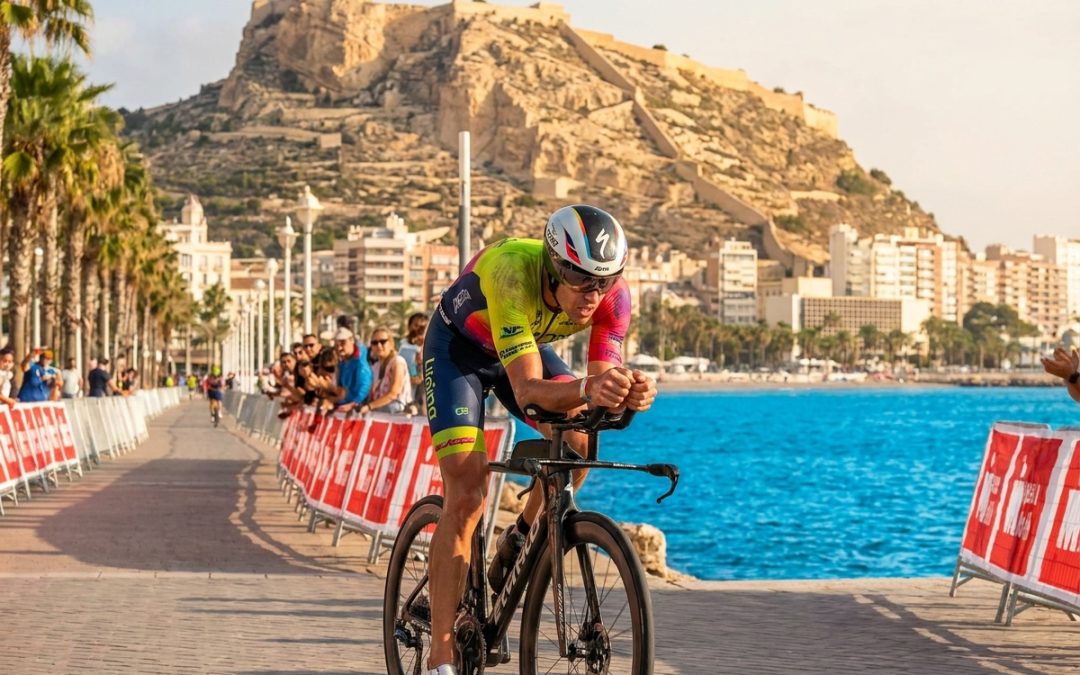
What makes this event special for the Costa Blanca cycling community is the course itself: the bike segment rolls along one of the most spectacular urban waterfronts in Spain, with Santa Bárbara Castle rising 166 metres above the city on one side and the Mediterranean stretching to the horizon on the other. It’s fast, flat, and genuinely beautiful.
Three Distances — One for Everyone
| OLYMPIC The Full Challenge — Sunday 17 May 1.5 km Swim 40 km Cycle 10 km Run ~2h30 Target time The standard Olympic distance triathlon — the classic test of multi-sport endurance. The swim takes place in the sheltered waters off Playa del Postiguet, the bike segment loops the city and waterfront, and the run finishes at the iconic Plaza del Ayuntamiento. Road bike with traditional drop bars required for this distance. The Olympic is the distance that rewards months of consistent training — and the finish line at the town hall square, in front of a crowd, is a moment worth every early morning. 🏅 Requires a road bike with drop handlebars. Recommended for athletes with a solid triathlon base. |
| SPRINT The Smart Middle Ground — Saturday 16 May 500 m Swim 20 km Cycle 5 km Run ~1h00 Target time Half the Olympic distance, all of the atmosphere. The Sprint is the most popular format at MTRI Alicante and the ideal entry point for first-time triathletes. Mountain bikes and regular flat-bar bikes are permitted — so if you haven’t got a road bike yet, this is your race. It’s also the perfect target if you’ve been building fitness on the Costa Blanca climbs and want to add a race to the calendar without committing to a full Olympic effort just yet. 🏅 Mountain bikes and flat-bar bikes permitted. Perfect for first-timers and fitness cyclists. |
| SUPERSPRINT The Taster — Sunday 17 May 350 m Swim 10 km Cycle 2.5 km Run ~30 min Target time New to triathlon? The Supersprint is your starting point. A 350m swim in calm Mediterranean waters, a 10km city bike loop, and a 2.5km run along the seafront promenade. It’s enough to give you the full race experience without requiring months of specialist training. Mountain bikes and flat-bar bikes permitted. From €25 entry. If you’ve ever been curious about triathlon, this is the race that will answer the question. 🏅 Mountain bikes and flat-bar bikes permitted. Open to all ages from 14+. From €25. |
Weekend Programme
| 📅 Friday 15 May 17:00 Athlete registration & expo opens — Paseíto Ramiro, Alicante 20:00 Registration closes for the day |
| 📅 Saturday 16 May 07:00 Registration resumes — Paseíto Ramiro ~09:00 Sprint Triathlon — race start, Playa del Postiguet Afternoon Family Duathlon — non-competitive pairs event (adult + child) |
| 📅 Sunday 17 May 06:45 Final registration & equipment check ~08:00 Olympic Triathlon — race start, Playa del Postiguet ~09:00 Supersprint Triathlon — race start Midday Finish line celebrations — Plaza del Ayuntamiento |
The Course
| 🏊 Swim — Playa del Postiguet All distances start at Playa del Postiguet — the main city beach of Alicante, set in a sheltered bay directly below Santa Bárbara Castle. The water in mid-May is typically 18–20°C and calm. It’s one of the most spectacular swim settings of any triathlon in Spain, with the castle walls rising directly above the water. |
| 🚴 Cycle — Waterfront & City Circuit The bike course rolls along the Alicante waterfront and circles Mount Benacantil — no climbing involved. The route takes in the seafront promenade and extends to the Cantera Paseo, with views across the port and the open Mediterranean. It’s a fast, largely flat circuit designed to be quick and spectacular in equal measure. Spectators line the route throughout. |
| 🏃 Run — Seafront to Plaza del Ayuntamiento The run is entirely along the seafront, finishing in the heart of the city at the emblematic Plaza del Ayuntamiento. The town hall square returns as the finish line in 2026, making for one of the most atmospheric finishes in Spanish triathlon. The crowd support on the final 500 metres is extraordinary. |
MTRI ALICANTE 2026 — ALREADY BREAKING RECORDS |
1,130+ Registered athletes | 17 Nationalities | 29.5% Female participation | 4,000+ Total circuit athletes |
| 👨👩👧 PERFECT FOR FAMILIES Family Duathlon — Saturday 16 May New for 2025 and back in 2026, the Family Duathlon is a non-competitive paired event for an adult and a child. Both participants complete all three segments together — run, cycle, run — over distances adapted for young athletes. It’s a brilliant way to introduce children to multi-sport events in a safe, supportive, festival atmosphere. Every pair that finishes receives a finisher medal. |
| 💡 PREPARING FOR MTRI ALICANTE — BIKE TIPS ● For the Olympic (40 km): Your Costa Blanca climbing legs are an advantage. Add two flat 40km time trial efforts per week in the two weeks before the race to simulate race pace on flat terrain — the city course is quite different from mountain roads. ● For the Sprint (20 km): Practice brick sessions — a short 20km effort immediately followed by a 5km run. Two or three of these in the fortnight before the race and your transition legs will be ready. ● Transitions matter. A smooth T1 (swim to bike) and T2 (bike to run) can save you two minutes against a comparable competitor. Practice clipping in quickly and rack your gear in order. ● The bike course is flat but exposed. There’s no shelter along the waterfront. A light aero position and consistent cadence matters more than raw power here. |
🏅 Ready to Sign Up? Individual entry from €25 (Supersprint) to €45+ (Olympic). The MTRI Pack covering all three cities is available for multi-event athletes. Registrations close Sunday 10 May at 23:59. → mediterraneatriatlon.com |
| 📅 Still in May Big events to go: V Aitana Tour (31 May). In June we shift to beating the heat with early morning routes, San Juan night rides, and the best beach stops along the coast. |
Sign up to our newsletter and get informed every time we publish new posts.