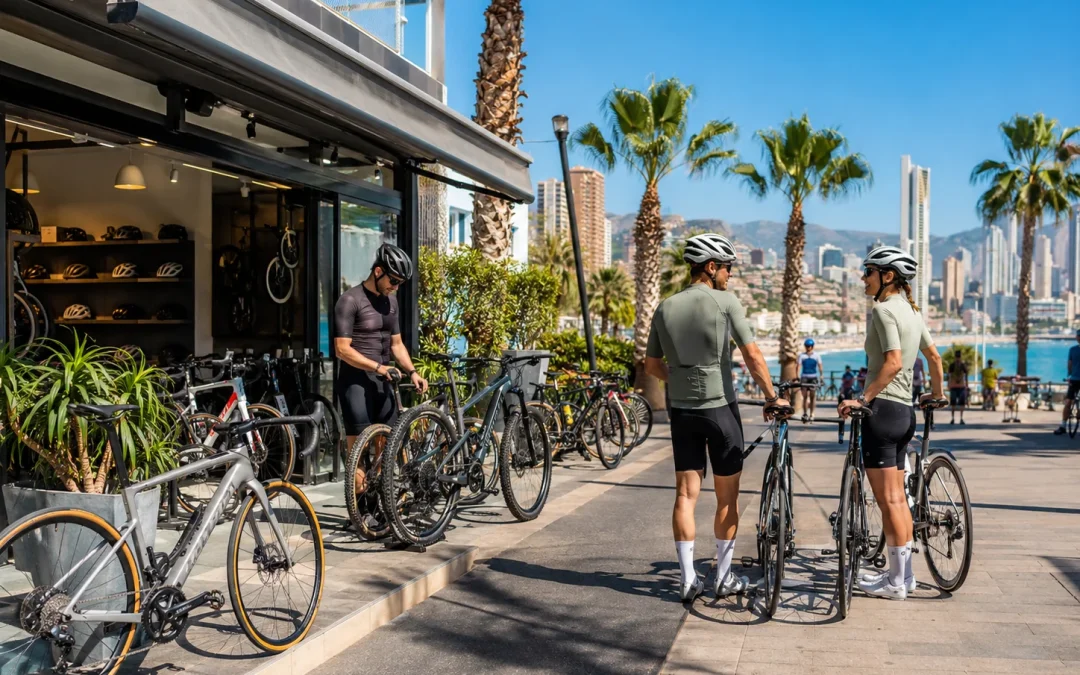
by Ralf Tenbrink | 13, Jun 2026 | Bike Rental Services in Costa Blanca, Costa Blanca News
Bike hire in Benidorm: road bikes, e-bikes & more delivered to your door
Benidorm sits at the center of one of Europe’s best cycling destinations, where the Mediterranean coast meets the mountains of the Marina Baixa. Whether you want smooth coastal roads or climbs like the Coll de Rates and Alto de Aitana, hiring a bike here is the practical choice.
Skip the airline bike fees. Avoid the risk of damage to your carbon frame or discovering your pedals are somewhere over the Atlantic. Bike hire in Benidorm puts you on a maintained, properly sized machine within hours of landing. Dozens of rental providers offer everything from carbon road bikes to family hybrids and e-bikes.
This guide covers bike rental in Benidorm: the types of bikes available, typical prices, what’s included, how delivery works, and the best routes once you’re riding.
Jump to: Why hire | What’s available | Delivery | Pricing | Routes | Tips | FAQ
Quick answer for busy cyclists
- Road bikes: €25-100/day. Mid-range carbon works for most riders.
- E-bikes: €45-70/day. Good for climbs without exhaustion.
- Delivery: Free to most hotels. Book 2-3 weeks ahead in peak season.
- Best routes: Guadalest (65km), Alto de Aitana (75km), Altea coastal (30km).
- Peak season: March-May, September-October.
Skip to directory: Compare Benidorm bike hire providers
Why hire a bike in Benidorm?
Benidorm has changed from a package holiday town into a cycling hub. Amateur riders, professional training camps, and cycling tourists from Northern Europe come for the reliable winter sunshine, good roads, and varied terrain.
Cycling infrastructure
The Valencian Community has invested in cycling infrastructure. According to the Comunitat Valenciana tourism board, the region has over 1,800 kilometers of signposted cycling routes, many accessible from Benidorm. The town has dedicated bike lanes along the seafront promenade for warming up before heading inland.
Access to good routes
From Benidorm, you can reach:
- Coastal routes along the CV-755 towards Altea and Calpe, with views of the Penon de Ifach
- Mountain climbs including the Alto de Aitana (1,558m), the highest peak in Alicante province
- The Guadalest Valley, through cherry orchards and reservoir-side roads
- Sierra Helada Natural Park, with gentle trails and Mediterranean views
Professional teams including Movistar, Jumbo-Visma, and INEOS Grenadiers use Costa Blanca for winter training. The 2026 Vuelta a España Stage 9 finishes atop the Alto de Aitana, 35 kilometers from Benidorm.
Practical benefits
Flying with your own bike costs money and carries risk. Most airlines charge €60-150 each way for bike transport, and damage or delays happen. When you hire locally:
- No airline bike fees. That €200+ round-trip cost stays with you.
- You get the right bike for your planned routes.
- Every bike is checked, cleaned, and ready.
- No assembly needed. Arrive, collect, ride.
- Hire shops know the roads and can recommend routes.
What bikes are available to hire in Benidorm?
Benidorm’s rental market covers every type of cyclist, from competitive road riders to families wanting a gentle pedal along the seafront.
Road bikes
Road bikes dominate the hire market. Most providers stock several tiers:
Entry-level road bikes have aluminum frames with Shimano Tiagra or Sora groupsets. They work for casual riders or those new to road cycling. The heavier frame (typically 9-10kg) and basic shifting make them less responsive on climbs but adequate for flat coastal routes. Expect €25-35 per day or €120-180 per week.
Mid-range road bikes have carbon frames and Shimano 105 groupsets. They weigh around 8-8.5kg and shift better. The 105 groupset gives crisp gear changes even under load, which matters on Guadalest or the Coll de Rates. Prices run €40-55 per day or €200-300 per week.
Premium road bikes have full carbon frames with Shimano Ultegra or Ultegra Di2 electronic shifting. These weigh under 7.5kg and offer the stiffest, most responsive ride. Some providers stock Dura-Ace or SRAM Red machines. Budget €60-100+ per day or €350-500+ per week.
Road bikes work best for coastal routes, long-distance rides, climbing, and anyone wanting to cover serious mileage on paved roads. The Benidorm to Guadalest scenic ride is a good test for a hired road bike.
Electric bikes
E-bike hire has grown quickly. The mountains around Benidorm have punishing gradients, and a quality e-bike opens up routes that might otherwise be too hard.
Most hire e-bikes use motors from Bosch, Shimano STEPS, or Fazua, with battery ranges of 60-120 kilometers depending on terrain and assistance level. Bosch motors offer the most powerful assistance for steep climbs. Fazua systems are lighter and feel more natural for experienced cyclists. E-road bikes are popular with older riders and those returning to cycling after time off.
Daily rates run €45-70, with weekly hire at €250-400.
E-bikes work well for riders who want to tackle climbs without exhausting themselves, couples with different fitness levels, and anyone who wants to explore further while still enjoying the ride. Good for routes like the Altea Hills Loop.
Mountain bikes
Costa Blanca’s interior has good mountain biking terrain. Several Benidorm providers stock quality MTBs.
Hardtail mountain bikes with front suspension cost around €30-45 per day or €150-250 per week. They suit most trail riders and work for the region’s fire roads and moderate singletrack.
Full-suspension mountain bikes cost €50-80 per day or €280-450 per week, but provide better comfort and control on technical terrain.
Mountain bikes work for trails in Sierra Helada Natural Park, the Orba Valley singletrack, or the Finestrat forest trails.
Hybrid and city bikes
Not every cyclist wants mountain climbs. Hybrid bikes offer a comfortable, upright position for leisurely exploration of Benidorm’s seafront, nearby villages, and gentle greenways.
Hybrid hire typically costs €15-25 per day or €80-130 per week. Many come with mudguards, kickstands, and baskets.
Hybrids work for casual exploration, shopping trips, short rides to beach cafes, and anyone prioritizing comfort over speed.
Kids’ bikes
Family cycling holidays are common, and most Benidorm hire shops offer children’s bikes in various sizes. Expect €10-20 per day for kids’ bikes, with discounts for weekly hire. Some providers offer child seats, tag-along attachments, and child trailers.
Tandems
Tandems are less common but available through specialist providers. They work for couples wanting a shared riding experience or for visually impaired cyclists riding with a sighted pilot. Tandem hire typically costs €50-70 per day.
Which bike should you rent?
Riding under 40km on flat terrain? A hybrid (€15-25/day) offers comfort without unnecessary expense.
Riding 40-70km with some climbing? A mid-range road bike with Shimano 105 (€40-55/day) hits the sweet spot.
Tackling 70km+ with major climbs like Aitana? Strong climbers will appreciate a premium road bike (€60-100/day). Everyone else should consider an e-bike (€50-70/day) to save their legs.
Heading off-road? Hardtail MTBs handle most Costa Blanca trails. Full-suspension is worth the extra cost only for technical singletrack.
For a broader overview, see our guide to bike rental services in Costa Blanca.
Browse Benidorm bike rental providers by bike type and price
Bike hire delivered to your hotel or villa in Benidorm
Most established rental providers deliver free to hotels, apartments, and villas throughout Benidorm and surrounding towns.
What’s typically included
A standard hire package usually includes:
- Helmet (required by law outside urban areas)
- Lock (cable or D-lock for cafe stops)
- Pump or CO2 inflator
- Basic tool kit with hex keys and tire levers
- Saddle bag with spare inner tube and basic tools
- Repair kit with puncture patches and tire boot
- Route map or GPX files (many providers share local routes)
Some premium providers also include bidons, cycling caps, and detailed route guides. Confirm what’s included when booking.
How delivery works
Most providers operate delivery and collection that fits your travel schedule:
- Book in advance, especially during peak season (March-May, September-October).
- Confirm your accommodation address and arrival time.
- The bike arrives fitted to your specifications. Provide your height, inside leg measurement, and any preferences (saddle type, pedal system).
- A technician walks you through the bike, demonstrating gears, brakes, and any quirks.
- At the end of your hire, the provider collects the bike from your accommodation.
During quiet periods, next-day delivery is often possible. In peak season, book two to three weeks ahead.
Getting your hire bike fitted correctly
Poor bike fit ruins cycling holidays. Spend ten minutes getting this right when your bike arrives.
Saddle height (most important)
When pedaling, your leg should be almost straight at the bottom of the stroke, with a slight bend in the knee (about 25-35 degrees). To check: sit on the saddle with the pedal at six o’clock. Your heel should almost touch the pedal. If your leg locks straight, the saddle is too high. If your knee bends more than 45 degrees, the saddle is too low.
Handlebar reach
Your arms should have a slight bend at the elbows when gripping the bars. If you’re stretching or crouching uncomfortably, the bike may be the wrong size. Most hire providers can swap stem lengths (usually 80-130mm) to adjust reach. Ask when collecting your bike.
Cleat position (if using clipless pedals)
Your foot should sit centered on the pedal, with your knee tracking directly over the pedal axle. Misaligned cleats cause knee problems quickly. If you’re unfamiliar with cleat setup, ask the rental shop to adjust them before you leave. It takes five minutes and prevents injury.
What to check when the bike arrives
When your hire bike is delivered, take five minutes to check:
- Frame size: can you comfortably straddle the top tube?
- Saddle height: your leg should be almost fully extended at the bottom of the pedal stroke
- Brake function: both front and rear should engage smoothly
- Gear shifting: run through all gears to check for smooth transitions
- Tire condition: look for cuts, bulges, or excessive wear
- Quick releases: ensure wheels and seat post are secure
- Pedals: if you requested SPD-SL or Look Keo cleats, confirm compatibility with your shoes
- Spare tube: check it matches your tire size (700×23-28c for most road bikes) and valve type (Presta or Schrader)
Good providers will adjust anything on the spot. Don’t ride away on a bike that doesn’t feel right.
For more detailed guidance, our self-guided cycling tours packing guide covers everything you need.
Check live availability from Benidorm bike hire shops
Bike hire prices in Benidorm
Understanding typical prices helps you budget and identify fair deals versus suspiciously cheap offerings.
Daily rates
| Bike Type | Budget | Mid-Range | Premium |
|---|
| Road bike | €25-35 | €40-55 | €60-100+ |
| E-bike | €45-55 | €55-65 | €65-80 |
| Mountain bike (hardtail) | €30-40 | €40-50 | €55-70 |
| Mountain bike (full-sus) | €50-60 | €60-75 | €75-90 |
| Hybrid/city bike | €15-20 | €20-25 | €25-30 |
| Kids’ bike | €10-15 | €15-20 | – |
How to choose between budget, mid-range, and premium
Budget rentals (€25-35/day) are fine for casual coastal rides but feel sluggish on climbs. The heavier aluminum frames and basic Sora/Tiagra groupsets work on flat terrain but require more effort when the road tilts upward. Best if you’re trying a road bike for the first time or sticking to the seafront.
Mid-range rentals (€40-55/day) are the sweet spot for most visiting cyclists. Carbon frames shed 1-2kg compared to budget options, and Shimano 105 groupsets shift crisply even under load. You’ll notice the difference on climbs like Guadalest or the approach to Aitana. Best if you’re here for three or more days and planning routes with significant elevation.
Premium rentals (€60-100+/day) make a real difference on mountain climbs. Electronic shifting (Ultegra Di2 or SRAM eTap) eliminates missed shifts, and sub-7.5kg frames make sustained climbing less painful. The extra cost only makes sense if you’re tackling multiple big climbs or you’re a serious cyclist who’ll appreciate the refinement. Best for riders covering 100km+ days or attempting Aitana without motor assistance.
Compare Benidorm bike rental providers by price tier
Weekly rates and discounts
Most providers offer discounts for weekly hire, typically 15-25% off the daily rate multiplied by seven. A mid-range carbon road bike at €50/day might cost €280-320 for a full week rather than €350.
Multi-bike discounts are often available for groups, and some providers offer loyalty discounts for returning customers.
Deposits
Expect a deposit of €100-500 depending on the bike’s value. Premium carbon bikes require larger deposits. Most providers accept credit card pre-authorization rather than cash.
Insurance and liability
Standard hire agreements typically make you responsible for the full replacement value in case of theft and a repair excess (€50-200) for accidental damage. Before signing:
- Ask about damage waivers. Some providers offer optional coverage (€5-15/day) that reduces or eliminates your excess.
- Check what’s excluded. Most policies don’t cover damage from racing, off-road use on road bikes, or riding under the influence.
- Confirm theft requirements. You’ll usually need to prove you used the provided lock; failure to do so may void coverage.
- Keep provider contact details in case of accident or theft. Report immediately.
Standard inclusions (helmet, lock, basic tools) are covered above. Additional charges may apply for:
- GPS units: €5-15/day for Garmin or Wahoo devices
- Pedal swaps: usually free if requested in advance
- Power meters: €15-30/day for bikes with power measurement
- Insurance upgrades: damage waivers as described above
For affordable MTB rental providers, our dedicated guide covers budget options.
Browse verified bike rental providers in Benidorm
Seasonal guide to Benidorm bike rental
Benidorm’s cycling conditions vary throughout the year.
Spring (March-May): peak season
- Weather: 15-22°C, light winds, occasional rain showers
- What to hire: Road bikes dominate; e-bikes popular for climbs
- Best routes: Aitana, Guadalest, and mountain routes before summer heat
- Booking: Reserve 3-4 weeks ahead; premium bikes sell out fast
- Pricing: Peak rates apply
Summer (June-August): heat season
- Weather: 25-32°C, strong Tramontana winds possible, intense afternoon sun
- What to hire: E-bikes help manage effort in heat; early morning rides recommended
- Best routes: Coastal spins, shaded valley trails, shorter distances
- Booking: Often next-day availability; fewer cyclists visit
- Pricing: Off-peak rates common; negotiate for longer rentals
Midday heat can be punishing. Plan rides for 6-10am.
Autumn (September-October): second peak
- Weather: 20-26°C, consistent conditions, low rain risk
- What to hire: All bike types popular
- Best routes: Full-distance rides including Aitana and multi-day tours
- Booking: Reserve 2-3 weeks ahead; nearly as busy as spring
- Pricing: Peak rates apply
October can bring stronger Tramontana winds. Ask providers about forecasts.
Winter (November-February): quiet season
- Weather: 12-18°C, more rain, occasional road closures at altitude
- What to hire: Road bikes remain popular; fewer e-bike rentals
- Best routes: Lowland routes, coastal rides; avoid exposed peaks
- Booking: Flexible; next-day availability typical
- Pricing: Lowest rates of the year; good for extended rentals
Some rental shops reduce hours in winter. Confirm availability before arrival.
Best cycling routes from Benidorm
The Guadalest Valley loop
Distance: 65 km | Elevation: 1,100m | Difficulty: Moderate to hard
This route heads inland through Finestrat and Sella before climbing to the village of Guadalest, perched on a rocky outcrop. The descent via Callosa d’en Sarria offers good views and smooth tarmac.
Best for: Experienced riders on road bikes seeking a challenge. Our full guide to the Benidorm to Guadalest scenic ride includes turn-by-turn directions.
Recommended bike: Mid-range road bike (€40-55/day) minimum. The 1,100m elevation makes lightweight frames and responsive shifting worthwhile. Budget bikes will feel sluggish on the sustained climbs.
Coastal cruise to Altea
Distance: 30 km (round trip) | Elevation: 150m | Difficulty: Easy
Follow the seafront promenade north, picking up quiet coastal roads towards Altea’s whitewashed old town. Stop for coffee in the marina before returning via the same route or looping through Alfaz del Pi.
Best for: Leisure riders, e-bike users, and anyone wanting a gentle spin with sea views. The Altea Hills Loop offers a slightly harder extension.
Recommended bike: Hybrid (€15-25/day) or budget road bike (€25-35/day). The gentle terrain doesn’t justify premium pricing.
Alto de Aitana challenge
Distance: 75 km | Elevation: 1,800m | Difficulty: Very hard
The highest point in Alicante province. This demanding route climbs from sea level to 1,558 meters via Sella and Confrides, with gradients regularly exceeding 10%. The descent via the Puerto de Tudons and Benifato completes an unforgettable day.
Best for: Strong climbers wanting to test themselves on a genuine mountain ascent. See our detailed preview of the Vuelta 2026 Stage 9 to Alto de Aitana.
Recommended bike: Premium road bike (€60-100/day) for strong climbers who want bragging rights. For everyone else, an e-bike (€50-70/day) makes this achievable. Budget road bikes are not recommended; the weight penalty is brutal over 1,800m of climbing.
For more route ideas, see our top 10 cycling routes in Costa Blanca.
Tips for hiring a bike in Benidorm
Book early in peak season
Benidorm’s cycling season peaks during spring (March-May) and autumn (September-October), when Northern European cyclists escape the cold. Premium bikes book up weeks in advance during these months.
Premium road bikes typically book out 3-4 weeks ahead. Mid-range options fill 10-14 days before arrival. If you’re visiting during peak season and have specific preferences (carbon frame, electronic shifting, particular frame size), reserve now.
Check availability for your dates
July and August see fewer road cyclists because of the heat, but e-bike and MTB demand remains steady.
Bring valid ID
Spanish rental agreements require identification. Bring your passport or EU driving license. Some providers also accept national ID cards from EU countries.
Pre-ride checks
Before setting off:
- Check tire pressure (typically 80-100 PSI for road bikes, 30-40 PSI for MTBs)
- Test both brakes at low speed
- Ensure quick-releases are secure
- Verify your spare tube matches your tire size and valve type
- Check that your CO2 canister is full (if provided)
Helmet fitting
Spanish law doesn’t require helmet use for adults in urban areas, but helmets are compulsory outside towns. Your helmet should sit level on your head, with the front edge about two finger-widths above your eyebrows. Straps should form a V-shape below your ears and feel snug but comfortable when buckled.
The Real Federación Española de Ciclismo provides cycling safety guidance for riders in Spain.
Ask about local conditions
Your hire provider rides these roads regularly. Ask about:
- Current road surface conditions
- Popular routes and recent closures
- Wind patterns (the Tramontana can make exposed coastal roads hard)
- Where to find water and food on your planned route
- Any ongoing construction or road works
What to do if you puncture
Punctures happen. If you’re carrying the standard repair kit:
- Move off the road to a safe location.
- Release remaining air and remove the wheel.
- Use tire levers to remove the tire from the rim.
- Locate the puncture (inflate the tube and listen or feel for escaping air).
- Either patch the tube or replace it with your spare.
- Check inside the tire for the cause (glass, thorn, wire).
- Reinstall the tire, inflate to correct pressure, and continue.
If you’re not confident with repairs, most Benidorm hire shops offer roadside assistance or can talk you through the process by phone. Save your provider’s number before you ride.
For more safety guidance, see our guide to safety tips when cycling alone.
What cyclists say about Benidorm bike hire
“Hired a Specialized Tarmac for a week through a local provider. Delivered to my hotel lobby, perfectly sized, and the mechanic spent 15 minutes adjusting everything. Best €320 I spent on the whole trip.”
“E-bike rental was a game-changer. Tackled Alto de Aitana without completely destroying myself. Highly recommend for anyone over 50 who still wants to ride the big climbs.”
- Per H., Gothenburg, Sweden
“We hired four bikes for the family, two adults, two kids. Delivery and collection were seamless, and the kids’ bikes came with helmets that actually fitted properly.”
- Familie Muller, Munich, Germany
Browse verified reviews on our bike rental directory
Featured bike hire providers in Benidorm
Benidorm has numerous bike rental shops. Our directory features verified providers offering quality machines and reliable service.
Compare bike hire options in Benidorm
Looking for recommendations? Our guide to top bike rental shops in Benidorm highlights established providers.
Can’t find what you need in Benidorm?
Bike hire in Calpe | Bike hire in Altea | Bike hire in Alicante
Are you a bike hire provider?
List your shop on Bikes Costa Blanca to:
- Reach thousands of visiting cyclists monthly
- Showcase your fleet and pricing
- Display availability and services
- Collect customer reviews
- Drive direct bookings
List your bike rental shop
Already listed? Update your profile
Bike hire and rentals
Cycling routes
Mountain biking
Planning your trip
Frequently asked questions
Can I hire a road bike in Benidorm?
Yes. Benidorm’s bike rental providers offer road bikes ranging from entry-level aluminum frames with Shimano Tiagra groupsets to carbon machines with Ultegra Di2 or Dura-Ace. Most providers stock multiple frame sizes and can accommodate riders from approximately 155cm to 195cm in height. Prices range from €25-100+ per day depending on the spec.
by Ralf Tenbrink | 13, Jun 2026 | Bike Rental Services in Costa Blanca, Costa Blanca News
Bike hire in Altea: road bikes, e-bikes and more delivered to your door
Altea sits where the Sierra de Bernia mountains drop to the Mediterranean Sea. The town has a blue-domed church, a whitewashed old quarter, and direct access to roads that climb into the mountains or run along the coast.
Whether you’re a road cyclist after mountain passes, a family wanting to explore the seafront, or a training camp needing a reliable rental fleet, bike rental in Altea works well. You skip the cost and hassle of flying with your own bike. Local providers deliver professionally serviced machines to your accommodation, ready to ride when you arrive.
The Costa Blanca region draws tens of thousands of cycling tourists each year, according to the Valencian Tourism Board. Altea has become a popular base because it combines Spanish village character with practical cycling infrastructure, decent accommodation, and varied terrain.
Last updated: June 2025
Altea vs other Costa Blanca bike hire destinations
Altea, Calpe, Javea, and Benidorm all have bike rentals. Here’s how Altea compares:
Terrain variety: You can reach both flat coastal routes and serious mountain climbing (Coll de Rates, Sierra Bernia) within 20-45 minutes of pedalling. No other Costa Blanca town offers this combination as conveniently.
Quieter than Benidorm: More authentic Spanish atmosphere. You’ll share roads with local club riders rather than tourist traffic.
Better climbing than Calpe: Calpe has easier coastal riding and the dramatic Penon de Ifach as a backdrop, but Altea’s mountain access works better for cyclists wanting elevation.
Authentic old town: Unlike Javea’s more upmarket feel, Altea’s whitewashed quarter feels genuinely Spanish. Good for post-ride tapas and cafe stops.
For training camps and serious cyclists, Altea makes sense. For families wanting beach time and gentle riding, it also works.
Why hire a bike in Altea?
Altea sits between the coastal lowlands and the mountainous interior, so you can easily reach everything from gentle seaside spins to leg-burning ascents.
Access to good terrain
From Altea’s harbour, you can be climbing within minutes. The road towards Callosa d’en Sarria rises steadily through terraced hillsides of citrus and almond groves, with consistent gradients good for building climbing fitness. Head north along the coast road and you’ll reach the base of the Coll de Rates, one of the Costa Blanca’s signature climbs, in under an hour.
For gentler rides, the coastal route towards Calpe follows the Mediterranean shoreline with manageable undulations and views of the Penon de Ifach. Mountain bikers will find trails in the Sierra Helada Natural Park, accessible directly from Altea’s eastern edge.
The Altea Hills Loop shows why this area attracts serious cyclists: challenging climbs with panoramic views stretching from Benidorm to Calpe.
A cycling culture
Altea has become a genuine cycling hub. Professional teams regularly base their winter training camps here for the consistent weather and varied terrain. You’ll see cyclists on every road, from club riders tackling the Bernia pass to retirees having morning coffee at the harbour cafes.
The Costa Blanca region gets over 300 days of sunshine annually, with average winter temperatures around 16C. Year-round cycling is not just possible but comfortable. This weather reliability explains why so many European cyclists choose this region for winter training.
“I’ve trained here three winters now. The roads are quiet, the climbs are proper, and the weather is reliable. Can’t ask for more.” – James T., amateur racer, UK
The practical benefits
Bringing your own bike to Spain costs money and carries risk. Airlines charge between 60 and 150 euros each way for bike carriage, and there’s always the chance of damage in transit. When you hire a bike in Altea, you avoid these problems.
Local bike rental providers maintain their fleets carefully. You’ll get a machine that’s been professionally serviced, with fresh bar tape, properly tensioned cables, and tyres suited to local road conditions. Many visitors find that the rental bike they collect in Altea is better maintained than their bike at home.
For cyclists travelling with non-cycling partners or family members, bicycle hire in Altea lets everyone participate at their own level. Hire an e-bike for your partner while you tackle the climbs on a road bike, or rent city bikes for leisurely family exploration of Altea’s old town and seafront.
Compare Altea bike rental providers now
Bike types and models available for rent in Altea
Altea’s bike rental providers cover every cycling discipline and ability level. Here’s what you’ll find:
Road bikes
Road bikes make up the core of most rental fleets in Altea, reflecting the area’s popularity with serious cyclists.
Entry-level road bikes typically have aluminium frames with Shimano Tiagra or 105 groupsets. These suit recreational riders and those wanting a comfortable machine for coastal routes and moderate hills. Expect to pay around 25-35 euros per day or 120-180 euros per week.
Performance road bikes step up to carbon frames with Shimano Ultegra or SRAM Rival groupsets. These machines are noticeably lighter and more responsive, good for cyclists who want to tackle serious climbs or cover longer distances. Daily rates range from 45-65 euros, with weekly hire typically 220-350 euros.
Premium road bikes include top-tier frames from brands like Specialized, Trek, Canyon, and Pinarello, equipped with Shimano Dura-Ace, SRAM Red, or Campagnolo Record. Serious enthusiasts and competitive cyclists will appreciate the performance. Expect to pay 75-120 euros per day or 400-600 euros weekly.
Most road bike hire in Altea includes pedals compatible with major cleat systems (SPD-SL, Look Keo), though you should confirm compatibility when booking.
E-bike rental in Altea: electric road bikes, e-MTBs and e-city bikes
E-bike hire in Altea has grown substantially. The region’s mountains become accessible to riders of all fitness levels when electric assistance takes the edge off the gradients.
E-road bikes combine road bike geometry with integrated motors, typically offering 250W assistance up to 25km/h (the EU legal limit). These suit cyclists who want to ride with stronger partners or tackle climbs they couldn’t manage unassisted. Daily rates run 55-80 euros, weekly 280-450 euros.
E-mountain bikes open up trails that would otherwise require significant fitness. Full-suspension e-MTBs let riders explore the hinterland’s technical terrain without complete exhaustion. Expect 60-90 euros daily or 300-500 euros weekly.
E-city bikes provide the most comfortable option for leisurely exploration. Upright geometry and step-through frames make these good for sightseeing, market visits, or coastal promenade rides. Prices typically sit at 35-50 euros per day, 150-280 euros per week.
Battery range usually exceeds 80km per charge on e-road and e-MTB models, enough for most day rides in the region.
“My wife hired an e-bike while I rode a carbon road bike. We did the Callosa loop together. First time we’ve actually ridden side by side in years!” – Marc & Sophie, Netherlands
Mountain bikes
The Costa Blanca’s interior offers good trail riding, and Altea provides a convenient base for accessing these routes.
Hardtail mountain bikes suit cross-country trails and gravel roads. Front suspension handles rough terrain while maintaining efficiency on climbs. Priced around 30-45 euros daily, 150-250 euros weekly.
Full-suspension mountain bikes handle more technical terrain, including the rocky trails around the Puig Campana and through the valleys behind Altea. Daily rates range from 50-75 euros, with weekly hire 250-400 euros.
For detailed information on local trails, the Sierra Helada Natural Park Trail guide covers one of the most accessible MTB routes from Altea.
Hybrid and city bikes
Not every visitor wants an aggressive riding position or technical machine.
Hybrid bikes blend road efficiency with upright comfort. Wider tyres and flat handlebars make these forgiving and accessible. Typical rates: 20-30 euros daily, 100-160 euros weekly.
City bikes prioritise pure comfort with basket mounts, kickstands, and relaxed geometry. Good for pottering around Altea’s old town or riding to the beach. Budget 15-25 euros daily, 80-140 euros weekly.
Kids’ bikes
Family cycling holidays require bikes for younger riders. Most Altea rental providers stock children’s bikes in sizes from 16″ wheels upwards, accommodating riders from approximately 4 years old.
Kids’ bikes typically cost 15-20 euros daily, with significant discounts for weekly hire. Tag-alongs and child seats are also available from some providers.
Tandems
For couples wanting to ride together regardless of fitness differences, tandem hire is available from select providers. These machines suit coastal routes and gentle terrain rather than serious climbing. Daily rates around 50-70 euros, weekly 250-400 euros.
Bike delivery to your hotel or villa in Altea
Most rental providers offer delivery service. This convenience changes the holiday experience.
How bike delivery works
When you book bike rental in Altea, you specify your accommodation address and arrival time. The rental provider delivers your bikes directly to your hotel, apartment, or villa, often meeting you personally to ensure proper setup.
Delivery is usually free within Altea town and the immediate surrounding area, including Altea Hills, Mascarat, and Cap Negret. For more distant locations, a small delivery fee may apply (typically 10-25 euros).
“Arriving jet-lagged and having premium bikes waiting in our apartment was a game-changer. We were riding by 9am the next morning.” – Maria & Carlos, Germany
What’s included with your rental
Standard bike hire packages in Altea typically include:
- Helmet (legally required in Spain outside urban areas and always sensible regardless of route)
- Lock (usually a cable or D-lock for coffee stop security)
- Pump (either a mini pump or CO2 inflator)
- Saddle bag containing basic tools, spare tube, and tyre levers
- Route map with local recommendations from the provider
Some providers also include GPS units or phone mounts, rear lights and reflectives, water bottles with cages, and emergency contact cards.
Booking and lead times
During peak season (Easter and July-September), advance booking is essential. Popular bike sizes and models can be reserved weeks ahead by training camps and tour groups. For summer visits, book at least two to four weeks in advance to secure your preferred bike.
Off-season (October-March), shorter notice bookings are usually possible, though weekend rentals around popular sportive events fill quickly.
Pre-delivery setup checklist
When the delivery arrives, check the following:
- Saddle height: The provider should adjust this to your specifications, but verify comfort before they leave
- Brake function: Test front and rear brakes for responsive stopping
- Gear shifting: Run through the full range to ensure smooth operation
- Tyre pressure: Confirm appropriate inflation for your weight and planned terrain
- Quick releases: Check wheels and seatpost are properly secured
For comprehensive information on rental services across the region, our bike rental services guide covers what to expect from Costa Blanca providers.
Ready to arrange hotel delivery? Browse providers and book here
Bike rental prices in Altea: daily rates, weekly discounts and deposit details
Understanding typical pricing helps you budget appropriately and recognise value when comparing providers.
Daily rates overview
| Bike Type | Budget Option | Mid-Range | Premium |
|---|
| Road Bike | 25-35 euros | 45-65 euros | 75-120 euros |
| E-Bike | 35-50 euros | 55-80 euros | 80-100 euros |
| Mountain Bike | 30-40 euros | 45-60 euros | 65-90 euros |
| Hybrid/City | 15-25 euros | 25-35 euros | 35-45 euros |
| Kids’ Bike | 15-20 euros | 20-25 euros | – |
Weekly and multi-day discounts
Virtually all Altea bike rental providers offer reduced rates for longer hires. A typical structure:
- 3-day hire: 10-15% discount versus daily rate
- Weekly hire: 25-40% discount versus daily rate
- Two weeks or more: Further negotiable discounts
For a week’s road bike rental, expect to pay the equivalent of approximately 5 daily rates rather than 7.
Deposit requirements
Most providers require a deposit, typically 100-200 euros for standard bikes and 300-500 euros for premium or electric models. This is usually held on your credit card and released upon return of the bike in good condition.
Some providers now accept a credit card pre-authorisation rather than an actual charge, meaning funds are only taken if damage occurs.
Insurance and damage cover
A common concern: what happens if you crash or the bike is stolen?
Standard liability: Most rental agreements hold you responsible for damage beyond normal wear and tear. Minor scuffs typically don’t incur charges, but significant damage (cracked frame, bent wheels) may result in partial or full deposit retention.
Damage waiver insurance: Many providers offer optional coverage for 5-8 euros per day, reducing or eliminating your liability for accidental damage. This is worth considering for premium bikes or if you’re tackling technical terrain.
Theft: Bikes are generally not covered for theft unless you’ve purchased specific insurance. Always use the provided lock during cafe stops, and never leave bikes unattended overnight outside.
Roadside assistance: Most reputable providers offer phone support and will collect riders stranded with mechanical problems. Confirm this is included before booking.
While basic equipment is included, some items may incur additional charges:
- Power meter equipped bikes: 10-20 euros/day supplement
- Disc brake road bikes: May carry small premium
- Premium GPS units: 5-10 euros/day
- Travel/bike bag for day trips: 10-15 euros/day
Budget vs premium providers
Budget providers offer serviceable bikes at competitive prices, suitable for casual riders and shorter rentals. Premium providers justify higher rates through newer fleet models, better component specifications, more comprehensive support, and often superior local knowledge.
For serious cyclists planning significant mileage, the difference between a 30 euro/day aluminium bike and a 60 euro/day carbon machine is usually worthwhile. For family exploration or short recreational rides, budget options work fine.
Compare prices and availability across Altea providers
Best cycling routes from Altea
The real value of bike hire in Altea shows when you explore the roads and trails accessible from town.
Distance: 35km | Elevation: 650m | Difficulty: Moderate
This local loop climbs gradually from Altea through increasingly rural landscape towards the mountain town of Callosa d’en Sarria. The Fonts de l’Algar waterfalls lie along this route and make an excellent mid-ride refreshment stop.
The climb averages around 4%, meaning you gain 4 metres of elevation for every 100 metres travelled. This is manageable for fit recreational cyclists but sustained enough to provide genuine training benefit. The descent back towards Altea offers sweeping views and fast, well-surfaced roads.
The Polop to Callosa route guide provides detailed information on this area’s roads.
Coastal route to Calpe (easy to moderate)
Distance: 45km return | Elevation: 400m | Difficulty: Easy
Following the N-332 and coastal roads north towards Calpe and the distinctive Penon de Ifach rock formation, this route suits riders seeking good scenery without extreme climbing. Several beach stops and cafe options punctuate the ride.
Best tackled early morning before traffic builds. The relatively gentle terrain makes it suitable for hybrid bikes and e-bikes as well as road machines.
Coll de Rates challenge (advanced)
Distance: 70km | Elevation: 1,200m | Difficulty: Hard
The Coll de Rates is one of the Costa Blanca’s defining climbs. From Altea, you’ll ride north through Benissa before tackling the climb proper from Parcent. The ascent covers 6.5km at an average gradient of 5.7%, with sections reaching 8%. Steep enough that you’ll be out of the saddle on a standard compact chainset.
This route demands respect but rewards with good views and the satisfaction of conquering a climb that regularly features in professional training programmes. The descent via Tarbena and back towards the coast completes a challenging but achievable day.
“I did the Coll de Rates on a rental carbon bike and set a personal best on the climb. The Ultegra shifting was flawless.” – Alex, France
For cyclists seeking even greater challenges, the Benidorm to Guadalest Scenic Ride provides another classic inland route accessible from Altea.
Recommended resources
The best apps for route navigation guide helps you download GPX files and plan routes using Strava, Komoot, and other popular platforms. Many rental providers also supply pre-loaded GPS units with local favourites.
Explore these routes on a premium rental. Find your ideal bike
Best months for cycling in Altea
Planning your trip around the weather maximises your riding enjoyment:
| Season | Months | Conditions | Best for |
|---|
| Winter | Dec-Feb | 14-18C, occasional rain, quiet roads | Serious training, escaping northern European weather |
| Spring | Mar-May | 18-24C, minimal rain, longer days | Good conditions, moderate crowds |
| Summer | Jun-Aug | 28-35C, hot afternoons, thermal winds | Early morning rides only, family holidays |
| Autumn | Sep-Nov | 20-26C, occasional storms, comfortable temps | Good overall conditions, fewer tourists |
Peak booking periods: January-April (training camps), July-August (summer holidays), Easter week. Book 3-4 weeks ahead during these times.
Quietest months: November and early December offer good riding with minimal competition for rental bikes.
Tips for hiring a bike in Altea
Some practical preparation helps you get the most from your rental.
Book early in peak season
Altea’s bike hire fleet has limits. Training camps and tour operators often block-book significant portions of available inventory from January through April and again in September-October. Summer family holidays create demand for hybrid and e-bike categories.
For visits during these periods, finalise your bike rental at least 2-4 weeks in advance. Confirm your booking includes specific bike sizes and any special requirements like electronic groupsets or particular pedal types.
Documentation requirements
Bring a valid photo ID (passport or driving licence) for the rental agreement. You’ll also need a credit card for deposit purposes. Most providers don’t accept debit cards for this.
Pre-ride checks
Before setting off on your first ride, spend five minutes on basic safety verification:
- Tyre pressure: Check with the provided pump or gauge. Road tyres typically need 90-110 PSI depending on rider weight; wider tyres and MTB tyres require lower pressures (30-50 PSI)
- Brake pads: Verify adequate pad material remains and that pads contact rims/discs cleanly
- Quick releases: Confirm wheels are fully secured
- Headset and stem: Check for play by applying front brake and rocking the bike
- Saddle security: Ensure the seatpost clamp holds firmly
Helmet fitting
Spanish law requires helmet use outside urban areas. A properly fitted helmet:
- Sits level on your head, not tilted back
- Covers your forehead, approximately two finger widths above your eyebrows
- Doesn’t rock forward or backward when you shake your head
- Has a chin strap snug enough that you can fit only one finger between strap and chin
The Real Federacion Espanola de Ciclismo provides official guidance on cycling regulations in Spain, including equipment requirements and road rules for cyclists.
Local knowledge
Ask your rental provider for current route recommendations. Road surfaces change, seasonal weather affects mountain passes, and local events may influence ideal routes on specific days. Good providers know which roads are newly surfaced and which to avoid after recent weather.
Puncture procedure
Punctures happen. If you’re not confident with tube changes, familiarise yourself with the basic procedure before setting off. Most rental saddle bags contain a spare inner tube, tyre levers (to remove tyre from rim), and a CO2 cartridge or mini pump.
Basic steps: Remove wheel. Lever off tyre. Remove punctured tube. Insert new tube. Reseat tyre. Inflate. Reinstall wheel.
For roadside emergencies, most providers offer phone support and will collect riders stranded with mechanical problems. Save the contact number in your phone before departing.
For comprehensive safety guidance, our safety tips when touring alone covers essential practices for independent cyclists.
Featured bike hire providers in Altea
Browse verified rental providers serving Altea, with fleet details, pricing, and delivery information.
Altea Bike Rentals
Location: Calle La Mar 42, Altea Port
Fleet: 25+ road bikes (Canyon, Giant), 12 e-bikes, 8 MTBs, 10 city/hybrid bikes
Daily rates: Road bikes 40-70 euros, e-bikes 55-75 euros, MTB 35-55 euros
Delivery: Free within Altea and Altea Hills; 15 euros to Calpe/Benidorm
Notes: Newest fleet in town (2023-2024 models), 24/7 phone support, multi-day discounts
Customer feedback: “Excellent bikes, perfectly maintained. The delivery driver gave us great route tips.” – Sarah M., UK
Visit Website | Book Now
Costa Blanca Cycling Centre
Location: Avda. del Puerto 15, Altea
Fleet: 40+ road bikes (Specialized, Trek), 15 e-road bikes, 10 e-MTBs, kids’ bikes available
Daily rates: Road bikes 35-90 euros, e-bikes 60-85 euros, kids’ bikes 15 euros
Delivery: Free within 15km of Altea; covers Calpe, Benissa, Alfaz del Pi
Notes: Training camp specialists, group discounts (10+ bikes), power meter bikes available (+15 euros/day)
Customer feedback: “We booked 12 bikes for our club trip. Flawless organisation and top-spec Ultegra bikes.” – Rotterdam Cycling Club
Visit Website | Book Now
E-Bike Altea
Location: Partida Cap Negret, Altea
Fleet: Specialist e-bike provider with 20 e-road bikes, 15 e-MTBs, 10 e-city bikes
Daily rates: E-road 50-70 euros, e-MTB 55-80 euros, e-city 35-45 euros
Delivery: Free throughout Altea area; 20 euros to wider Costa Blanca
Notes: Best e-bike selection locally, battery swap service for long rides, guided e-bike tours available
Customer feedback: “Finally rode with my husband without being dropped! The e-road bikes are fantastic quality.” – Linda, Germany
Visit Website | Book Now
Altea Family Bikes
Location: Calle San Pedro 8, Altea Old Town
Fleet: 15 city bikes, 12 hybrids, 8 kids’ bikes (16″-24″), tag-alongs, child seats
Daily rates: City bikes 18-25 euros, hybrids 22-30 euros, kids’ bikes 12-18 euros
Delivery: Free within Altea; collection from shop also available
Notes: Family specialists, tandem hire, bike trailers for toddlers, relaxed coastal route maps included
Customer feedback: “Perfect for our family holiday. The kids loved having their own bikes, and the coastal path was beautiful.” – The Anderson Family, Sweden
Visit Website | Book Now
Pro Bike Hire Costa Blanca
Location: Based in Calpe, delivers to Altea
Fleet: Premium only with 30 high-end road bikes (Pinarello, Cervelo, Factor), Dura-Ace/SRAM Red equipped
Daily rates: 85-120 euros
Delivery: Free to Altea hotels and villas
Notes: Top-tier bikes only, race-day support available, disc and rim brake options, custom fitting service
Customer feedback: “The Pinarello Dogma was immaculate. Better than my bike at home.” – Thomas, competitive amateur, Belgium
Visit Website | Book Now
Can’t find what you need? Our complete Costa Blanca bike rental guide covers providers across the region.
List your bike hire business
Are you a bike rental provider serving Altea? Join our directory to reach cyclists planning their Costa Blanca cycling holidays.
Register Your Business
Routes and rides
Practical information
Frequently asked questions
Can I hire a road bike in Altea?
Yes. Road bike hire in Altea is widely available from multiple providers. You’ll find options ranging from entry-level aluminium bikes with Shimano 105 groupsets to premium carbon frames with Dura-Ace or SRAM Red electronic shifting. Most providers offer free delivery to accommodation within Altea and surrounding areas. During peak season (January-April, July-August), book at least 2 weeks ahead to secure your preferred size and spec.
Do bike hire shops in Altea deliver to hotels?
Yes. Hotel and villa delivery is standard practice for bike rental in Altea. Providers typically deliver free within Altea town, Altea Hills, and nearby urbanisations. For more distant locations like Calpe or Benidorm, a small delivery fee (usually 15-25 euros) may apply. Book in advance and specify your accommodation address to arrange convenient delivery timing. Many providers will meet you personally to ensure proper bike setup.
How much does it cost to hire a bike in Altea?
Prices vary by bike type and quality. Budget road bikes start around 25-35 euros per day, mid-range carbon bikes 45-65 euros daily, and premium models 75-120 euros. E-bikes typically cost 55-80 euros per day. Weekly rentals offer significant savings, usually equivalent to paying for 5 days rather than 7. Deposits range from 100-200 euros for standard bikes to 300-500 euros for premium or electric models.
What is the best bike to hire for cycling around Altea?
For most visitors, a mid-range carbon road bike with compact gearing suits Altea’s terrain well. The area has significant climbing, so appropriate gearing (typically 34/32 or similar) helps manage gradients like the Coll de Rates (5.7% average). E-bikes work well for those wanting to tackle climbs without exhaustion or ride with fitter partners. Hybrid bikes suit casual coastal exploration and family rides along the promenade.
Can I hire an e-bike in Altea?
Yes. E-bike hire in Altea has grown substantially and multiple providers now offer electric road bikes, e-mountain bikes, and e-city bikes. Prices typically range from 35-50 euros daily for city e-bikes up to 80-100 euros for premium e-road models. Battery range usually exceeds 80km per charge, enough for most day rides including mountain routes. E-bikes are popular with couples of different fitness levels who want to ride together.
Do I need to book bike hire in Altea in advance?
Advance booking is recommended, especially during peak periods (January-April for training camps, July-August for summer tourists, Easter week). For visits during these times, book 2-4 weeks ahead to secure your preferred bike type and size. Off-season bookings (November-December, May-June) can often be arranged at shorter notice, but booking ahead ensures availability and lets providers prepare your bike to your specifications.
What documents do I need to hire a bike in Altea?
You’ll need a valid photo ID (passport or driving licence) and a credit card for the deposit. Most providers take a pre-authorisation rather than an actual charge, which is released when you return the bike undamaged. Debit cards are typically not accepted for deposit purposes. Some providers may ask for your height and inside leg measurement in advance to prepare the correct frame size.
What happens if I get a puncture or mechanical problem?
Rental bikes in Altea come equipped with basic repair supplies including spare tubes, tyre levers, and inflation devices. If you’re not comfortable with roadside repairs, most providers offer phone support and can arrange collection for stranded riders. Save the emergency contact number in your phone before departing. For serious mechanical issues, providers will typically deliver a replacement bike or collect you and the bike from your location at no charge.
What if I damage the rental bike?
Standard rental agreements hold you responsible for damage beyond normal wear and tear. Minor scuffs typically don’t incur charges, but significant damage may result in partial or full deposit retention. Many providers offer optional damage waiver insurance (5-8 euros/day) that reduces or eliminates your liability. Theft is generally not covered unless specifically insured. Always use the provided lock during stops.
Browse our verified bike hire listings above to compare providers, check availability, and book your rental directly. Whether you’re chasing mountain passes or cruising the coast, the right bike is waiting in Altea.
Peak season (July-August, Easter, January-April) fills quickly. Book 2-4 weeks ahead to secure your preferred bike.
Written by the BikesCostaBlanca team, local cyclists and Costa Blanca cycling guides since 2018.
by Ralf Tenbrink | 13, Jun 2026 | Bike Rental Services in Costa Blanca, Costa Blanca News
Bike hire in Alicante: road bikes, e-bikes and more delivered to your door
Alicante sits between the Mediterranean Sea and the mountain ranges of the Costa Blanca interior. Cyclists can ride flat coastal roads or tackle alpine-style climbs within 30 kilometres of the city centre. The area gets over 300 days of sunshine per year, which makes it popular with cyclists escaping northern European winters or looking for reliable conditions in spring and autumn.
For visitors planning a cycling holiday, hiring a bike locally makes more practical sense than bringing your own. Airline bike fees often exceed €100 each way. There is the risk of damage in transit. You have to reassemble the bike in an unfamiliar location. Local rental shops stock bikes suited to the terrain, maintain them professionally, and can advise on gearing for specific climbs or tyre choices for local roads.
Whether you race up mountains, want to explore coastal promenades with family, or prefer a relaxed pace through nearby towns, hiring gives you access to a suitable bike without the logistics.
Peak season booking note: March to May and September to November are busy. Book at least two weeks ahead to get your preferred bike.
Check availability and compare prices now →
What this guide covers
This guide explains bike types, pricing, delivery options, and routes around Alicante. It covers budget options, premium carbon road bikes, and family-friendly choices.
Why hire a bike in Alicante?
Alicante has become a cycling destination in its own right, not just an airport for cyclists heading elsewhere. The city has dedicated bike lanes along the seafront and through the centre. The Valencian Tourism Board (turismovalenciana.com) has invested in cycling infrastructure, recognising the economic value of cycling tourism.
The cycling culture is visible. Early mornings, local club riders head inland toward the Sierra de Aitana. Evenings bring recreational cyclists to the Paseo Marítimo. Professional teams have used the Costa Blanca as a winter training base for years. The region has hosted multiple Vuelta a España stages, and Stage 9 of the 2026 edition will finish on the Alto de Aitana.
From Alicante, you can reach varied terrain quickly. Flat coastal roads run north toward Benidorm for warm-up and recovery rides. Head inland and within 30 kilometres you hit serious climbing: the Puerto de Tudons, the road to Relleu, the Coll de Rates. Converted railway lines offer traffic-free routes for families.
Hiring locally has practical advantages beyond avoiding airline hassle:
- Professional fitting: The rental shop adjusts saddle height, stem length, and handlebar position to match your measurements.
- Local knowledge: Staff know current road conditions, temporary closures, and which routes suit your ability.
- Mechanical backup: If something breaks, you have a local contact who can help, swap the bike, or arrange repairs.
- No wear on your own machine: Spanish roads can be rough. Your bike stays safe at home.
Browse our directory of rental shops →
Renting from Alicante airport
Many providers deliver bikes to the airport or your hotel within two hours of landing. This means you can be riding the same day you arrive. When booking, confirm whether your provider offers airport collection or hotel delivery. Most established shops provide both at no extra charge within central Alicante.
Alicante compared to Benidorm and Calpe
| Factor | Alicante | Benidorm | Calpe |
|---|
| Best for | Road routes, mountain access, variety | Families, beach rides, nightlife | Serious climbers, iconic ascents |
| Rental shops | 12+ | 8 | 6 |
| Average daily rate (road bike) | €45 | €48 | €52 |
| E-bike availability | Excellent | Good | Limited |
| Airport distance | 15 min | 45 km | 65 km |
| Route variety | Coastal and mountain | Mostly coastal | Mountain-focused |
Alicante offers the most rental competition, which keeps prices lower. It has direct airport access and the widest variety of routes from a single base. If you want to ride coastal flats one day and mountain passes the next without changing accommodation, Alicante works best.
What bikes can you hire in Alicante?
Rental fleets have expanded. You can find bikes for every riding style and ability.
Road bikes
Road bikes make up most hire fleets here.
Entry-level aluminium frames with Shimano Tiagra or 105 groupsets suit recreational riders and those new to road cycling. They shift and brake reliably. Expect to pay €25 to €40 per day or €120 to €200 per week. Frame weight is typically 9.5 to 10.5 kg.
Mid-range carbon frames with Shimano 105 or Ultegra groupsets are where most visiting cyclists land. Carbon reduces weight (typically 7.5 to 8.5 kg) and absorbs road vibration better on long rides. Daily rates run €45 to €70, weekly rates €200 to €350.
Premium carbon bikes with Shimano Ultegra Di2 or SRAM Force eTap electronic shifting are for serious riders who want top performance. These often include deep-section carbon wheels. Budget €80 to €120 per day or €400 to €600 per week. Frame weights start around 6.8 kg.
Road bikes suit the coastal loop from Calpe to Denia, the Benidorm to Guadalest scenic ride, and the mountain routes that define Costa Blanca cycling.
Electric bikes
E-bike hire has grown as batteries improve. Electric bikes open mountain roads to riders who might find the gradients too hard otherwise. They also let couples or groups with different fitness levels ride together.
Electric road bikes combine lightweight frames with integrated motors, typically 250W with ranges of 80 to 120 km depending on terrain and assistance level. Daily rates run €60 to €90.
Electric city and touring bikes have upright geometry, wider tyres, and often racks and mudguards. Good for exploring Alicante and coastal paths. Expect €40 to €60 per day.
E-bikes work well for routes like the climb to Guadalest or the Vall de Laguar, where gradients regularly exceed 10%.
Find rental providers and check availability →
Mountain bikes
The Costa Blanca interior has excellent mountain biking: flowy singletrack through pine forests, technical rocky descents. The off-road trails guide covers the options.
Hardtail mountain bikes with front suspension suit cross-country riding, fire roads, and moderate trails. Aluminium frames with 100-120mm air forks and hydraulic disc brakes handle most recreational off-road needs. Daily hire costs €30 to €50, weekly rates €150 to €250.
Full suspension mountain bikes handle rougher terrain, absorbing impacts while maintaining traction. These typically have 120-150mm travel front and rear. Good for the Orba Valley singletrack and Sierra Helada Natural Park trail. Daily rates €50 to €80, weekly €250 to €400.
See the affordable MTB rental providers for budget options.
Hybrid and city bikes
Not everyone wants steep climbs or technical trails. Hybrid bikes have comfortable upright positions, flat handlebars, and medium-width tyres that handle both tarmac and light gravel.
These suit exploring Alicante city, riding along the seafront, and gentle trips to nearby towns. They often include kickstands, lights, and sometimes baskets or racks. Daily rates run €15 to €30, weekly €70 to €150.
City bikes with step-through frames suit complete beginners and those who prioritise comfort.
Kids bikes and family options
Children’s bikes come in various sizes, from balance bikes to geared bikes for teenagers. Quality children’s bikes have appropriate brake lever reach and proportional gearing. Daily rates typically range from €10 to €20.
Some providers offer tag-along attachments that connect a child’s bike to an adult’s. Child seats and trailers are available for very young children.
The bike rentals for groups and families resource has specific guidance.
Tandems
For couples who want to ride together at the same pace, tandems work well. They require coordination but let partners of different abilities share the experience. Availability is limited. Book well ahead. Daily rates start around €50.
Delivery to your hotel or villa
Most providers deliver directly to your accommodation, whether that is a beachfront hotel, a city apartment, or a rural villa inland.
What delivery typically includes
Reputable providers include more than just the bicycle:
- Helmet: Fitted to your head circumference if you specify it when booking.
- Lock: A cable or D-lock for coffee stops.
- Saddle bag: Contains tools, spare inner tube, tyre levers, often a mini pump.
- Pump: Either frame-mounted or a track pump left at your accommodation.
- Route suggestions: Printed maps or digital recommendations.
- Contact number: Direct line to the rental company for emergencies.
Some providers also offer GPS units, power meters, and specific pedal systems (SPD, Look, Speedplay) for additional cost.
Booking lead time
During peak season (March through May, September through November), fleets fill quickly. Book at least two weeks ahead. Book earlier if you need specific high-end models or multiple bikes.
Summer demand differs. July and August bring family tourists who book e-bikes and hybrids. Serious road cyclists avoid the hottest weeks, so road bike availability may actually be better in midsummer. Start rides early to beat the heat.
Winter offers the best availability, though some smaller operators reduce their fleets.
Checking your bike on arrival
When the bike arrives, verify everything before signing off:
- Frame size: Does it match what you ordered? Does it roughly fit you?
- Saddle height: Ask the delivery person to adjust it, or use the quick release yourself.
- Brakes: Squeeze both levers firmly. Do they engage properly?
- Tyre pressure: Are the tyres inflated appropriately for your weight and terrain?
- Gears: Shift through all gears. Is the operation smooth?
- Pedals: If you requested specific cleats, are the correct pedals fitted?
- Quick releases: Are wheel quick releases or thru-axles properly secured?
- Accessories: Is everything you were promised present?
- Existing damage: Note any scratches or marks to avoid disputes on return.
The rent a bike on the Costa Blanca guide has more detail on the rental process.
Prices
Daily rates
| Bike type | Budget | Mid-range | Premium |
|---|
| Road bike | €25-35 | €45-65 | €80-120 |
| E-bike | €40-50 | €60-80 | €90-120 |
| Mountain bike | €30-40 | €50-65 | €70-90 |
| Hybrid/city | €15-25 | €25-35 | €35-45 |
| Kids bike | €10-15 | €15-20 | €20-25 |
Weekly rates
Most providers discount weekly rentals to the equivalent of five or six days:
| Bike type | Budget | Mid-range | Premium |
|---|
| Road bike | €120-180 | €225-350 | €400-600 |
| E-bike | €200-280 | €350-450 | €500-700 |
| Mountain bike | €150-220 | €280-380 | €400-550 |
| Hybrid/city | €70-120 | €130-180 | €180-250 |
Many providers offer 10-15% discounts when you book two or more weeks in advance.
Browse providers and compare current rates →
Deposits
Expect a security deposit, typically via credit card pre-authorisation rather than actual charge. Standard deposits range from €200 for budget bikes to €500 or more for premium carbon machines. The deposit is released when you return the bike undamaged.
Rental insurance and damage waivers
Most providers offer optional damage waiver insurance for €5-15 per day. This typically reduces your liability from the full deposit to a smaller excess (often €50-100) if you damage the bike accidentally. Standard policies usually cover:
- Mechanical failures not caused by misuse
- Accidental damage from falls or collisions
- Theft (with police report and returned lock/keys)
Policies generally exclude damage from negligence, racing, or ignoring provider warnings. Confirm coverage limits and exclusions when booking.
Typically included: Helmet, lock, saddle bag with basic tools, delivery within central Alicante
Often charged extra: GPS units (€5-15/day), power meters (€10-20/day), specific pedal systems (€5-10), extended delivery zones (€20-50), insurance upgrade (€5-15/day)
Budget versus premium providers
Budget providers keep costs low through older bikes, basic groupsets, and sometimes limited delivery options. These suit recreational riders who prioritise value.
Premium providers stock current-model-year bikes with top components and extensive backup services. Professional fitting, 24/7 mechanical support, and route consultation come standard. The extra cost delivers a noticeably better experience, particularly on longer or harder routes.
The top bike rental shops in Alicante lists reputable providers across price ranges.
Best time to hire
Spring (March to May)
Temperature: 15-22°C. Mountain climbs benefit from cooler air. All routes are accessible. Rental demand is high. Book two or more weeks ahead. Road bikes and e-bikes fill quickly. March can have occasional rain; April and May are usually near-perfect.
Summer (June to August)
Temperature: 25-35°C. Early morning coastal rides work well. Avoid afternoon mountain climbs. Demand is medium to high, mostly families and tourists. Road bike availability is often good because serious cyclists stay away from the heat. E-bikes and hybrids are in demand. Start rides by 7am. Carry extra water.
Autumn (September to November)
Temperature: 18-26°C. All routes work. Arguably the best overall conditions. This is the second peak season for cycling tourists, so demand is high. Premium bikes book out early. The sea stays warm enough for post-ride swims. Weather is reliable.
Winter (December to February)
Temperature: 10-18°C. Inland sheltered valleys and coastal roads on calm days are best. Demand is low, so availability is excellent. Some providers reduce their fleet size. Pack arm warmers and a gilet; mornings can be cool.
Routes from Alicante
Coastal route: Alicante to San Juan Beach
Distance: 25 km return. Elevation: under 100m total. Difficulty: easy. Time: 1.5-2 hours.
This flat route follows dedicated cycling infrastructure along the coast, passing through Albufereta to San Juan Beach. Good for a first-day warm-up or recovery ride. The wide cycle path separates you from traffic. Cafes along the route offer stops.
Ride early morning or late afternoon in summer to avoid beach traffic.
Inland challenge: Alicante to Jijona and Tibi
Distance: 80 km loop. Elevation: 1,200m. Difficulty: hard. Time: 4-5 hours.
Head northwest toward Jijona, a town known for turrón production. The road climbs steadily through farmland before steepening near town. Continue to the Tibi reservoir, one of the oldest operational dams in Europe, then descend back toward the coast.
This route tests your climbing. Bring enough water and food; services thin out past Jijona.
Classic training ride: Alicante to Calpe
Distance: 65 km one way. Elevation: 400m. Difficulty: moderate. Time: 2.5-3.5 hours.
The long-distance ride from Alicante to Calpe follows the coastal corridor north through Villajoyosa and Benidorm. The main N-332 can be busy, but parallel routes through beach towns offer quieter alternatives.
Many cyclists arrange collection from Calpe or ride it as an out-and-back for a full day. The Peñón de Ifach rock in Calpe makes a dramatic destination.
For more routes, see the top 10 cycling routes in Costa Blanca.
Tips
Book early during peak season
The best bikes go first. If you want a specific model or size (especially very large or small frames), reserve as early as possible. March through May sees the highest demand from cycling tourists.
Bring valid identification
Spanish rental regulations require ID for all rentals. Bring your passport or EU national ID card. Some providers also require a credit card in the renter’s name for the deposit.
Pre-ride checks
Before setting off each day:
- Squeeze the brakes to confirm they engage properly
- Check tyre pressure with the provided pump
- Spin the wheels to ensure they rotate freely
- Shift through gears to verify cable tension
- Confirm your phone is charged for navigation and emergencies
Helmet fitting
A helmet only protects if it fits correctly. It should sit level on your head, covering your forehead rather than tipping back. Straps should form a V-shape under each ear. The chin strap should allow only one finger between strap and chin. Ask the rental provider to adjust it if needed.
Ask about local conditions
Before riding, ask the rental staff about current road conditions. They know about recent resurfacing, temporary closures, and which roads are busy at certain times.
Puncture protocol
Carry the spare tube and tools provided. If you puncture and cannot fix it yourself, contact the rental provider. Most offer roadside assistance or can direct you to help. Save their emergency number in your phone before you leave.
The Real Federación Española de Ciclismo recommends all cyclists carry basic repair equipment and know how to change a tube. Learn the process before tackling remote routes.
Hydration and nutrition
The Alicante climate demands respect. Even in spring and autumn, temperatures rise quickly once you leave the coast. Carry at least two full water bottles and plan refill stops. Drink before you feel thirsty. On rides over two hours, consume electrolytes.
What cyclists say
“Booked a carbon road bike three days before arrival. The bike was delivered to my hotel lobby with helmet, tools, and route maps. Staff knew every climb in the region and suggested routes that matched my fitness. Made my trip hassle-free.” – Sarah T., Manchester
“Hired an e-bike for five days to ride with my husband, who is much fitter than me. Battery lasted all day even at assistance level three, and I tackled Guadalest without feeling like I was holding him back. We will rent again next year.” – Ingrid M., Amsterdam
“Third year renting from Alicante providers. Consistently excellent bikes. This time a Specialized Tarmac with Ultegra Di2. Picked up from my villa at 8am, returned at the airport on departure day. Professional service every time.” – Marco B., Munich
Featured providers
Alicante has over a dozen established bike rental providers, from specialist road cycling outfitters to family-friendly shops with mixed fleets. Our directory features verified providers with:
- Quality ratings based on bike condition, service, and customer feedback
- Price comparisons across budget, mid-range, and premium categories
- Delivery coverage maps
- Availability information for popular models
- Direct booking with instant confirmation
Average rating across Alicante providers: 4.7/5 stars based on 850+ verified reviews
Browse all Alicante bike hire providers →
Own a bike hire business? List your shop to reach cyclists planning Costa Blanca holidays. Register your shop →
Bike hire and rentals
Cycling routes
Planning your trip
Bike shops and repairs
Frequently asked questions
Can I hire a road bike in Alicante?
Yes. Road bikes are the most common type available. Providers stock everything from entry-level aluminium bikes with Shimano Tiagra to premium carbon machines with electronic shifting. Most shops carry frame sizes from XS to XXL. You can specify your preferred groupset and pedal system when booking. Winter has the best availability; spring and autumn require advance booking.
Do bike hire shops in Alicante deliver to hotels?
Most established providers deliver to hotels, apartments, and villas throughout the city and surrounding areas. Delivery to central Alicante is usually included. Locations further out (Benidorm, Calpe, rural villas) may cost an extra €20-50. Confirm delivery arrangements and fees when you book.
How much does it cost to hire a bike in Alicante?
A basic road bike costs €25 to €40 per day. A mid-range carbon road bike costs €45 to €70 per day. An e-bike costs €60 to €90 per day. Weekly rentals offer better value, typically costing the equivalent of five or six daily rates. Security deposits of €200 to €500 are standard, usually held via credit card pre-authorisation.
What is the best bike to hire for cycling around Alicante?
For coastal rides and flat terrain, a hybrid or city bike is comfortable and practical. For mountain roads inland, a road bike with appropriate gearing (compact chainset with 11-32 or 11-34 cassette) handles the climbs. If you want to explore mountain passes without excessive effort, an e-bike opens routes that might otherwise be too hard. Couples with different fitness levels often find e-bikes let them ride together comfortably.
Can I hire an e-bike in Alicante?
Yes. Electric bike hire is widely available, including both electric road bikes and electric touring/city bikes. E-bikes suit riders who want to experience mountain routes without the full physical demands, or groups with varying fitness levels. Most offer 80-120 km range depending on assistance level and terrain. Book early in peak season; e-bike availability can be limited.
Do I need to book bike hire in Alicante in advance?
Advance booking is strongly recommended, especially during spring (March to May) and autumn (September to November). Booking two weeks ahead secures better availability and lets providers source specific bikes if needed. Last-minute rentals sometimes work, but you risk finding only limited or unsuitable options, especially for premium bikes, e-bikes, and unusual frame sizes.
What should I bring when collecting a hire bike?
Bring valid identification (passport or EU national ID), a credit card for the security deposit, and your own cycling shoes if using clipless pedals. Comfortable cycling clothing, sunglasses, and sunscreen are useful. The provider supplies a helmet, but you can bring your own. Have your phone charged and the provider’s emergency contact saved.
Is bike hire in Alicante suitable for beginners?
Yes. Providers stock bikes for all experience levels, from stable hybrid bikes to performance road bikes. The flat coastal routes around Alicante are good for those new to cycling. More challenging options are available as confidence grows. Rental shops can recommend appropriate routes based on your experience.
What happens if the bike breaks down during my rental?
Contact the rental provider using the emergency number (usually in the saddle bag or on paperwork). Most established providers offer:
- Free repair or bike swap if the issue is mechanical failure not caused by misuse
- Roadside assistance for punctures and minor issues
- Collection and replacement if the bike cannot be repaired on-site
Damage caused by negligence, crashes, or ignoring provider warnings may result in charges against your deposit.
Can I get a refund if I return the bike early?
Policies vary. Some providers offer prorated refunds for early returns due to weather, injury, or travel changes. Others maintain a no-refund policy once the rental begins. Multi-day packages typically have less flexibility than daily rentals. Confirm cancellation and early-return policies before paying your deposit, especially for longer rentals.
by Ralf Tenbrink | 13, Jun 2026 | Bike Rental Services in Costa Blanca, Costa Blanca News
Bike hire in Albir: road bikes, e-bikes and more delivered to your door
Albir sits in one of the best positions on the Costa Blanca for cyclists. This compact, unassuming resort town offers something that larger neighbours like Benidorm or Altea cannot match: immediate access to both flat coastal riding and serious mountain terrain without the crowds. Within minutes of collecting a hire bike, you can be spinning along the seafront promenade or grinding up the switchbacks toward Sierra Helada Natural Park.
For visitors arriving from the UK, northern Europe, or further afield, hiring a bike locally beats battling airline bike fees and risking damage in transit. You arrive, your bike arrives at your door within hours, and you ride. No stress. No assembly. No hidden costs.
Whether you are a road cyclist chasing cols, a family wanting to cruise the promenade, or a mountain biker eyeing the trails above Altea la Vella, bicycle hire in Albir connects you with the right equipment for your riding style. We’ll help you compare options.
Why hire a bike in Albir?
Albir has quietly developed into a genuine cycling hub. It sits between the busier resort towns while maintaining access to the same terrain that draws professional training camps to the region each winter and spring.
A cycling culture that works for everyone
The town itself has a fully pedestrianised seafront and dedicated cycling infrastructure along the coast toward Altea. The local cycling culture is relaxed but knowledgeable. You will share coffee stops with club riders from across Europe, spot professional teams on training blocks, and find that drivers on the quieter inland roads are accustomed to cyclists.
According to the Valencian Tourism Board, the Costa Blanca region records over 300 days of sunshine annually, with average winter temperatures between 12-18°C. This climate has made the area one of Europe’s top destinations for cycling holidays, particularly between October and May when northern Europeans escape the cold.
Terrain that suits every rider
From Albir, your options spread in every direction.
Coastal routes: The flat, smooth cycling path connects Albir to Altea in one direction and toward Benidorm in the other. Perfect for warm-up rides or families.
Mountain passes: The Coll de Rates, Puerto de Tudons, and Alto de Confrides are all within comfortable riding distance. These climbs regularly feature in professional races and offer challenging gradients with Mediterranean views.
Greenway trails: The Via Verde options in the region provide traffic-free riding on converted railway lines, ideal for those wanting distance without traffic stress.
Natural park riding: Sierra Helada Natural Park starts directly from Albir, offering both road and off-road options with clifftop scenery.
Should you hire in Albir, Altea, or Benidorm?
| Factor | Albir | Altea | Benidorm |
|---|
| Bike shop density | 2-3 providers | 1-2 providers | 4-5 providers |
| Delivery coverage | Free (town + nearby) | Free (town) | Variable |
| Mountain access | Direct (Sierra Helada) | Direct (hills) | Via inland roads |
| Coastal riding | Excellent path to Altea | Scenic but limited | Busy, chaotic |
| Climbing routes | 15min to Guadalest | 20min to Orcheta | 10min to Coll de Rates |
| Peak season crowds | Lower | Lower | Very high |
| Average hire pricing | €35-50 (mid-range) | €35-55 | €40-60 |
| Best for | Road cyclists, families | Smaller groups | Large families, budget tourists |
Verdict: Choose Albir if you want a balance of road and mountain riding, prefer a quieter atmosphere, and value easy delivery and local support. Choose Altea if you’re focused on old-town charm and shorter coastal rides. Choose Benidorm if you need maximum bike shop choice and don’t mind crowds.
Why hiring beats bringing your own
The practical argument for bike rental in Albir is straightforward:
- No airline bike fees (typically €50-150 each way)
- No risk of transit damage to your carbon frame
- No assembly required on arrival
- Access to bikes suited specifically to local terrain
- Option to try different bike types during your stay
- No return logistics or bike box storage
For training camps and longer stays, hiring also means you can focus on riding rather than maintenance. Most reputable bike rental services on the Costa Blanca include basic mechanical support throughout your hire period.
Getting to Albir (and why it’s easy to hire)
Albir is 40km north of Alicante airport and 15km south of Valencia airport. Most cyclists arrive by:
Flight + rental car: Pick up a hire car, drive to Albir, drop the car. Rent bikes for the rest of your stay. This eliminates airline bike fees entirely.
Flight + bus: Direct buses run from Alicante to Albir (€5-8, 45 mins). Ideal if you’re not renting a car.
Flight + train: Less convenient but workable. Train to Benidorm, then local bus or taxi to Albir.
Most cyclists who arrive by plane and hire a car for 3-4 days find this the most flexible option. You can collect bikes the same day you land, leave the car after exploring inland, and rely on bikes and public transport for the rest of the week.
See our guide to self-guided cycling tours in Costa Blanca for logistics on multi-town trips.
What bikes are available to hire in Albir?
The bike hire market in Albir and surrounding towns has matured significantly. You can now access equipment that matches what you might ride at home, from entry-level aluminium frames to high-end carbon race machines.
Road bikes
Road bike hire in Albir typically falls into three categories:
Entry-level (aluminium frames, Shimano Tiagra/Sora)
Best for casual road riders, those new to cycling holidays, riders prioritising comfort over speed. Typical daily rate: €25-35. Weekly rate: €120-180.
These bikes handle the coastal routes and moderate climbs comfortably. They are durable and forgiving, making them sensible choices for mixed-ability groups.
Mid-range (aluminium or carbon frames, Shimano 105)
Best for regular club cyclists, sportive riders, those tackling longer routes with significant climbing. Typical daily rate: €40-55. Weekly rate: €180-280.
Shimano 105 groupsets offer performance that satisfies most experienced riders. Carbon frames at this level provide meaningful weight savings on the climbs to Guadalest or Coll de Rates.
Premium (carbon frames, Shimano Ultegra or SRAM Rival/Force)
Best for serious road cyclists, training camp participants, those wanting race-day performance. Typical daily rate: €60-90. Weekly rate: €300-450.
These are the bikes that professional teams train on. Expect current-generation groupsets, carbon wheels on many models, and frames from recognised manufacturers. If you are targeting the serious climbs around Aitana or preparing for a sportive, this is the category to consider.
Electric bike rental (e-bikes)
E-bike rental in Albir has grown substantially as battery technology has improved. Modern e-bikes extend possibilities dramatically, particularly for:
- Riders returning to cycling after injury or extended breaks
- Couples with differing fitness levels wanting to ride together
- Anyone wanting to tackle mountain routes without months of base training
- Older cyclists who love the terrain but need assistance on gradients
E-road bikes: Typical daily rate €50-70, weekly rate €250-380. These offer pedal assistance while maintaining road bike geometry and handling. Motors are typically integrated into the frame, making them almost indistinguishable from standard road bikes at a glance.
E-mountain bikes: Typical daily rate €55-80, weekly rate €280-420. Full-suspension or hardtail options with motors capable of handling the technical trails in the hills behind Albir and Altea.
E-city/hybrid bikes: Typical daily rate €35-50, weekly rate €170-260. Upright riding position, comfortable saddles, and enough battery range for full-day exploration of coastal towns.
Mountain bike rental and off-road options
The Costa Blanca interior offers excellent off-road riding, and mountain biking trails in Costa Blanca range from flowing fire roads to technical singletrack.
Hardtail MTB: Best for fire roads, gravel tracks, less technical trails. Typical daily rate €30-45, weekly rate €150-220.
Full-suspension MTB: Best for technical descents, rocky terrain, all-day trail riding. Typical daily rate €50-75, weekly rate €250-380.
The trails around Orba Valley and Sierra Helada Natural Park particularly reward capable full-suspension bikes.
Hybrid and city bikes
Not every ride needs to be an athletic endeavour. Hybrid bikes suit:
- Town exploration and café visits
- Rides to local beaches
- Shopping trips where cargo capacity matters
- Riders who find drop handlebars uncomfortable
Typical daily rate: €15-25. Weekly rate: €70-130.
Kids bikes
Family cycling holidays work best when everyone has appropriate equipment. Most hire shops stock children’s bikes in various sizes, from balance bikes for toddlers through to junior road bikes for teenagers.
Typical daily rate: €10-20. Weekly rate: €50-100.
Tag-along attachments and child seats are also commonly available.
Tandems
Where available, tandems offer a unique solution for couples with significant fitness differences or parents wanting to ride with older children.
Typical daily rate: €40-60. Weekly rate: €200-300.
Availability is more limited than single bikes, so book ahead during peak season.
Bike hire delivered to your hotel or villa in Albir
One of the genuine advantages of bicycle rental in Albir is the delivery service that most providers offer. Unlike larger resort towns where bike shops are hidden inland, Albir rentals deliver directly to your hotel. You’re riding within hours of arrival.
How delivery works
When you book, you provide your accommodation address, arrival time, and basic fit information (height, inside leg measurement, any specific requirements). The hire shop prepares your bike, adjusts it to your specifications, and delivers it to your hotel, villa, or apartment at an agreed time.
Most providers in the Albir area offer free delivery within the town and to nearby locations including Altea, Alfaz del Pi, and La Nucia. Deliveries further afield (to Calpe, Benidorm, or Moraira) may incur a small charge or require minimum hire durations.
What you need to bring vs what’s included
You bring:
- Cycling shoes (SPD or flat pedals available at booking)
- Padded shorts or cycling wear
- Sunscreen and sunglasses
- Your own water bottles (unless you want to buy locally)
The rental includes:
- The bike itself, fully serviced and checked
- Helmet (fitted at delivery)
- Basic lock
- Saddle bag with spare tube, tyre levers, and multi-tool
- Frame-mounted pump or CO2 inflator
- Bottle cages
- Route suggestions and local cycling information
- Emergency contact number
Some providers also include:
- Flat pedals and SPD pedals (you choose at booking)
- GPS computer mount
- Printed route maps or GPX file access
Booking lead time
During the quieter months (June-August when it is too hot for serious cycling, and November when the training camp season has not yet begun), same-day or next-day delivery is often possible.
During peak cycling season (February-May and September-October), booking at least one week in advance is sensible. The best bikes in the fleet go quickly, and last-minute requests often mean compromising on equipment quality or bike size.
The handover process
When your bike arrives, take time for a proper handover:
- Check the fit: Saddle height should allow a slight bend in your knee at the bottom of the pedal stroke. Handlebar reach should feel comfortable, not stretched.
- Test the brakes: Squeeze both levers firmly. They should engage smoothly with no rubbing or squealing.
- Spin the wheels: Check for any wobbles or rubbing against brake pads.
- Test the gears: Run through the full range. Shifting should be crisp in both directions.
- Inspect the tyres: Look for cuts, embedded glass, or bulges. Check pressure (road bikes typically run 80-100 PSI, MTBs much lower).
- Confirm the helmet fits: It should sit level on your head, snug but not tight, with the straps forming a V under each ear.
Any issues should be addressed immediately. Reputable hire providers expect questions and will make adjustments on the spot.
For accommodation options that cater specifically to cyclists, including secure bike storage and workshop facilities, explore the cycling accommodation options across Costa Blanca.
Bike hire prices in Albir
Understanding the pricing structure helps you budget accurately and identify value.
Daily rates summary
| Bike type | Budget | Mid-range | Premium |
|---|
| Road bike | €25-35 | €40-55 | €60-90 |
| E-bike | €35-50 | €50-70 | €70-90 |
| Mountain bike | €25-35 | €40-55 | €55-75 |
| Hybrid/city | €15-20 | €20-25 | €25-30 |
| Kids bike | €10-15 | €15-20 | – |
Weekly and multi-day discounts
Most providers offer progressive discounts:
- 3-day hire: 10-15% discount on daily rate
- Weekly hire: 25-35% discount on daily rate
- Two-week hire: 35-45% discount on daily rate
For a two-week training camp, hiring a premium road bike might cost €400-500. That’s still significantly less than return flights for your own bike plus the risk of damage.
Deposit requirements
Expect to leave a security deposit of €100-300 depending on bike value. Providers typically hold this as a pre-authorisation on your credit card rather than an actual charge. They release it when the bike returns undamaged.
Some providers accept cash deposits, though this is becoming less common.
Damage, accidents and peace of mind
Most visitors worry about this unspoken question: “What happens if I crash or damage the bike?”
Insurance options:
- Basic hire: €100-300 security deposit held on credit card (released when bike returns undamaged)
- Damage waiver: €5-10/day, reduces your excess to €0-50 in case of crashes, punctures, or mechanical failures
- Travel insurance: Many UK/EU travel policies cover hired sports equipment. Check your policy before declining waiver insurance.
Reality check: Most hire bikes see minor dings or punctures, not catastrophic damage. The damage waiver exists for peace of mind. On a €400 weekly hire, an extra €50 in insurance is reasonable cost protection.
Check with the hire shop at delivery about what qualifies as “accidental damage” vs “negligence.” Most providers are reasonable about typical riding accidents.
While helmets and basic accessories are usually included, some items may carry additional charges:
- GPS computers: €5-15/day (Garmin or Wahoo units)
- Power meters: €10-20/day
- Premium pedals: €5-10/day (if you want specific models)
- Second helmet for a passenger: €3-5/day
- Child seat or trailer: €10-15/day
Budget vs premium: what you get
Budget providers offer functional bikes that will get you around. Expect older groupsets, heavier frames, and less personalised service. Fine for casual riding, but serious cyclists may find limitations on longer or steeper routes.
Premium providers invest in current equipment, maintain bikes to professional standards, and typically offer better support (route advice, mechanical assistance, flexible delivery times). The price difference pays for peace of mind and performance.
For a comprehensive overview of what different rental tiers offer, see this guide to bike rental services on the Costa Blanca.
Compare bike hire options in Albir →
Best cycling routes from Albir
Hiring a bike only makes sense if you have somewhere worth riding. Albir delivers.
Route 1: Albir to Altea old town (easy)
Distance: 8km round trip Elevation gain: Minimal (50m) Best for: Warm-up rides, families, evening spins
This route follows the coastal path south from Albir toward Altea. The path is smooth, largely flat, and separated from traffic. You pass small beaches, the Albir lighthouse path junction, and eventually climb the gentle slope into Altea’s old town with its blue-domed church.
Stop for coffee in the Plaza de la Iglesia before returning. The entire route works perfectly on any hire bike type, including city bikes and e-bikes.
Route 2: Albir to Guadalest via Polop (medium)
Distance: 55km round trip Elevation gain: 850m Best for: Regular road cyclists, those wanting a classic Costa Blanca experience
Head inland from Albir through La Nucia, then climb toward Polop. The road to Guadalest is one of the most scenic on the Costa Blanca. It winds through almond groves and pine forests with the reservoir glinting below.
Guadalest itself is a dramatic hilltop village with a castle, museum, and several cafés. The return can follow the same route or extend via Callosa d’en Sarrià for variety.
This route rewards a mid-range road bike or above. The climbing is sustained but never brutal. Gradients rarely exceed 7%.
For more detail on this area, the Polop to Callosa route guide provides additional options.
Route 3: Sierra Helada circuit (challenging)
Distance: 35km Elevation gain: 700m Best for: Fit riders wanting dramatic coastal scenery
This route climbs out of Albir directly into Sierra Helada Natural Park. The road surface is good, but gradients hit 12-15% in sections. Views from the top extend across the entire bay to Benidorm’s skyline and beyond.
The descent toward Benidorm requires confident bike handling. Return via the coastal road or take the tunnel shortcut back to Albir.
This route demands a quality road bike with compact gearing. Check your lowest gear before committing. You will need it.
Route 4: Coll de Rates from Albir (hard)
Distance: 80km round trip Elevation gain: 1,400m Best for: Experienced climbers, training camp riders
The Coll de Rates is one of the Costa Blanca’s signature climbs: 11km at an average of 5.5% from Parcent. Approach via the coastal road to Calpe, then head inland through Benissa and up the Jalón Valley.
The climb itself is beautifully surfaced with sweeping views at every turn. The summit café is a mandatory stop.
Return via Tárbena and Bolulla for a full mountain day, or retrace your route for a more direct return.
Premium hire bikes make a genuine difference on this route. The extra grams saved on climbs and the superior descending confidence of quality brakes and wheels justify the higher daily rate.
For downloadable route files and detailed climbing profiles, cycling routes on the Costa Blanca provides extensive resources.
Browse available rentals →
Training camp rentals (weekly multi-bike hire)
Groups of 6+ cyclists often visit Albir for structured training weeks (February-April, September-October). Bike hire providers support this segment with:
- Fixed daily routes: 3-4 curated training blocks (climbs, endurance, recovery rides)
- Bike swaps: Test different equipment throughout the week
- Group discounts: 5-8% on weekly rates for parties of 6+
- Mechanical support: Priority support if issues arise
- Route guidance: Experienced ride leaders available (additional cost)
For a typical training camp (5 riders, 7 days, mid-range road bikes):
- Total cost: €1,200-1,400 (€240-280 per person)
- Includes delivery, routes, emergency support, weather-appropriate guidance
See full guide to cycling training camps on the Costa Blanca →
Tips for hiring a bike in Albir
A few practical considerations will make your hire experience smoother.
Book early in peak season
The Costa Blanca cycling season peaks February through May and again September through October. During these months, the best bikes go first. If you know your dates, book at least two weeks ahead. For premium bikes during March and April, a month’s notice is not excessive.
Bring valid ID
Spanish rental regulations require identification. A passport or EU driving licence works. Some providers photograph your ID at handover. This is standard practice.
Check the bike before you ride
Covered above, but worth emphasising: a five-minute check saves a ruined ride. Pay particular attention to tyre condition. Spanish roads accumulate glass and debris, especially on rural routes. A tyre showing cuts or wear should be flagged immediately.
Get the saddle height right
Many riders accept whatever height the bike arrives at. This is a mistake. Even a centimetre too high or low affects efficiency and comfort over a three-hour ride. Ask the delivery person to adjust it, or learn the simple method: sit on the saddle with your heel on the pedal at its lowest point. Your leg should be straight.
Ask about local conditions
Hire shop staff ride these roads constantly. They know which routes have roadworks, which descents have loose gravel after recent rain, and which climbs are best tackled early before afternoon winds pick up. This local knowledge is often more valuable than any guidebook.
The Royal Spanish Cycling Federation (RFEC) provides additional safety guidelines and regional cycling information that can complement local advice.
Prepare for punctures
Even with good tyres, punctures happen. Know how to change a tube before you leave home. If you are genuinely unfamiliar with the process, ask the hire provider for a quick demonstration at handover. Carry your phone with the provider’s emergency number saved.
Hydrate properly
Costa Blanca temperatures, even in spring, climb higher than many northern European visitors expect. The 300 days of sunshine that make this region ideal for cycling also mean UV exposure and dehydration risk. Carry two bottles minimum and refill at every opportunity.
For comprehensive safety advice specifically for solo riders, this guide to safety tips when touring alone covers the essentials.
Quick tips
- Book in advance during Feb-May and Sept-Oct. Peak season fills up. Your preferred bike spec might not be available last-minute.
- Ride early. Coastal roads are quieter before 9am. Start at 7am, finish by 1pm, and avoid the afternoon heat.
- Ask about local conditions. Hire shop staff know which roads have recent roadworks, loose gravel, or aggressive dogs.
- Test your brake setup on day 1. Spend 10 minutes in a flat, empty car park. Confident braking means confident descents.
- Punctures happen. Carry your phone with the hire shop’s emergency number saved. You’re never far from help.
Cycling in Albir by season
Winter (November-February)
Conditions: 12-18°C, low winds, professional training camps common. Best time to hire a bicycle in Albir if you want quiet roads and comfortable temperatures.
What to rent: Road bikes (budget-friendly; many pros rent during camps).
Best routes: All mountain passes; coastal riding on cool days.
Spring (March-May)
Peak season. Warm but not hot, clear skies, low rainfall.
What to rent: Mid-range to premium road bikes (book 2+ weeks ahead).
Best routes: Climbs to Guadalest, Coll de Rates, longer endurance rides.
Summer (June-August)
Challenging. 28-35°C, midday riding uncomfortable, early starts essential.
What to rent: E-bikes (assistance eases heat stress), city bikes (short, flat rides only).
Best routes: Coastal only, early morning only.
Autumn (September-October)
Second peak. Warm but cooling, increasing cloud cover, wind builds mid-month.
What to rent: All types; transition back to mountain riding.
Best routes: Climbs and routes that offer shade.
Featured bike hire providers in Albir
Below are bike hire services currently operating in Albir and surrounding areas. All providers listed here offer delivery to accommodation, helmet hire, and basic mechanical support.
[PLACEHOLDER: Directory listings for bike hire providers operating in Albir and surrounding areas will appear here]
Not yet listed? If you operate a bike hire business serving the Albir area, reach cyclists actively planning their Costa Blanca trips.
List your bike hire business →
Looking for bike hire in neighbouring towns?
Compare bike hire options in Albir →
Make the most of your Albir cycling holiday with these additional guides:
Bike hire and rentals
Cycling routes
Planning your trip
Local support
Frequently asked questions
Can I hire a road bike in Albir?
Yes. Multiple providers serve the Albir area with road bikes ranging from entry-level aluminium frames with Shimano Tiagra to premium carbon bikes with Ultegra or SRAM groupsets. Providers deliver to your accommodation as standard, and bikes are available for daily, weekly, or longer hire periods.
Do bike hire shops in Albir deliver to hotels?
Most bike hire services covering Albir offer free delivery and collection to hotels, villas, and apartments within the town and surrounding areas including Altea, Alfaz del Pi, and La Nucia. Deliveries further afield may carry a small charge. Always confirm delivery arrangements when booking.
How much does it cost to hire a bike in Albir?
Prices vary by bike type and quality. Expect €25-35 per day for entry-level road bikes, €40-55 for mid-range bikes with Shimano 105, and €60-90 for premium carbon bikes. E-bikes typically cost €50-70 per day. Weekly hire offers 25-35% discount on daily rates.
What is the best bike to hire for cycling around Albir?
For most visitors, a mid-range road bike with Shimano 105 groupset offers the best balance of performance and value. This handles coastal rides comfortably while also being capable on longer climbs toward Guadalest or Coll de Rates. E-bikes suit riders wanting assistance on the mountainous terrain.
Can I hire an e-bike in Albir?
E-bike rental is widely available, including e-road bikes, e-mountain bikes, and e-city bikes. Daily rates typically range from €50-70 depending on bike type. E-bikes are particularly popular for tackling the climbs inland from Albir without requiring extensive fitness training.
Do I need to book bike hire in Albir in advance?
During peak cycling season (February-May and September-October), booking at least one week ahead is strongly recommended, especially for premium bikes. During quieter months, shorter notice is often possible, but advance booking ensures you get the right size and specification for your needs.
What should I check when my hire bike is delivered?
Check saddle height (slight knee bend at the bottom of pedal stroke), brake function (firm engagement without rubbing), gear shifting through full range, wheel trueness, and tyre condition (no cuts, bulges, or excessive wear). Also ensure the helmet fits properly: level on your head with straps forming a V under each ear.
Are helmets included with bike hire in Albir?
Yes, helmets are included with hire from all reputable providers. They will fit the helmet to you at delivery. If you prefer your own helmet, bring it, but the included option meets EU safety standards and avoids the luggage space that a personal helmet requires.
What is the difference between bike hire and rental?
In practical terms, “bike hire” and “bike rental” mean the same thing: temporary use of a bicycle for a fee. “Hire” is more commonly used in British English, while “rental” is standard in American English. Providers in Albir use both terms interchangeably.
Albir is a strong base for cycling holidays on the Costa Blanca. You get immediate access to varied terrain, established hire services, and a genuine cycling culture. Arrive, collect your bike, and focus on what you came for: riding some of the best roads in Europe.
Whether you are planning a week of training, a family adventure, or simply want to explore the coast and mountains at your own pace, bike hire in Albir removes the barriers between you and the ride.
by Ralf Tenbrink | 29, May 2026 | Costa Blanca Bike Shops, Costa Blanca News
Bike Shops in Benidorm: Where Cyclists Rent, Repair & Ride
Benidorm gets a bad press in some circles, but cyclists who know the area understand what sits just behind the tower blocks: one of the best road cycling playgrounds on the Costa Blanca. Within twenty minutes of the seafront you can be climbing towards Guadalest through orange groves and winding mountain roads. Within an hour you can tag the top of Coll de Rates, one of the most popular climbs in the whole of the Valencian Community.
That combination — mass tourism infrastructure plus serious mountain access — means Benidorm has a genuine cycling ecosystem. Shops here deal with visiting riders every week, not as a novelty but as a core part of their trade. Whether you need a hire bike for the week, an emergency repair after a mechanical, or a proper pre-season service before your training camp, there are providers in town who can handle it.
This guide covers the main bike shops operating in and around Benidorm, what each specialises in, what things typically cost, and how to get the best out of your time here on the bike.
Bike Shops in Benidorm: Quick Reference
| Shop | Type | Rentals | Repairs | E-Bikes | Hotel Delivery |
|---|
| Benidorm Cycle Hire | Road specialist | Yes | Yes | No | Yes (fee) |
| Blanca Bikes | Road + hybrid | Yes | Yes | No | Yes (fee) |
| Alfas Bike Hire | Carbon road | Yes | Limited | No | Free |
| Marco Polo Expeditions | General | Yes | Basic | Yes | Limited |
| ListNRide | MTB specialist | Yes | No | Some | Varies |
For full listings and current availability, visit the Costa Blanca bike shops directory.
Why Benidorm Works as a Cycling Base
The geography is the main reason. Benidorm sits between the coast and the Sierra Helada to the north, with the Sierras de Aitana and Bernia to the west and the Guadalest valley cutting inland. That range of terrain means you can ride flat coastal routes, technical mountain stages, or long sportive-style days out — often from the same base.
The Benidorm to Guadalest road is one of the most-ridden routes on the coast. It’s not a brutal climb, but it builds steadily and the views across the reservoir are genuinely good. More serious climbers use Benidorm as a launching pad for Alto de Aitana, at 1,558 metres the highest peak in the province of Alicante. The Benidorm to Guadalest scenic ride is a proper half-day out with a rewarding descent.
The town’s size matters too. Because Benidorm has so many hotels, apartments, and package tour operators, it has the transport links, the bike-friendly accommodation options, and the critical mass of cyclists that makes a shop viable year-round. Most Costa Blanca towns have seasonal shops; Benidorm has shops that stay busy even outside peak season, which tends to mean better-stocked workshops and more experienced mechanics.
The Spanish cycling federation (RFEC) maintains that the Valencia region attracts more international cycling tourism than almost anywhere else in mainland Spain, and the area around Benidorm is a significant part of that. The UCI’s records of professional training camps in the region show teams from across Europe returning year after year — which tells you something about the roads.
Types of Bike Shops in Benidorm
Benidorm’s bike shops broadly split into a few categories, and knowing which type you need saves time.
Rental-focused shops are the most common and most visible. These stock fleets of road bikes, hybrids, mountain bikes, and increasingly e-bikes. They’re set up for quick turnover — fitting a rental customer, getting them out the door, and receiving the bike back in one piece. Most of them can handle basic repairs and carry common spares, but a full workshop service isn’t always their main business.
Workshop-led shops are smaller, less prominent on the main strips, and more useful if you’ve got a mechanical problem that needs proper diagnosis. These are the places to bring a bike with a creaking bottom bracket or a shifting problem that’s been annoying you for three hundred kilometres.
Road bike specialists tend to cater to the training camp crowd and serious amateur racers. They stock quality carbon bikes for hire — the kind of machines that a time-poor rider from the UK or Germany wants to ride rather than hauling their own bike on a flight — and their workshop staff know how to set them up properly.
E-bike providers have grown quickly over the last few years. The Costa Blanca’s terrain is well-suited to electric-assisted riding, especially for groups where fitness levels vary, or for anyone who wants to cover more ground without arriving at their destination completely done in.
Bike Rentals in Benidorm
Benidorm is one of the best places on the Costa Blanca for rental choice. The volume of cycling tourists passing through means shops invest in decent fleets, and competition keeps quality reasonably high.
For road cyclists, you’ll typically find carbon and aluminium bikes in various sizes from major brands. Better shops will offer integrated groupsets and ask about your riding position so they can set the bike up before you leave. If you’re particular about saddle height or stem length, say so — most shops are used to fitting international riders and won’t rush you out the door.
Mountain bike rentals are also well covered. The trails around Sierra Helada Natural Park sit almost within pedalling distance of the town centre, and the Sierra Helada natural park trail is a genuinely good half-day out. Shops catering to this market usually carry full-suspension and hardtail options.
Delivery to hotels is standard practice among the better rental operators. If you’re staying in one of the larger resorts and don’t want to carry a bike through a hotel lobby, call ahead — most shops in Benidorm are used to this request and will arrange a drop-off time. The same applies to villa rentals in the surrounding area.
Demand peaks in February to April, when the bulk of the European training camp season runs, and again in September and October. Book ahead during these windows. July and August are busy with leisure riders and tourists, but the heat means serious cyclists tend to come earlier or later in the year.
For an overview of what’s available across the region, the bike rental services guide for Costa Blanca covers the options in detail. If you’re coming with a group or family with mixed ability levels, the bike rentals for groups and families page is worth a look before you book.
Bike Repairs and Emergency Services in Benidorm
A mechanical mid-ride is one of those things that happens to almost every cyclist eventually, and being in a tourist town when it happens is actually an advantage. Benidorm’s shops are well-practised at emergency repairs for riders on a schedule.
For something straightforward — a puncture, a snapped cable, a brake pad replacement — most rental and repair shops can turn a bike around the same day, often within a couple of hours if they’re not slammed. For more involved work like wheel truing, drivetrain replacement, or headset overhaul, realistically budget a day or overnight. That’s not specific to Benidorm; it’s just workshop logistics anywhere.
Mobile repair services operate in the area too, which is useful if your hire bike has a problem while you’re out on a route. Ask the shop you rented from what their protocol is for a breakdown — a good operation will have a number you can call. Some also run mechanical support for organised group rides and training camps, so if you’re with a club, it’s worth asking about that when you book.
For shops across the Costa Blanca with repair and workshop services, the bike repair Costa Blanca directory lists providers by area.
Where to Find Bike Shops in Benidorm
Benidorm splits into the old town (casco antiguo), which sits on the headland between the two bays, and the newer resort areas along Levante and Poniente beaches. Most bike-related services cluster in a few areas:
The streets around Avenida del Mediterráneo and the zones behind the Levante beach strip are where you’ll find the highest concentration of cycle-related businesses. These areas are accessible on foot or by bike from most hotels, which makes dropping off a bike for service straightforward.
The edges of town, towards the Finestrat and La Nucia side, tend to have shops with more workshop space — useful if you need a bigger job done and don’t mind a short ride to get there. La Nucia in particular has a strong cycling culture thanks to the municipal velodrome and the proximity of the professional training facilities there.
For cycling shops across the entire Costa Blanca, the bike shops Costa Blanca directory gives a broader picture if Benidorm’s options don’t cover what you need.
Prices and What to Expect in Benidorm
Rental prices in Benidorm are broadly in line with the rest of the Costa Blanca, though the competition in town means you can often find reasonable deals if you shop around.
Road bike hire typically runs from around €25–35 per day for a decent aluminium bike, up to €50–80 per day for a quality carbon machine with Ultegra or similar components. Weekly rates usually offer a discount of roughly 20–30% against the daily price.
E-bike rentals sit in the €40–60 per day bracket for most providers, though pricing varies with battery capacity and bike quality.
For workshop services, expect to pay €30–60 for a standard service, €15–25 for a brake or gear adjustment, and upward from €20 for wheel truing depending on severity. Labour rates on the Costa Blanca are generally lower than in northern Europe, which is one reason some riders time their servicing to coincide with a trip here.
The higher-spec rental bikes at specialist road shops command a premium, and that’s usually worth it for a serious cyclist. A week on a well-fitted carbon bike with a proper groupset is a different experience from a fleet hire bike that’s been ridden by two hundred people before you. Ask what’s in the fleet and whether you can see the bike before committing.
Insider Tips for Cyclists in Benidorm
Book rentals in advance for February–April. The training camp season fills up specialist fleets fast. Shops know this and the better bikes go first. If you’re visiting for a dedicated cycling week, sort the hire before you book the flights.
Ride early. In summer, the roads around Benidorm get hot by 10am and unpleasant by noon. The same routes in February or March at 8am are a completely different experience. Even in shoulder season, getting out before 9 is the standard approach.
The roads inland are better than the coastal strip. The N-332 coast road has too much traffic to be enjoyable. Head up towards Guadalest, Polop, or Finestrat and the roads open up considerably. For routes with proper elevation data and segment information, Strava is widely used by riders in the area and has good local segments.
Don’t underestimate Alto de Aitana. Benidorm is close enough to Aitana that it features on many riders’ tick lists. The full climb from the coast involves serious accumulated elevation — treat it as a mountain day, not an afternoon spin. The Vuelta 2026 Stage 9 guide to Alto de Aitana is a useful resource if you’re planning to ride this.
Take a spare tube, even on a rental. Most rental shops send you out with a pump and a basic kit, but habits vary. Confirm before you leave what’s on the bike.
Water stops on mountain routes are limited. The villages inland are small. Carry more water than you think you need, especially between April and October.
Cycling UK’s travel guides note that the Costa Blanca offers some of the most consistent winter cycling weather in Europe, which is why it attracts so many club groups and training camps from the UK and Germany between November and April. If you’re planning a trip specifically around riding, that window is the sweet spot.
Featured Bike Shops in Benidorm
Benidorm Cycle Hire — Premium Road Bikes with Personal Service
Benidorm Cycle Hire is the name that comes up most often among road cyclists based in the resort. The focus is on premium carbon bikes with Shimano Ultegra components — not fleet-grade machines that have been ridden by two hundred people, but properly maintained bikes that still feel sharp. Fittings are taken seriously: staff ask about your riding position before you leave, and they’ll adjust saddle height, stem length, and cleat position if you’re particular about setup.
Speciality: Carbon road bikes | Rental prices: from €25/day | Delivery: Yes (fee) | Repairs: Yes
Blanca Bikes — Quality Carbon at Competitive Prices
Blanca Bikes covers the gap between fleet-hire and full specialist pricing. Their road bike fleet includes carbon frames from well-regarded brands, and they run multiple collection points — the main location in Albir is a short ride from central Benidorm, with other pick-up options available. Weekly rates bring the daily cost down to a level that makes a proper carbon bike accessible for most budgets.
Speciality: Road bikes, some hybrid | Rental prices: from €25/day | Delivery: Yes (fee) | Repairs: Yes
Alfas Bike Hire — New RIBBLE Carbon with Free Delivery
Alfas distinguishes itself on two points: fleet freshness and delivery. They update their bikes regularly and currently run RIBBLE carbon road bikes, which puts the hardware at a level you’d expect from a specialist operation. Free delivery to hotels and villas anywhere in the Benidorm area is included in the rental price — no extra charge for the convenience, which is unusual in this market.
Speciality: Carbon road bikes | Rental prices: from €30/day | Delivery: Free | Repairs: Limited
Marco Polo Expeditions — Best for Mixed Groups
Marco Polo is the practical choice when your group has different needs. Their fleet covers city bikes, hybrids, mountain bikes, and road bikes, which makes them the natural option for families or groups where one person wants to do a coastal cruise and another wants to tackle a climb. Staff are good at route suggestions for non-specialist riders. They also operate in Altea and other towns along the coast.
Speciality: General | Rental prices: from €15/day (city), €30/day (road) | Delivery: Limited | E-bikes: Yes
ListNRide — Mountain Bike Specialists
ListNRide operates on a peer-to-peer rental model, connecting local owners with riders. For mountain bikers, this is where the interesting hardware tends to be — full-suspension enduro bikes, trail hardtails, and bikes from brands like Eleven and Megamo that you won’t find in standard rental fleets. Local owners often include GPX files and trail recommendations with the hire, which is a genuine advantage for anyone unfamiliar with the area’s off-road options.
Speciality: MTB, some road | Rental prices: €30–45/day | Delivery: Varies by owner
See all bike shops and rental providers in Benidorm
Are you a bike shop owner in Benidorm or the surrounding area? Get your business listed in front of thousands of cyclists actively searching for rental, repair, and retail services.
List your bike shop on Bikes Costa Blanca
Why Cyclists Choose to Live Near Benidorm
This section comes up in conversation more than you might expect. A significant number of the cyclists who start out renting bikes in Benidorm for a week end up asking questions about what it would be like to base here permanently — or at least semi-permanently.
The reasons are fairly obvious once you’ve been here in February. You’re riding in shorts while everyone you know is either on a turbo trainer or dealing with ice. The climbs are within fifteen minutes of town. The roads are quieter than you’d expect given the tourist numbers, particularly once you get inland.
The area that makes most practical sense for cyclist-residents sits in a band roughly between La Nucia, Polop, Alfaz del Pi (El Alfàs), and the lower slopes toward Finestrat. These villages are close enough to Benidorm’s services and the coast, but you’re already at altitude — which means you’re at the start of the interesting roads rather than grinding up the first five kilometres just to reach them.
La Nucia has a municipal velodrome and is effectively a dedicated cycling infrastructure town. The velodrome is used by professional teams during training camps and is accessible for amateurs too. Living within a few kilometres of it means access to a training venue used by WorldTour squads.
Property in this belt — urbanisations on the hillside above Benidorm, villages like Polop, smaller developments around Finestrat — is generally more affordable than the coast while offering faster access to the routes that make this area worthwhile for cyclists. A lot of the expat cycling community based on the Costa Blanca has quietly figured this out.
If you’re thinking about that step, cycling-friendly accommodation on the Costa Blanca is a starting point for understanding where cyclists tend to base themselves in the region.
Related Cycling Resources for Benidorm Riders
If you’re basing yourself in Benidorm and planning your riding, these pages are worth bookmarking:
FAQ: Bike Shops in Benidorm
Can I rent a road bike in Benidorm? Yes. Several shops in and around Benidorm have road bike fleets covering a range of sizes and specifications, from aluminium endurance bikes to carbon race bikes. The better specialist shops will fit you to the bike before you leave, which makes a significant difference on longer rides.
Are there bike repair shops near me in Benidorm? Yes, though the mix varies. Rental-focused shops handle basic repairs as standard. For more involved workshop work, look for shops with a dedicated mechanic on-site. The bike repair Costa Blanca directory covers providers across the area.
Do bike shops deliver bikes to hotels in Benidorm? Most of the larger rental operators in Benidorm offer hotel delivery, and it’s standard practice for training camp groups. Call or email in advance to confirm and agree a time. Delivery charges vary — some shops include it in the weekly rate, others charge a small fee.
Is Benidorm good for a cycling holiday? It depends what you’re after. If you want a mix of good riding and resort amenities, it works well. The mountain access is excellent and the accommodation options are wider than almost anywhere else on the coast. If you want a quiet, picturesque cycling village, look further along the coast — Calpe, Altea, and Javea are smaller and more atmospheric. But for variety of terrain, proximity to big climbs, and practical infrastructure, Benidorm is hard to fault as a base.
What is the best time of year to cycle in Benidorm? February to April is the peak season for serious cyclists, and September to November is also excellent. Midwinter riding is possible — temperatures rarely drop below 10°C even in January — though some mountain roads can be cold early in the morning. Summer is viable for early-morning rides but the afternoon heat makes long days on the bike uncomfortable.
Can I find e-bike rentals in Benidorm? Yes. E-bike availability has increased considerably in recent years. Most rental shops now have at least a few in the fleet. If e-bikes are your priority, specify this when booking — fleets are still smaller than standard rental bikes and popular models get reserved quickly in high season.
How much does it cost to rent a bike in Benidorm for a week? A standard road bike hire for a week typically runs from around €150–200 for an aluminium bike, up to €300–400 for a quality carbon machine. Prices vary by shop and season. E-bikes tend to be at the higher end of that range. Always ask what’s included — some shops include a lock, helmet, and basic repair kit; others charge for these separately.
Are the bike shops in Benidorm open year-round? Most are, because the tourist infrastructure keeps demand running through winter. This is one of the practical advantages of basing a cycling trip in Benidorm rather than a smaller town where a shop might close from November to January.