by Ralf Tenbrink | 8, May 2026 | Newsletter
MAY 2026 · TRIATHLON SPECIAL
Triathlon Fever: Get Ready for the Mediterránea Triatlón Alicante
Swim the Mediterranean. Cycle the waterfront. Run to the Plaza del Ayuntamiento.
📅 Saturday 16 & Sunday 17 May 2026 · Playa del Postiguet, Alicante
🏊 Swim Mediterranean Sea | 🚴 Cycle Waterfront & City | 🏃 Run Seafront Promenade |
The Mediterránea Triatlón is the most popular triathlon circuit on the Spanish Mediterranean coast, bringing together over 4,000 participants across three cities — Alicante, València and Castellón. The Alicante edition opens the series and sets the tone for the season. In 2026, MTRI Alicante is already breaking registration records, with athletes from 17 nationalities signed up and counting.
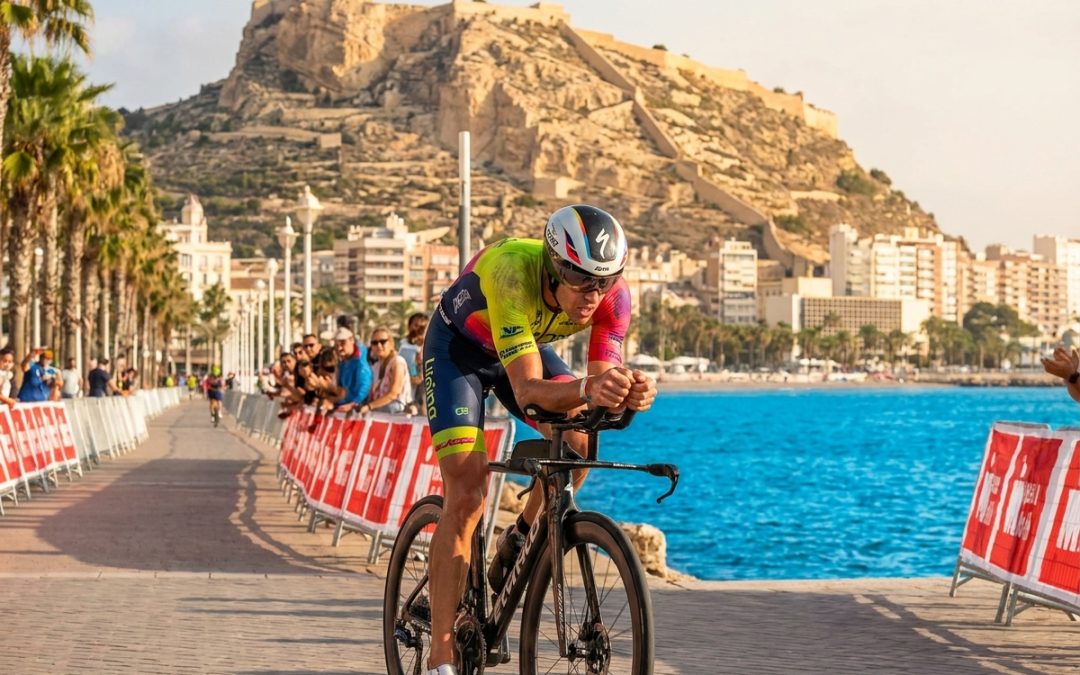
What makes this event special for the Costa Blanca cycling community is the course itself: the bike segment rolls along one of the most spectacular urban waterfronts in Spain, with Santa Bárbara Castle rising 166 metres above the city on one side and the Mediterranean stretching to the horizon on the other. It’s fast, flat, and genuinely beautiful.
Three Distances — One for Everyone
| OLYMPIC The Full Challenge — Sunday 17 May 1.5 km Swim 40 km Cycle 10 km Run ~2h30 Target time The standard Olympic distance triathlon — the classic test of multi-sport endurance. The swim takes place in the sheltered waters off Playa del Postiguet, the bike segment loops the city and waterfront, and the run finishes at the iconic Plaza del Ayuntamiento. Road bike with traditional drop bars required for this distance. The Olympic is the distance that rewards months of consistent training — and the finish line at the town hall square, in front of a crowd, is a moment worth every early morning. 🏅 Requires a road bike with drop handlebars. Recommended for athletes with a solid triathlon base. |
| SPRINT The Smart Middle Ground — Saturday 16 May 500 m Swim 20 km Cycle 5 km Run ~1h00 Target time Half the Olympic distance, all of the atmosphere. The Sprint is the most popular format at MTRI Alicante and the ideal entry point for first-time triathletes. Mountain bikes and regular flat-bar bikes are permitted — so if you haven’t got a road bike yet, this is your race. It’s also the perfect target if you’ve been building fitness on the Costa Blanca climbs and want to add a race to the calendar without committing to a full Olympic effort just yet. 🏅 Mountain bikes and flat-bar bikes permitted. Perfect for first-timers and fitness cyclists. |
| SUPERSPRINT The Taster — Sunday 17 May 350 m Swim 10 km Cycle 2.5 km Run ~30 min Target time New to triathlon? The Supersprint is your starting point. A 350m swim in calm Mediterranean waters, a 10km city bike loop, and a 2.5km run along the seafront promenade. It’s enough to give you the full race experience without requiring months of specialist training. Mountain bikes and flat-bar bikes permitted. From €25 entry. If you’ve ever been curious about triathlon, this is the race that will answer the question. 🏅 Mountain bikes and flat-bar bikes permitted. Open to all ages from 14+. From €25. |
Weekend Programme
| 📅 Friday 15 May 17:00 Athlete registration & expo opens — Paseíto Ramiro, Alicante 20:00 Registration closes for the day |
| 📅 Saturday 16 May 07:00 Registration resumes — Paseíto Ramiro ~09:00 Sprint Triathlon — race start, Playa del Postiguet Afternoon Family Duathlon — non-competitive pairs event (adult + child) |
| 📅 Sunday 17 May 06:45 Final registration & equipment check ~08:00 Olympic Triathlon — race start, Playa del Postiguet ~09:00 Supersprint Triathlon — race start Midday Finish line celebrations — Plaza del Ayuntamiento |
The Course
| 🏊 Swim — Playa del Postiguet All distances start at Playa del Postiguet — the main city beach of Alicante, set in a sheltered bay directly below Santa Bárbara Castle. The water in mid-May is typically 18–20°C and calm. It’s one of the most spectacular swim settings of any triathlon in Spain, with the castle walls rising directly above the water. |
| 🚴 Cycle — Waterfront & City Circuit The bike course rolls along the Alicante waterfront and circles Mount Benacantil — no climbing involved. The route takes in the seafront promenade and extends to the Cantera Paseo, with views across the port and the open Mediterranean. It’s a fast, largely flat circuit designed to be quick and spectacular in equal measure. Spectators line the route throughout. |
| 🏃 Run — Seafront to Plaza del Ayuntamiento The run is entirely along the seafront, finishing in the heart of the city at the emblematic Plaza del Ayuntamiento. The town hall square returns as the finish line in 2026, making for one of the most atmospheric finishes in Spanish triathlon. The crowd support on the final 500 metres is extraordinary. |
MTRI ALICANTE 2026 — ALREADY BREAKING RECORDS |
1,130+ Registered athletes | 17 Nationalities | 29.5% Female participation | 4,000+ Total circuit athletes |
| 👨👩👧 PERFECT FOR FAMILIES Family Duathlon — Saturday 16 May New for 2025 and back in 2026, the Family Duathlon is a non-competitive paired event for an adult and a child. Both participants complete all three segments together — run, cycle, run — over distances adapted for young athletes. It’s a brilliant way to introduce children to multi-sport events in a safe, supportive, festival atmosphere. Every pair that finishes receives a finisher medal. |
| 💡 PREPARING FOR MTRI ALICANTE — BIKE TIPS ● For the Olympic (40 km): Your Costa Blanca climbing legs are an advantage. Add two flat 40km time trial efforts per week in the two weeks before the race to simulate race pace on flat terrain — the city course is quite different from mountain roads. ● For the Sprint (20 km): Practice brick sessions — a short 20km effort immediately followed by a 5km run. Two or three of these in the fortnight before the race and your transition legs will be ready. ● Transitions matter. A smooth T1 (swim to bike) and T2 (bike to run) can save you two minutes against a comparable competitor. Practice clipping in quickly and rack your gear in order. ● The bike course is flat but exposed. There’s no shelter along the waterfront. A light aero position and consistent cadence matters more than raw power here. |
🏅 Ready to Sign Up? Individual entry from €25 (Supersprint) to €45+ (Olympic). The MTRI Pack covering all three cities is available for multi-event athletes. Registrations close Sunday 10 May at 23:59. → mediterraneatriatlon.com |
| 📅 Still in May Big events to go: V Aitana Tour (31 May). In June we shift to beating the heat with early morning routes, San Juan night rides, and the best beach stops along the coast. |
Sign up to our newsletter and get informed every time we publish new posts.
by Ralf Tenbrink | 8, May 2026 | Newsletter
MAY 2026 · EVENT SPECIAL
The Road to Aitana: Preparing for the V Aitana Tour
165 km. 3,400 metres of climbing. Four of the Costa Blanca’s greatest passes. One unforgettable day.
📅 Sunday, 31 May 2026 · Callosa d’en Sarrià
165 km Gran Fondo | 3,400 m Elevation | 4 Mountain Passes | 1,700 Max Riders |
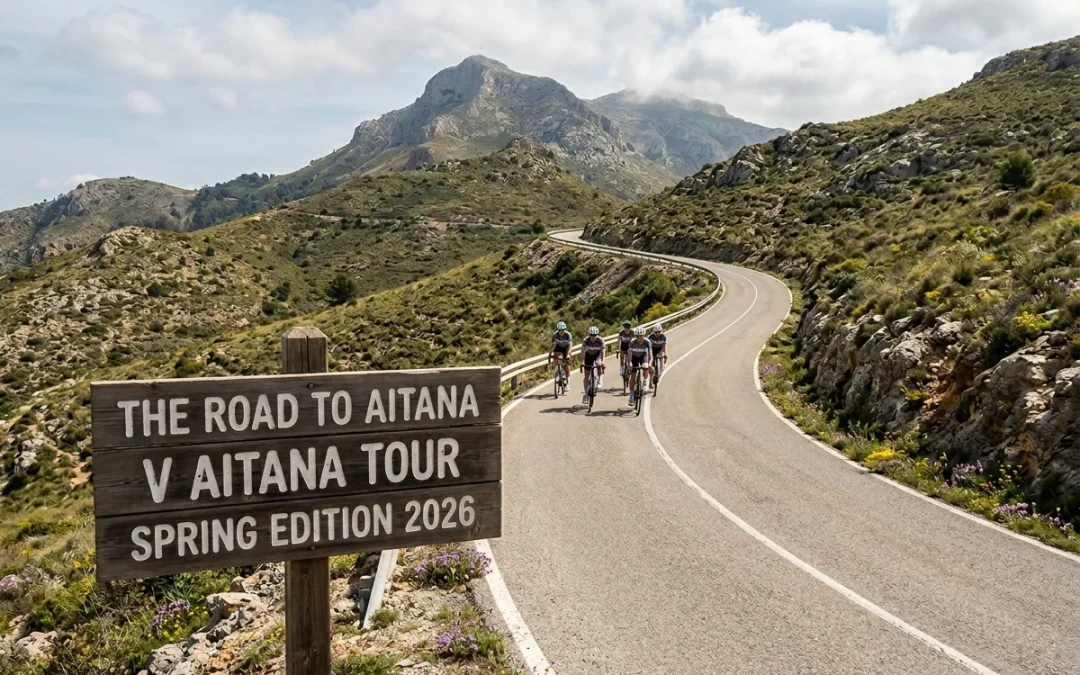
In just five editions, the Aitana Tour has established itself as one of the finest gran fondos in Spain. It starts and finishes in the market town of Callosa d’en Sarrià, a 25-minute drive inland from Calpe, and proceeds to take you over four of the most celebrated mountain passes in the province of Alicante. The climbs you’ve been training on all spring — Coll de Rates, Puerto de Tudons, Puerto de Confrides — are all here, strung together in a single epic day.
Whether you’re targeting the full 165 km Gran Fondo or the 100 km Medio Fondo, this newsletter gives you everything you need to arrive at the start line ready.
Choose Your Route
| GRAN FONDO The Full Challenge — 165 km 165 km · 3,400 m elevation · 4 major passes The complete Aitana Tour experience. From Callosa, the route climbs deep into the interior via Puerto de Confrides, crosses to Puerto de Tudons — the highest pass in Alicante province at 1,024 metres — then takes in Sa Creueta before the legendary Coll de Rates as the final timed climb of the day. This is a serious undertaking. Budget 7–9 hours and arrive at the start line with a solid base of long rides in the legs. |
| MEDIO FONDO The Smart Option — 100 km 100 km · 1,900 m elevation · 2 major passes The Medio Fondo splits off at kilometre 99.8 on the CV-715. You still take on Puerto de Confrides and the early climbs, finishing back in Callosa before the route heads out to Tudons and Coll de Rates. This is still a proper day out — 1,900 metres of climbing is no joke — but it’s the right choice if your April training hasn’t quite gone to plan, or if you’re riding your first gran fondo on the Costa Blanca. |
The Four Passes
| 1. Puerto de Confrides — via Ares del Bosc 4.6 km · 257 m elevation · Beautiful but demanding ascent The third climb of the march and the last challenge of the Medio Fondo route. Redesigned for this edition — the organisation has rerouted via Benifallim to make the ascent harder and more spectacular. A real wake-up call after the opening kilometres. |
| 2. Puerto de Tudons — via Sella 12 km · 5.3% avg · 603 m elevation · 1,024 m summit · Timed segment The roof of the Aitana Tour and the highest mountain pass in Alicante province. Twelve kilometres with an average of 5.3% and sections hitting 11%. This is where the Gran Fondo is won and lost. Pace it carefully — there are still two climbs to come. |
| 3. Puerto de Sa Creueta Featured in La Vuelta a España · Spectacular ridge-line views A Vuelta a España climb that winds along an exposed ridge with views across the full breadth of the Costa Blanca interior. By this point in the Gran Fondo you will have over 2,500 metres in the legs. Ride it to your own rhythm. |
| 4. Coll de Rates — The Grand Finale 6.7 km · 6.7% avg · 14.1% max · 350 m elevation · Timed segment The most famous climb on the Costa Blanca saves itself for last. After 150+ kilometres you’ll tackle the Coll de Rates in a timed segment from Parcent to the summit. The descent to Tarbena, and the final roll back into Callosa, is one of the most satisfying moments in cycling. |
| 🏆 2026 EVENT AMBASSADOR Roberto Heras — Four-Time Vuelta a España Champion This year’s Aitana Tour has a remarkable guest. Roberto Heras — the most decorated rider in La Vuelta’s history, sharing the record with Primož Roglič — will ride alongside all participants as the official event ambassador. If you’ve ever wanted to share a mountain road with a Grand Tour champion, May 31st is your day. |
Your 4-Week Preparation Plan
With the event on May 31st, you have the whole of May to build specific fitness. Here’s a structured four-week block designed around the Costa Blanca’s roads.
| Week | Key Session | Focus |
| Week 1 May 4–10 | Coll de Rates ×2 repeats + Val d’Ebo | Build climbing endurance. Keep effort at 75–80% FTP. |
| Week 2 May 11–17 | Long ride 120–140 km with Puerto de Tudons | Race-specific climbing. Practise fuelling every 45 min. |
| Week 3 May 18–24 | Back-to-back: 80 km Sat + 100 km Sun | Fatigue resistance. Simulate tired-legs climbing on Day 2. |
| Week 4 May 25–31 | Taper — 50% volume, short sharp efforts only | Arrive fresh. Trust your training. |
| 💡 RACE DAY TIPS ● Start conservative. The first 40 km feel easy. Riders who go too hard early pay for it on Puerto de Tudons. ● Fuel early and often. At 165 km and 3,400 m of climbing you need to eat from kilometre 1, not when you feel hungry. ● Know the cut-off point. At km 99.8 on the CV-715, riders not on pace for the full route are directed to the Medio Fondo finish. ● Savour the Coll de Rates descent. After everything you’ve been through, those hairpins down to Tarbena deserve to be enjoyed. |
🎪 Gran Zona Expo — Saturday 30 May The day before the ride, the Polideportivo Municipal in Callosa hosts a free public cycling expo — open to all. Bike brands, local industry, rider registration, and the atmosphere of a major event the night before. Well worth making a weekend of it. → aitanatour.com |
| 📅 Also in May Don’t forget the Mediterránea Triatlón Alicante (16–17 May) for multi-sport athletes. Covered in upcoming newsletters. |
Sign up to our newsletter and get informed every time we publish new posts.
by Ralf Tenbrink | 2, May 2026 | Newsletter
5 Best Cycling Climbs on the Costa Blanca (From Calpe)
The Costa Blanca has some of Europe’s finest road cycling climbs, and five of them sit within 40 kilometres of Calpe: Coll de Rates, Cumbre del Sol, Val d’Ebo, Port de Bèrnia and Castell de Guadalest. Together they form the core of what draws WorldTour teams to this coast for winter training, and they’re just as rewarding for anyone building fitness for the season ahead.
Starting from Calpe, the natural hub of Costa Blanca cycling, all five are reachable within a short drive or ride of each other, which makes it easy to combine two or three into a single loop once you know them.
The Five Climbs
1. Coll de Rates — The Icon
6.4 km · 5.5% average grade · 275 m elevation · Category 2
Difficulty: Accessible, all levels welcome
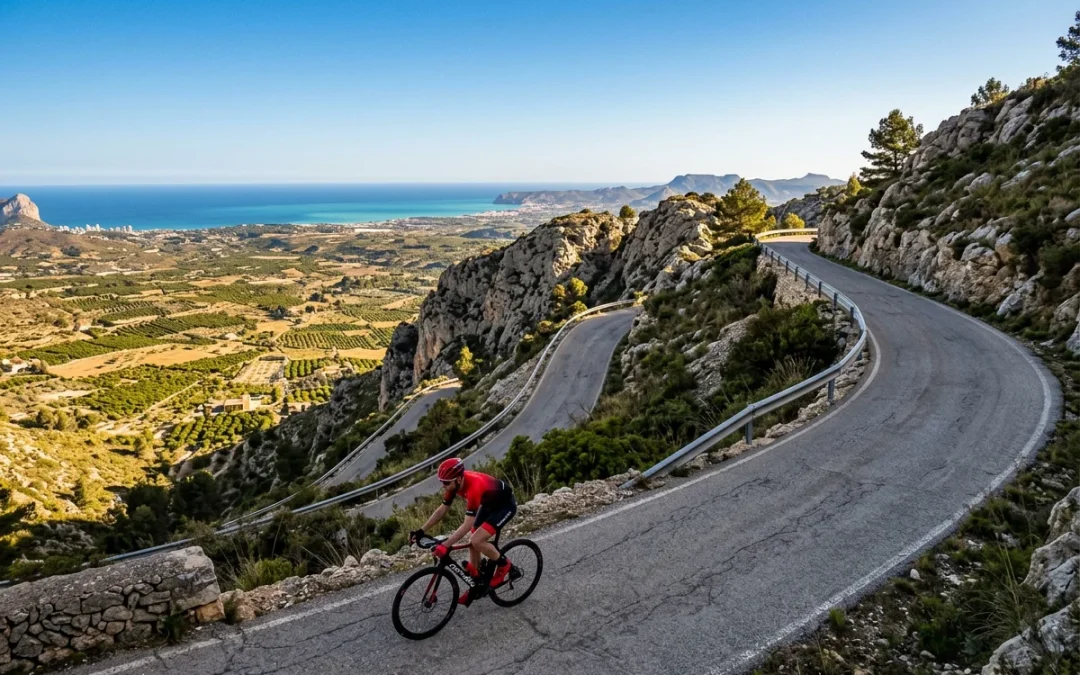
If there’s one climb that defines cycling on the Costa Blanca, this is it. The approach from Parcent is steady and rhythmic: the road winds upward through a rocky limestone landscape, with the gradient building gradually through the second half. The views from the top open across the entire Marina Alta valley toward the sea. It’s not the region’s hardest climb, but it’s the one every visiting cyclist rides first.
It’s also become one of the most closely watched Strava segments in professional cycling. Tadej Pogačar set the current KOM at 11:57 during a training ride with UAE Team Emirates. For the full breakdown of the climb, its stats and its Strava history, see our complete guide to Coll de Rates.
2. Cumbre del Sol — The Vuelta Wall
3.7 km · 9.6% average grade · 356 m elevation · Category 1
Difficulty: Challenging, intermediate to advanced
Short, sharp and unrelenting. The climb to Cumbre del Sol averages nearly 10%, with ramps that regularly push past 15%, rising from sea level in under 4 kilometres. It’s a genuine race climb: a La Vuelta a España summit finish in both 2015 and 2017, with Tom Dumoulin winning there in 2015 and Chris Froome taking it back in 2017. Start steady, because this one punishes anyone who goes out too hard.
Route it yourself with our Jávea to Cumbre del Sol route guide.
3. Val d’Ebo — The Hidden Gem
8 km · 5.7% average grade · ~426 m elevation · Category 2
Difficulty: Accessible, all levels
Val d’Ebo is what happens when a climb gets everything right. Eight kilometres of well-paved, well-graded road wind through a dramatic gorge deep in the Marina Alta interior. The lower section is sheltered by trees with wide, sweeping hairpins; the upper section opens up to panoramic views back toward the sea. On a quiet weekday you may not see another cyclist for the entire climb, and that’s the appeal, not a drawback.
It’s one of the standout routes covered in our self-guided cycling tours hub, if you want to build a longer trip around it.
4. Port de Bèrnia — The Scenic Test
8 km · 5.7% average grade · 280 m elevation · Category 3
Difficulty: Accessible, great for first-timers
Narrower, quieter and arguably more beautiful than Coll de Rates, the Port de Bèrnia winds up through dramatic limestone scenery with the Sierra Bernia ridge towering above. The gradient is irregular, with plenty of steep, punchy sections interspersed with recovery stretches. The views looking back toward Calpe and the Peñón d’Ifach are among the finest from any climb in the region. It’s often paired with Coll de Rates for a full day out, and both feature in our top 10 cycling routes in Costa Blanca.
5. Castell de Guadalest — The Cultural Climb
7.5 km · 5.0% average grade · ~380 m elevation · Category 3
Difficulty: Accessible, ideal for building base fitness
The road to Guadalest passes through citrus groves and dramatic rock formations before arriving at one of the most spectacular hilltop villages in the province. The climb itself is steady and manageable, making it ideal for building early-season base fitness. The reward at the top is a genuinely ancient one: the castle’s origins date to the 11th century, built during the Islamic period of the Iberian Peninsula, making it close to a thousand years old. Stop for coffee in the village, you’ve earned it.
For the full ride, see our Benidorm to Guadalest route guide.
Training Tip
For an early-season fitness benchmark, ride Coll de Rates first: it’s the most reliable climb on the coast for tracking form across the season. Once you can ride it comfortably, add Cumbre del Sol for intensity and Val d’Ebo for endurance. All three in a single day is a serious 130 km challenge that will tell you exactly where your fitness stands.
It’s also good preparation for the region’s best-known cyclosportive: the V Aitana Tour, a gran fondo based in Callosa d’en Sarrià that takes in several of these same climbs each spring. If you want a fuller sense of what a structured, multi-day trip around climbs like these looks like, our self-guided cycling tours hub is the place to start.