by Ralf Tenbrink | 1, Jan 2026 | Cycling Accommodation Costa Blanca
Cycling Accommodation in Calpe: Where Cyclists Stay on the Costa Blanca
Also known as: alojamiento ciclismo Calpe / apartamentos para ciclistas Calpe
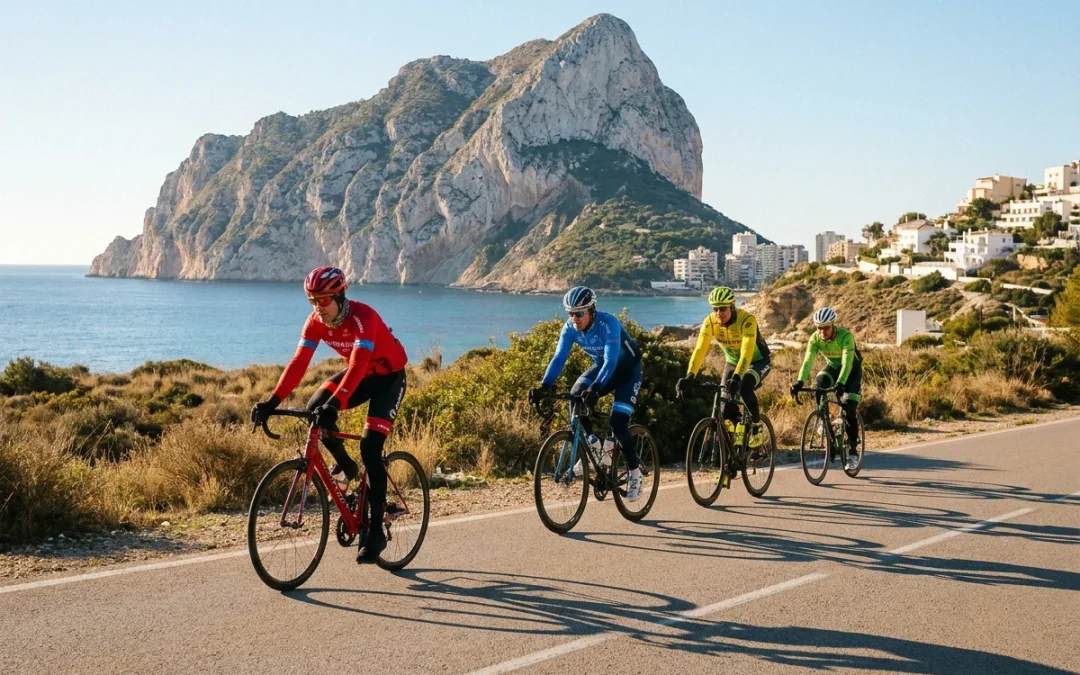
Calpe pulls in more cyclists per head of population than almost anywhere else on the Spanish Mediterranean coast. The reasons are straightforward: you step out of your accommodation and within ten minutes you can be climbing into the mountains, rolling along the coast towards Altea, or picking up the N-332 for a proper training loop. The town is compact, the roads hold together well, and the Peñón de Ifach — Calpe’s distinctive limestone rock sitting at the entrance to the bay — gives you a landmark you can navigate by from almost anywhere on a bike.
But the accommodation choice matters more in Calpe than people realise before they arrive. The town splits into several quite different zones: the old fishing quarter, the beachfront along Playa Arenal-Bol, the higher ground behind Puerto Blanco, and the residential sprawl climbing towards the hills to the west. Where you stay determines how easily you roll out in the morning, whether you need to cross traffic to reach the good roads, and whether your bike is genuinely secure overnight.
This page covers the options honestly.
Why Stay in Calpe for a Cycling Holiday?
Calpe sits in the Marina Alta, the northern section of the Costa Blanca, and it has better road access to the inland mountain climbs than towns like Benidorm or Villajoyosa further south. The road north from Calpe towards Benissa and on to Pedreguer, or the climb up towards Benitachell and the Cumbre del Sol ridge, give you altitude gain without the heavy traffic you’d face leaving some other resorts.
The three climbs that most road cyclists come specifically to ride are all within 45 minutes of Calpe’s town centre. The Coll de Rates (560 m, 7.7 km from the Parcent approach) is perhaps the most famous club cyclists’ climb on the Costa Blanca. The Col de Xàbia via the CV-734 from Gata de Gorgos is more testing than it looks. And the Bernia ridge road, accessed via Benissa or from the Altea side, gives you a harder, quieter alternative when you want something with less traffic.
The climate is the other major draw. Calpe gets around 320 days of sun a year according to the Costa Blanca Tourism Board (costablanca.org), and winter temperatures between November and March regularly reach 15–18°C on days with no cloud — typical ranges based on AEMET regional climate data for the Marina Alta. For riders from northern Europe, that means proper outdoor riding in conditions that are impossible at home. December and January groups coming from the UK, Germany, Belgium and the Netherlands are a familiar sight in Calpe’s cafes.
The town has a functioning cycling infrastructure. There are bike shops that understand race bikes rather than just tourist cruisers, mechanics used to dealing with high-end groupsets, and a growing number of accommodation providers who have put genuine thought into what cyclists actually need.
What Cyclists Should Look For in Accommodation
Not all bike-friendly claims are equal. Some properties hang a bike hook in the car park and call it a cycling hotel. What actually makes accommodation work for cyclists involves a specific set of features that are worth checking before you book.
Secure, covered bike storage — this is non-negotiable. A bike worth €3,000–€10,000 cannot be left outside. Look for locked storage, ideally inside the building rather than an outbuilding. Ground-floor access helps enormously when you’re returning tired with a loaded bike.
Workshop facilities — a workstand and basic tools are the difference between fixing a mechanical on-site and spending an hour finding a bike shop. A torque wrench, chain wear gauge, hex keys, and a track pump are the minimum. Better properties have full workshop space with cleaning facilities.
Laundry or drying facilities — cycling kit washed at 30°C dries overnight if you have a rack or outdoor space. Properties without laundry facilities or at least a drying room force you to either rotate fewer changes of kit or spend time and money at a laundrette.
Early breakfast — most group rides depart between 7:30 and 9:00 to get miles in before the midday heat from May onwards. A property that serves breakfast from 7:00 or earlier makes a real difference. Some cycling-specific properties go further and prepare boxed breakfasts or leave cold food out the night before.
Recovery facilities — after a hard day in the hills, a proper shower, a pool for cold-water leg immersion, and somewhere comfortable to sit and eat are worth more than a hotel gym. Stretching space matters.
Bike wash facilities — coastal riding, particularly after rain, means dirty drivetrains. A hose point and a flat surface to work on prevents the bathroom becoming a workshop.
Airport transfer options — Alicante-Elche Airport is about 75 km from Calpe. If you’re flying with a bike box, getting a transfer that can take a bike case without an argument is worth arranging in advance. Some cycling-specific properties organise this directly.
Bike rental partnerships — useful if you’re flying without a bike or if a travelling companion wants to ride but doesn’t own a road bike. Properties with direct links to a local rental provider save you time.
Types of Cycling Accommodation in Calpe
Cycling-Specific Hotels
A small number of properties in and around Calpe operate as genuine cycling hotels — meaning the entire operation is built around riders. These properties typically offer guided rides, route planning support, nutritional breakfast options (rice cakes, energy bars, proper coffee), and staff who actually cycle. They’re well-suited to solo travellers who want company on the road and to training camps where a structured week with support matters.
Apartments
Self-catering apartments are the most popular choice for groups and clubs coming to Calpe for a week or two. The ability to cook, wash kit in your own machine, and come and go without reference to hotel schedules suits groups well. The trade-off is that bike storage and workshop facilities vary enormously between properties. Ask specifically before booking — “bike-friendly” in an Airbnb listing sometimes means nothing more than “you can bring a bike.”
Villas
Privately rented villas work particularly well for groups of 6–12 riders who want privacy, space, and a full kitchen. A private villa with a secure garage or gated garden solves the bike storage problem neatly. The Calpe hinterland — the area above the CV-749 towards Benitachell — has a good number of villas positioned in quiet settings with direct road access to the climbing routes. The drawback is that group logistics (transfers, food shopping) require more organisation than a hotel provides.
Training Camp Accommodation
Calpe has built a genuine reputation as one of the best pre-season training camp locations in southern Europe. Training camp accommodation in Calpe typically bundles accommodation, guided rides, massage, meals, and route support into a single package. This suits teams, clubs doing pre-season camps, or individuals who want a structured, coached week rather than independent riding. The January–March window fills fast — some operators are fully booked by October for the following season. Prices reflect the all-inclusive nature.
Boutique and Lifestyle Accommodation
A newer category on the Costa Blanca generally, boutique properties in Calpe tend to sit in the higher price bracket and often market to cyclists alongside a broader leisure clientele. Facilities vary, but the better ones have made proper provision for bikes. Worth asking about specifically if the marketing is vague.
Budget Options
Hostals and smaller family-run guesthouses around the old town and the Ifach area offer significantly lower nightly rates. The trade-off for cyclists is usually less secure bike storage and fewer specialist facilities. For solo riders on a tight budget who are comfortable locking a bike in a shared space and washing kit in a bath, these can be perfectly adequate. For groups with expensive bikes, they’re a risk.
Luxury Options
Several four and five-star hotels operate in and around Calpe, primarily aimed at the general tourist market. Some have added cycling packages in response to demand. These work well for cyclists who want genuine comfort around their riding — spa access, good restaurants, quality beds — and are prepared to pay for it. The critical question remains whether secure, private bike storage is available, as luxury hotels don’t always handle this as well as purpose-built cycling properties.
Best Areas to Stay in Calpe
Town Centre and Old Town (Ifach Quarter)
Staying centrally means easy walking access to restaurants, cafes, the market, and the shops on Avenida Gabriel Miró. For cyclists the main advantage is proximity to the coast road — the CV-740 towards Altea picks up just south of town and gives you a clean run without fighting through suburbs. The downside is parking, which is tight, and older buildings often have no suitable storage for bikes.
Playa Arenal-Bol and Puerto Blanco
The beachfront strip is the heart of Calpe’s tourism accommodation — hotels, apartamentos, and rental blocks running along the main beach. It’s convenient for restaurants and the cycling distances from here to the main roads are short. The area is flat, which makes the roll-out easy. Accommodation quality ranges from basic to comfortable. A few hotels here have added cycling facilities in recent years.
La Canuta and the Area Towards Benissa
The district climbing west from the main town towards the CV-745 and Benissa sits at slightly higher elevation and gives you quieter morning roll-outs. This is where some of the better villas are located, and it puts you on the right side of town for the Coll de Rates approach via Alcalalí or the inland routes through Senija and Benissa. Less busy than the beachfront, more space, and more useful for cyclists who don’t need to be on the sand between rides.
Maryvilla and the Northern Side
The residential area north of the Peñón has less accommodation but is quieter and sits closer to the CV-749 towards Benitachell and the Cumbre del Sol. Good for riders focusing on the northern routes towards Dénia or the gravel options through the vineyards above Xàbia.
Accommodation Near Popular Cycling Routes
Coll de Rates
To ride the Coll de Rates from Calpe — the most popular single day-ride in the area — you typically head north along the coast towards Benissa, cut inland through Llíber or Jalón/Xaló, and approach the col from Parcent. The route from Calpe to the foot of the climb is roughly 25 km. Any accommodation in or near Calpe works for this ride; the key variable is what roads you use getting there. Cycling traffic to Coll de Rates is heavy on weekends from October to April. After the descent, the café in Parcent village is the standard mid-ride stop for most groups — Bar-Restaurant Nou Racó is well-used by cyclists and opens from early morning. See the Coastal Loop from Calpe to Dénia for route context.
The Jalón Valley and Inland Routes
The Jalón/Xaló valley — covered on the Jalón Valley Scenic Loop — is excellent for mid-week quieter riding away from the coast. Accommodation on the western side of Calpe, towards La Canuta or above the CV-749, puts you 10–15 minutes closer to this network without a traffic battle.
The Altea Hills and Coastal Corridor
The ride south from Calpe through Altea and along the coast, covered in the Altea Hills Loop, is good year-round. Flat to gently rolling, café stops in Altea old town, and the option to loop back inland via La Nucia or Polop. Accommodation anywhere in Calpe works for this — it’s an out-and-back or a loop that starts and ends at the same point.
Alicante to Calpe Long Distance
If you or guests are riding the Alicante to Calpe long-distance route, Calpe accommodation is the obvious overnight or end-point. Properties near the beach strip are easiest for groups meeting arriving riders with cars.
Mountain Bike Access
The trails around the Sierra Helada, Finestrat, and the Puig Campana massif are the closest serious mountain bike terrain to Calpe. The Sierra Helada Natural Park Trail starts near Benidorm, about 30 km south. The Finestrat Forest Trail is accessible as a day trip. Accommodation in Calpe works for MTB if you have transport; if the trail network is the primary purpose of your trip, Benidorm or La Nucia may be a better base.
Cycling Training Camps in Calpe
Calpe is one of the most established cycling training camp bases in southern Europe. The combination of reliable winter weather, route variety, and proximity to both coastal intervals and mountain climbs makes it a logical choice for pre-season preparation. The area hosts a mix of professional team camps, semi-professional squads, cycling club tours, and individually booked training weeks from October through to April.
What makes a training camp in Calpe work is the route access from the town itself. Within a single day’s riding you can cover flat coastal tempo work, steady climbing on the Coll de Rates or the Bernia approach, and threshold intervals on the rolling inland roads through the Jalón Valley. There is no need for a support vehicle to reach the climbs — you roll out from the door.
What training camp packages in Calpe typically include:
- Accommodation for 5–10 nights
- Guided rides with a local cycling guide (daily or selected days)
- Sports massage — most operators include at least one massage per stay
- Nutritional meals calibrated for training load
- Route planning and GPX files
- Airport transfer options
Booking window: The January–March peak is genuinely competitive. Training camp specialists in the area report that popular weeks — particularly the last two weeks of January and the first two weeks of February — are often fully committed by the previous October. If a specific date window matters, contact operators directly rather than waiting for online availability to appear.
Cyclists looking for campamento ciclista Costa Blanca packages should check the Bikes Costa Blanca Accommodation Directory for current operators offering structured camp weeks.
Accommodation for Different Cyclists
Solo Riders
The best option for solo cyclists coming to Calpe for a week is usually a cycling hotel or training camp property. These give you route support, people to ride with (most properties run guided group rides of mixed abilities), and the kind of social structure that makes a week on your own actually enjoyable. Apartments work fine for solo riders who are self-sufficient and have a pre-planned route schedule, but the isolation can be a factor on longer trips.
Couples
Where one person is a committed rider and the other isn’t, or where both ride but at different levels, a well-located hotel or apartment near the beach works better than a dedicated cycling property. The non-rider has Calpe’s beaches, restaurants, and the old town. The rider has direct road access to the mountains. Properties near Arenal beach give both parties something useful.
Groups and Clubs
A group of 6–16 club riders is the natural client for a Calpe villa or a block booking at a cycling hotel. The villa option works well when the group wants flexibility — no fixed meal times, freedom to ride different loops, the ability to debrief over a barbecue. A cycling hotel works better when the group wants structured rides with guiding and doesn’t want to organise logistics themselves. Check bike storage capacity before booking either option; 12 bikes need significant space.
Training Camps
Calpe’s reputation as a training camp destination is well-established. Several professional and semi-professional teams run pre-season camps here between January and March. The route mix — flat coastal intervals, medium mountain climbs, and the longer passes further inland — covers all training objectives within day-ride distance. Training camp properties typically include massage services, nutritional support, and organised ride schedules. Book well in advance for the January–March window — Calpe’s limited stock of genuinely good cycling accommodation fills months ahead of peak dates.
Families
Calpe works for cycling families if the children are experienced riders. The coast road is not suitable for children on bikes — it carries significant vehicle traffic. The seafront promenade offers safe cycling for children. For families where adults want to ride seriously and children need non-cycling alternatives, a beach hotel works better than a cycling-specific property. Calpe’s beaches (Arenal-Bol and La Fossa) are among the best on the Costa Blanca. The family-friendly MTB trails on the Costa Blanca offer further options for mixed-ability family groups.
Long-Stay Winter Cyclists
November to March is the most interesting period for serious winter training in Calpe. Temperatures are mild enough to ride comfortably most days, the crowds are gone, and many accommodation providers offer significantly discounted rates for stays of two weeks or more. Long-stay apartments in the town centre or the beachfront areas are the most cost-effective option. Some cycling hotels offer winter rate packages specifically targeting this market. Be aware that some smaller properties close for refurbishment in January and February — check availability early.
Accommodation Prices in Calpe
Prices vary considerably depending on season and property type.
October to April (Peak Cycling Season): Counter-intuitively, Calpe’s best months for cycling coincide with the shoulder and off-peak tourist season. Hotel rooms in October–November and February–March typically run cheaper than summer rates. Expect to pay €60–€120 per night for a decent hotel double. A 2-bedroom self-catering apartment for a group of 4 in October or March starts from around €500–€700 per week; a 3-bedroom property for 6 runs €750–€1,100. Villas with private pool access start higher and vary significantly by location and spec.
December and January: The quietest period for general tourism, which makes it excellent value for cyclists — unless you’re booking a specialist training camp package, where prices reflect the all-inclusive services included. Longer stay discounts on apartments are common. This is when training camps are at their busiest and independent cycling accommodation bookings are most competitive.
July and August: Peak tourist season, highest prices, most crowded roads. Not the preferred period for serious training. Road temperatures make riding before 8:00 and after 18:00 the only comfortable options. Prices for all accommodation types increase significantly. Most dedicated cycling properties shift focus to leisure visitors in summer.
Group and Long-Stay Discounts: Most accommodation providers in Calpe will negotiate for group bookings (10+ people) or stays of two weeks and above. It is worth asking directly rather than booking through standard online channels where discounts are harder to apply. Cycling hotels in particular tend to have packages that represent better value than room-only rates.
Insider Tips for Cyclists Staying in Calpe
Book winter training camp accommodation early — seriously early. January and February see professional and club teams competing for the limited genuinely good cycling accommodation in Calpe. Popular weeks in late January and early February are often fully booked by October. If you want a specific property or date window, contact operators directly in September or October for the following year.
The Wednesday market in Calpe is worth knowing about. Held near the seafront, it’s useful for fruit, snacks, and supplies — particularly for self-catering groups.
Morning traffic on the CV-740 towards Altea is manageable before 8:30. After that, lorry traffic builds towards Benidorm. If you’re heading south for a longer ride, roll out early.
The road north from Calpe towards Benissa via the CV-749 is quieter than the coast road and gives you a cleaner exit for inland routes. Worth routing out this way even if it adds 2 km.
Winter weather is usually mild but not guaranteed. November and December can bring rain. March can be cold in the mountains. Check the forecast before committing to a long climb — the Bernia road in particular can have ice in January at altitude.
Bike rental is available in Calpe through several providers. See the top bike rental shops in Calpe for current options. If a group member needs a rental bike, book at least a week ahead in the October–March peak period.
A word on bike security in the town. Calpe is not a high-theft area but valuable bikes should never be left in cars or outside restaurants. Any property that doesn’t offer a locked storage space is not genuinely cycle-friendly, whatever their marketing says.
Alicante Airport transfers with a bike box need to be booked with a specialist transfer operator rather than a standard taxi. The bike case needs a vehicle with adequate loading space. Your accommodation provider can often recommend someone they use regularly.
Featured Cycling Accommodation in Calpe
The Bikes Costa Blanca accommodation directory lists verified cycling-friendly properties across the Costa Blanca. The directory is growing — if you’re a Calpe accommodation provider catering to cyclists and don’t yet have a listing, see the registration details at the end of this section.
Coll de Rates Cycling Holidays
Type: Cycling holiday specialist / Guided camps Location: Marina Alta, Costa Blanca — Calpe routes and climbs covered daily Key Cycling Features: Guided rides on the Costa Blanca’s most famous climbs, local route expertise, quality accommodation, structured holiday packages for individuals and groups Best Suited For: Solo riders and groups wanting a guided cycling holiday with local knowledge; anyone coming specifically to ride Coll de Rates and the surrounding passes with support rather than self-navigating View listing and enquire →
Rental Partner: DP Cycling
DP Cycling is not an accommodation provider but a premium bike rental service that delivers directly to your Calpe accommodation — making it relevant for anyone booking any of the properties above. Their fleet includes the Colnago V4 and Olmo E-Road, maintained to race standard, with free delivery and collection. With over 16 years on the Costa Blanca, they’re a well-regarded option for riders travelling without a bike.
DP Cycling website →
Add Your Property
Are you a Calpe accommodation provider catering to cyclists? The Bikes Costa Blanca directory is the primary cycling accommodation resource for the Costa Blanca region. Listing details, verified facilities, and enquiry contact options are available for properties that meet the cycling-friendly criteria.
Register your accommodation →
Compare Cycling Accommodation in Calpe
The Bikes Costa Blanca Accommodation Directory lists verified cycling-friendly properties across the Costa Blanca, filterable by town.
When comparing properties for a Calpe cycling trip, the questions worth asking each provider directly:
- Is there locked, covered storage specifically for bikes (not just a car park)?
- What time does breakfast service start?
- Is there a workstand and basic tools on site?
- Do you have a laundry service or drying room for kit?
- Can you organise airport transfers with bike box capacity?
- Do you have a preferred local bike rental partner?
- What is the minimum stay for a group booking discount?
Properties that answer these questions clearly and specifically are the ones that have thought about cyclists as guests rather than simply added cycling to their amenities list.
View all Calpe cycling accommodation →
Frequently Asked Questions
What is the best cycling hotel in Calpe?
Calpe has a small number of properties that genuinely cater to cyclists, including dedicated training camp operators and cycling holiday specialists. The Bikes Costa Blanca directory lists current verified options with facilities details. For most club groups, the combination of a well-located villa or apartment with a relationship with a local bike shop and rental provider gives comparable results at lower cost than a specialist hotel.
Do cycling hotels in Calpe provide secure bike storage?
Genuine cycling hotels do, but the term “cycling-friendly” is applied loosely by some properties. Before booking, ask specifically whether storage is inside a locked room or building (not an open car park), and whether you’ll have access to your bike early in the morning without waking reception staff.
Can accommodation in Calpe arrange bike rentals?
Several cycling-specific properties and training camp operators work directly with local rental providers and can include a rental bike as part of a package. See bike rental shops in Calpe for providers who rent directly.
Is Calpe good for winter cycling?
Yes. November to March is when Calpe works best for training cyclists. Temperatures are mild (typically 12–18°C in midwinter, based on AEMET regional climate data), roads are quiet, and the climbing routes are fully open except after unusual weather. Most serious training camps in the area run during this window. It is worth checking the higher mountain roads (Bernia, Sierra de Serrella) after cold nights, as frost can occur above 600 m.
How far is the nearest major climb from Calpe?
Coll de Rates is roughly 25–30 km from Calpe town centre depending on your approach. The Puerto de Benissa, a shorter but steep climb directly above the town, is accessible in under 20 minutes of riding. The Col de Xàbia via Gata de Gorgos is about 30 km north. All three are achievable in a day ride that returns to Calpe for lunch.
What facilities should cyclists look for in Calpe accommodation?
The non-negotiables are: locked indoor bike storage, early breakfast from 7:00 or earlier, and a way to wash and dry kit. Useful additions are a workstand and basic tools, a bike wash point, pool access for recovery, and relationships with local rental and transfer providers. Any property charging cycling-specific rates should be able to confirm all of these without hesitation.
Can I ride year-round in Calpe?
In practical terms, yes. The Costa Blanca’s climate means outdoor riding is possible every month of the year. Summer (July–August) is the most demanding period — heat makes midday riding uncomfortable and the roads are at their busiest with tourist traffic. October to May is the preferred window for performance cycling. December and January are excellent for training if you’re prepared for the occasional cold morning in the mountains.
Are there gravel routes near Calpe?
Yes, though the area around Calpe proper is more road than gravel. The best gravel riding near Calpe requires heading inland — the tracks above Llíber, Alcalalí, and the lower slopes of the Sierra de Bernia give good unpaved options. The Jalón Valley Scenic Loop incorporates some quieter paved roads that are practically traffic-free, and the area north of Dénia has more developed gravel riding.
How do I get to Calpe from Alicante Airport with a bike?
Alicante-Elche Airport (ALC) is around 75 km from Calpe. A standard taxi will not accommodate a full bike box. You need a specialist transfer company or to arrange collection through your accommodation provider. Journey time is roughly 1 hour to 1 hour 15 minutes depending on traffic. Several cycling-specific properties in the area have established relationships with transfer operators — worth asking when you book.
Is mountain biking possible from Calpe?
The town itself is better positioned for road and gravel riding. Serious mountain bike trails are more accessible further south, particularly around Finestrat, the Sierra Helada above Benidorm, and the Puig Campana area. Day trips from Calpe to these trail networks are manageable with a car. See Costa Blanca MTB trails for a full overview.
Is Calpe a good base for a self-guided cycling tour of the Costa Blanca?
It’s one of the best. The position on the northern Costa Blanca puts you within a single day’s ride of Dénia, Jávea, the Jalón Valley, Altea, and Benidorm. A week based in Calpe with a different route each day covers a significant chunk of the Costa Blanca’s best cycling. See self-guided cycling tours on the Costa Blanca for structured itinerary options.
Last reviewed: May 2026. Accommodation listings are subject to change. Verify facilities directly with providers before booking. Contact Bikes Costa Blanca to add or update a Calpe cycling accommodation listing.