
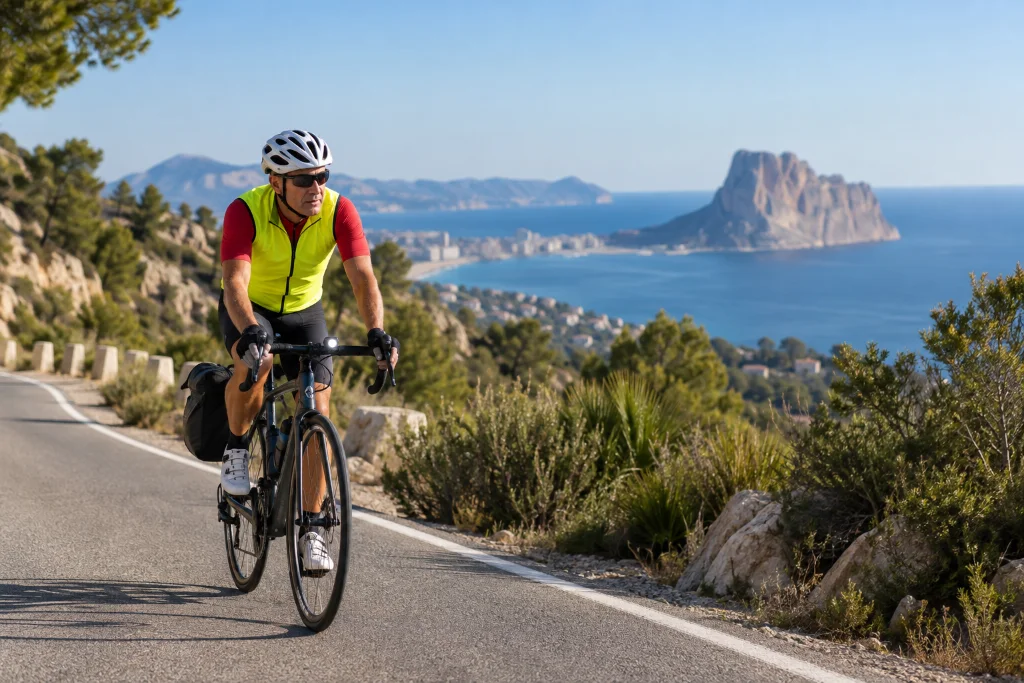
Safety Tips for Cycling Alone in Costa Blanca
Key Takeaways
| Topic | What to Know |
|---|---|
| Helmets | Mandatory for all cyclists outside built-up areas from October 2026, no exemptions |
| Overtaking | Drivers must keep 1.5m clearance and reduce speed by 20 km/h on interurban roads |
| Lighting | Front and rear lights required at night and in tunnels; missing lights carries a fine of up to €200 |
| Road position | Riding centrally in the lane is safer and legally supported, not just tolerated |
| Emergencies | Spain’s emergency number is 112; operators generally speak English |
| Water | Some mountain sections run 30km between refill points; carry at least two bottles |
Cycling alone in the Costa Blanca is generally safe: locals cycle regularly, drivers are used to sharing the road, and the region has well-maintained roads throughout. The main risks for solo riders are the same ones that catch out any touring cyclist anywhere: being caught without the right equipment, misjudging a route’s difficulty, or not having a clear plan for what to do if something goes wrong, with no one else there to help. This guide covers Spain’s current traffic rules for cyclists (which changed substantially in 2026), the equipment worth carrying, and what to do in an emergency.
Spain’s 2026 Traffic Rules for Cyclists
Spain’s traffic regulations for cyclists changed significantly this year under Real Decreto 518/2026, with the cycling-specific provisions taking effect from October 2026. Full detail is in our dedicated article on the 2026 rules; the parts that matter most for solo touring:
Helmets are now mandatory for all cyclists on any road outside a built-up area, with no exemptions for heat, gradient, or anything else. This is a real change from the previous rule, which only required helmets for riders under 16. If you’re touring on interurban roads and mountain passes, which is most of what a Costa Blanca cycling holiday involves, wear a helmet before you leave town.
Overtaking rules got significantly tighter. On interurban roads, a driver overtaking a cyclist must now reduce speed by at least 20 km/h below the limit, keep at least 1.5 metres of lateral clearance, and change lanes completely where the road has more than one lane in each direction. A group of cyclists is treated as a single unit for overtaking purposes, so a driver can’t thread through gaps in a group.
In towns, cyclists have more clearly defined road space. You’re generally entitled to ride in the centre of the lane rather than hugging the kerb, and vehicles following a cyclist in the same lane must keep at least 5 metres back. Filtering past stationary traffic on either side is explicitly permitted in congested urban conditions.
Fines for common violations, cross-referenced against DGT’s published schedule: riding without a required helmet, up to €200; missing or uncertified lights, up to €200; using a phone or headphones while riding, €200; failing to signal a manoeuvre, €200; missing required reflective clothing, up to €100; cycling under the influence, €500-1,000; improper conduct at a pedestrian crossing, up to €200.
Essential Safety Equipment
Your safety kit for solo touring should include:
- A properly fitted helmet (now required outside towns regardless of age, as above)
- Front white light and rear red light, required at night and in tunnels
- Reflective strips or a vest for low-visibility conditions
- ID and emergency contact information
- Sunglasses, for both sun protection and debris
- Cycling gloves
- A bell or horn
Don’t skimp on lighting redundancy. Carrying a spare light or extra batteries is a small cost against a €200 fine and a real safety risk if your primary light fails after dark. Hydration and sun protection matter as much as visibility gear here: the Costa Blanca sun is stronger than most visitors from northern Europe expect, so carry at least two water bottles, high-factor sunscreen, and lip balm with SPF even on overcast days.
Road Positioning
Ride roughly a metre out from the road’s edge rather than hugging the shoulder. It feels counterintuitive if you’re used to riding close to the kerb, but it increases your visibility and discourages the close, dangerous passes that hugging the edge tends to invite, and it’s the position the new overtaking rules are effectively designed around. On roads with two lanes in the same direction, position yourself centrally in the right-hand lane rather than at its edge.
Roundabouts are common in Spain and can be intimidating for visiting cyclists. Signal clearly, take the lane when you need to, and remember vehicles already in the roundabout have priority. If you’re continuing past the first exit, stay in the outer lane and signal before you leave the roundabout.
If you’re riding with others, groups may ride two abreast but should return to single file in low visibility or when traffic builds up behind. Riding solo, you’re more exposed at junctions, which is where most cyclist-vehicle incidents happen, so treat every junction with extra caution regardless of who technically has priority.
Planning a Safer Solo Route
Consider traffic patterns when choosing a route: coastal roads get busy in summer, especially between the larger towns, while inland routes tend to be quieter. Our bike routes page has pre-planned options that balance scenery against traffic exposure.
Ride earlier in the day where possible. Traffic is lighter and temperatures are cooler before 9am, which matters even more in summer when afternoon heat becomes a genuine risk on top of a traffic risk.
A practical route-planning checklist for solo riders:
- Check road surface quality and avoid routes with known poor surfaces
- Identify refuelling points (cafés, water fountains) along the way
- Note potential shelter spots in case of sudden weather
- Mark bike shops along the route for mechanical issues
- Identify bail-out options: bus stops, train stations, towns with taxi services
- Share your planned route with someone before you set off
Start with shorter loops near your accommodation before attempting longer point-to-point rides, particularly if it’s your first time in the region. Staff at local bike shops are a good source of current road-condition and traffic advice that doesn’t always show up on a map.
Weather and Seasonal Safety
Summer (June-August) brings real heat risk: temperatures regularly exceed 30°C by midday, and asphalt radiates additional heat on top of the air temperature. Riding between roughly noon and 4pm in summer is worth avoiding altogether where your schedule allows it. A reasonable summer approach: start before 7am, favour routes with shade, carry extra water (at least 750ml per hour of riding), use electrolytes in at least one bottle, wear light-coloured clothing, and reapply sunscreen during any breaks.
Winter (December-February) is genuinely good cycling weather, typically 15-20°C during the day, but mornings can be cold, especially inland, so pack removable arm and leg warmers even when the forecast looks mild.
Spring and autumn carry a different risk: sudden rain showers, which make roads slippery, especially in the first 30 minutes after rain starts, when built-up oil residue hasn’t washed away yet. Check the forecast before departing and carry a packable rain jacket through these seasons.
The Levante, an easterly wind, can create serious crosswinds on coastal roads and mountain passes, typically strengthening through the day. Riding into the wind on the outward leg, so you get a tailwind on the way back when you’re more tired, is a reasonable default strategy. The AEMET app gives accurate local forecasts and weather warnings if you want to check before setting out.
Mechanical Preparedness
Punctures are the most common mechanical issue, particularly after windy or wet weather washes debris onto the road. Carry at minimum two spare inner tubes of the correct size, tyre levers, a multi-tool with a chain breaker, a mini-pump (CO2 inflators are convenient but can fail without a backup), a puncture repair kit, a quick link for chain repairs, electrical tape and cable ties.
Practise basic repairs, especially changing a tube, before you leave rather than for the first time on the roadside. If you’re bringing your own bike, give it a full check before travelling; if renting, test it thoroughly before accepting it. Bike repair services across the region can help with pre-ride checks.
A small first aid kit alongside your repair kit covers antiseptic wipes, adhesive bandages, pain relief, and any personal medication. Phone battery management matters too: GPS navigation drains a battery fast, especially at full brightness in direct sun, so a small power bank is worth carrying, and switching to airplane mode when you’re not actively navigating extends battery life considerably. For genuinely remote mountain routes with unreliable phone coverage, a satellite messenger device is worth considering, since it lets you call for help where a phone can’t.
Emergency Protocols
If you have a mechanical problem you can’t fix roadside, get yourself and your bike completely off the road first, ideally behind a barrier, before doing anything else. A small LED flasher you can attach to yourself or the bike is worth carrying for exactly this situation.
For medical emergencies, Spain’s emergency number is 112; operators generally speak English. Be ready to describe your location precisely, which is where knowing your route in advance pays off.
Emergency contact basics:
- Call 112 for serious emergencies
- Contact local police (Policía Local) for non-urgent issues
- Keep your accommodation’s phone number saved
- Save contact details for nearby bike support services
If you’re injured but mobile, assess whether you can reach the nearest town or bus stop safely. Public transport is generally bike-friendly but policies vary: the TRAM light rail permits bikes outside peak hours, and regional trains typically allow bicycles with some restrictions, so check specific carrier policies rather than assuming.
Know the signs of heat exhaustion (heavy sweating, rapid pulse, dizziness, nausea) and heatstroke (hot dry skin, confusion, rapid strong pulse). Heat exhaustion calls for stopping immediately in shade, drinking water, and cooling down; heatstroke is a medical emergency requiring immediate professional help, not self-treatment.
For theft prevention: never leave a bike unattended without locking it. If it’s stolen, report it to local police and your insurance company immediately, and take photos of your bike plus a note of its serial number before your trip, so you have that information ready if you need it.
Communication and Navigation Safety
Coverage is generally good along the coast and in towns, patchier in the mountains. Download offline maps before you set off; cycling-specific apps like Komoot or RideWithGPS offer better bike routing than general navigation apps and work without a live connection once routes are downloaded.
A reasonable navigation setup: a smartphone in a waterproof mount, offline maps downloaded in advance, a written cue sheet as backup, and a power bank for longer days. Manage battery by keeping the phone in airplane mode when you’re not actively navigating and the screen dimmed to a usable minimum.
Regular check-ins with someone who knows your route add a real safety layer: agree a rough schedule of messages at set points or times, with an understanding of what they should do (try to reach you, then alert authorities) if you go quiet past a certain point.
Keep a note of a few key Spanish emergency phrases even if you don’t speak the language: “Necesito ayuda” (I need help) and “Llame una ambulancia” (Call an ambulance) cover the essentials, and a translation app that works offline is worth having as backup.
Frequently Asked Questions
Is it safe to cycle alone in Costa Blanca? Generally, yes, with proper precautions. The region has cyclist-friendly roads and drivers accustomed to sharing them with cyclists. Solo riders should be more vigilant than they might be in a group about route planning, mechanical preparedness, and having a communication plan, since there’s no one else there if something goes wrong.
What changed in Spain’s cycling rules for 2026? Helmets are now mandatory for all cyclists outside built-up areas, with no exemptions. Overtaking on interurban roads now requires both 1.5m of lateral clearance and a 20 km/h speed reduction from drivers, plus a full lane change where the road allows it. See our full breakdown of the 2026 rules for the complete list.
What should I do if my bike breaks down in a remote area? Move completely off the road to a safe spot first. If you have phone signal, call for assistance from a bike support service. Without signal, you may need to walk toward the nearest town or wait for another cyclist to pass.
Do I need special insurance for cycling in Costa Blanca? It’s not legally required, but specialised cycling cover is worth having: check specifically whether it includes liability, medical costs, and bike theft or damage, since standard travel insurance often excludes cycling or limits what it covers.
Are bike repair shops available throughout the region? Yes, in every major town along the coast and in several inland areas. Bike shops across Costa Blanca lists current options; worth noting shop locations along your planned route in advance.
Can I take my bike on public transport? Most local buses don’t accommodate bikes, but the TRAM light rail allows them outside peak hours, and regional trains typically permit bikes with some restrictions. Check the specific carrier’s current policy before relying on public transport as a backup plan.
What should I do in extreme weather? For sudden rain or storms, shelter immediately in a café, bus shelter, or underpass. For extreme heat, stop in shade and hydrate rather than pushing through. Never continue riding if you see lightning or notice symptoms of heat exhaustion in yourself.
Before You Go
Read our guide to planning a self-guided tour for route and logistics planning, check Spain’s 2026 cycling rules in full, and see our main self-guided cycling tours guide for routes, costs and starting towns.
Research sources: Traffic law changes from Real Decreto 518/2026 (BOE) and the DGT press release, as also cited in our 2026 cycling rules article. Fine amounts cross-referenced against motor16.com’s summary of DGT’s cyclist fine schedule.