
How to Plan a Self-Guided Tour
Key Takeaways
| Step | What to Decide |
|---|---|
| Routes | Pick a mix of coastal and mountain days; see our essential climbs for specifics |
| Season | February-November is the practical riding window; see Climate below |
| Navigation | GPX files plus offline maps as backup; mobile signal is patchy inland |
| Base | One town for day rides (simplest) or multiple towns with luggage transfer |
| Support level | Fully independent, à la carte (rental plus transfer), or a supported self-guided package |
| Budget | Roughly €1,000-1,500 per person for a week, excluding flights |
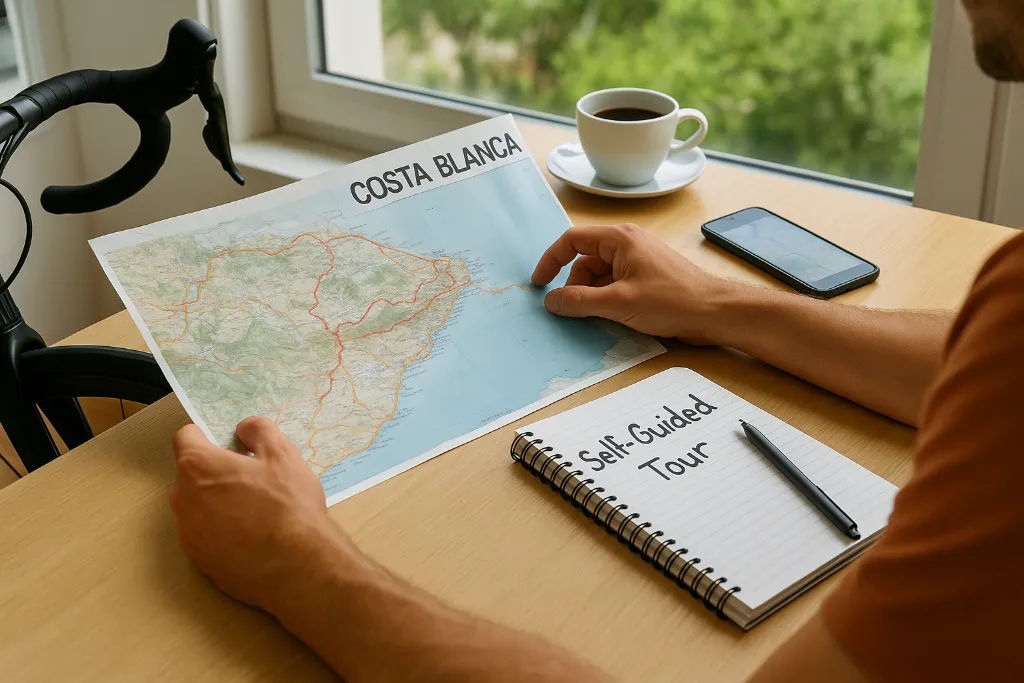
Planning a self-guided cycling tour of the Costa Blanca comes down to five decisions: which routes to ride, what time of year, how you’ll navigate, where you’ll base yourself, and how much support you want to pay for versus arrange yourself. None of it is complicated on its own. The region has well-marked major routes, widely available bike rental, and a long enough season that timing mistakes are rarely costly. This guide walks through each decision in order.
Choosing Your Routes
Start with the essential climbs and routes on our main self-guided tours guide, which covers Coll de Rates, Port de Confrides, Alto de Aitana and the rest in detail, plus our full Coll de Rates guide if that’s your main target climb.
A few other routes worth knowing about when you’re planning a mix of days:
- Xorret de Catí has two very different approaches, worth knowing before you pick one. From Castalla it’s a short, brutal 3.8 km at an average 11.6% gradient, with the steepest section averaging close to 19-20%. From Petrer it’s a longer, gentler 13.2 km at 5.3% average, topping out around 13.8% on its hardest ramp. Pro teams have used both for training; pick Castalla if you want a short leg-breaker, Petrer if you’d rather grind it out over distance.
- Sierra Mariola, up to the hilltop village of Banyeres de Mariola, runs through lavender fields and pine forest rather than the coastal terrain most first-time visitors expect. It’s a genuinely different character of ride from the Coll de Rates side of the region, worth including if you’re staying more than a few days.
- Alicante to Valencia, ridden in stages of 40-60 km a day, is the option if you want to cover ground and see more towns rather than repeat loops from one base.
Mix mountain days with flatter coastal or valley days. Costa Blanca’s terrain reads as deceptive on paper: a 60 km day on the map can take much longer than a flat 60 km once you add the climbing and heat, so plan distances around elevation gain, not just kilometres.
Picking Your Season
The practical riding season runs February to November, and the shoulder months either side of summer are generally considered the best combination of weather and quiet roads. Alicante-Elche Airport, the closest official weather station, averages 2,953 hours of sunshine a year, according to AEMET’s official 1981-2010 climate normal, among the highest totals in mainland Europe.
Winter (December-February) has cool mornings and mild afternoons, quiet roads, and is when professional teams often train here. Spring (March-May) brings wildflowers and almond blossom (February especially) alongside comfortable temperatures. Summer (June-September) gets genuinely hot, regularly into the low 30s°C by midday, so plan to start by 7am and treat the afternoon as recovery time rather than riding time. Autumn (September-November) mirrors spring, with warmer sea temperatures.
Accommodation prices follow the same pattern as everywhere in southern Europe: shoulder-season (spring, autumn) tends to offer the best combination of good weather and lower rates than peak summer.
Sorting Navigation
Free GPX routes are available from local cycling groups and bike shops, and apps like Komoot, Strava and RideWithGPS offer pre-made routes with turn-by-turn directions. Download routes before you set off. Mobile coverage is generally solid along the coast but genuinely patchy in the mountains, so relying on a live connection for navigation is a real risk on remote sections, not just a theoretical one. A physical backup map or a written cue sheet costs nothing and covers you if a device fails.
Choosing Where to Stay
You have two basic strategies: base yourself in one town and do day rides, or move between towns and use a luggage transfer service.
One base, day rides is the simpler logistics. Calpe, Denia and Altea are the most popular choices, all offering reasonable access to both coastal and mountain routes without needing a car. Our accommodation directory lists cyclist-friendly options; look for secure bike storage, early breakfast times, and laundry facilities if you’re touring for more than a few days.
Multiple bases, moving each day gives more variety but adds planning overhead. Luggage transfer services, including local operators like Caffee Cadanz, move your bags between hotels so you can ride with just the day’s essentials. If you’re booking a package through an operator such as Sierra Sports & Tours, transfers are usually included.
Either way, build a rest day or two into the itinerary that can move if the weather doesn’t cooperate. Flexibility is one of the real advantages of planning your own trip rather than following a fixed guided schedule.
Preparing Physically and Packing
Costa Blanca’s climbing rewards some hill training before you arrive. Reasonable fitness benchmarks: comfortable with 50 km on flat terrain for coastal routes, able to sustain a steady effort uphill for 30-45 minutes for the mountain routes, and roughly 2,000 m of weekly elevation gain in training if you’re aiming for mixed terrain across a full week.
For gear: a compact chainset (50/34) with a cassette of at least 32T handles the steeper gradients comfortably if you’re bringing your own bike or specifying a rental. Pack layers regardless of season, since mountain descents run noticeably cooler than the coast even in summer. Sun protection matters more than most visitors expect: bring high-factor sunscreen and good sunglasses, and carry at least two water bottles, since some mountain sections go 30 km between villages with a reliable refill point.
Spanish meal times run later than many visitors are used to: lunch from around 2-4pm, dinner rarely starting before 8:30pm. That doesn’t always line up neatly with a riding schedule, so carrying emergency snacks and using local bakeries for morning pastries covers the gap.
Deciding How Much Support You Want
Self-guided doesn’t have to mean entirely on your own. Three broad options:
Fully independent: you plan routes, book accommodation and rental bikes yourself, and handle logistics as you go. Cheapest, most flexible, most time to arrange.
À la carte support: you handle the core planning but pay for specific services, most commonly bike rental with delivery to your accommodation, a luggage transfer service between bases, or hiring a local guide for a specific challenging day.
A supported self-guided package: an operator plans the route, books accommodation, arranges transfers and provides an emergency contact number, while you still ride independently on your own schedule. Sierra Sports & Tours and Cycle Fiesta both run this kind of package for around €1,270-1,400 per person for a week; see our self-guided tours guide for a fuller price comparison.
Budgeting for a Week
As a rough planning guide for a mid-range week, excluding flights: accommodation runs roughly €50-100 a night, bike rental €150-300 for the week, food €30-50 a day, and luggage transfers (if you’re using them) around €15-20 per move. That puts a typical mid-range trip at roughly €1,000-1,500 per person. Budget self-catering options can bring that down toward €700-900; a fully supported package with premium accommodation can run past €2,000. Treat these as planning estimates rather than current quotes, since prices shift with the season and the specific operators you book.
Frequently Asked Questions
How difficult is Costa Blanca cycling for an intermediate rider? There’s a route for most ability levels. Coastal riding is generally moderate rolling terrain; the well-known mountain climbs like Coll de Rates are genuinely challenging but not extreme (around 5-6% average gradient). If you’re comfortable with 50-60 km and 500-800 m of climbing at home, you’ll find plenty here to enjoy without needing to push into the hardest routes.
What’s the best base for a first-time visit? Calpe, for its central location and access to both coastal and mountain routes, plus the widest choice of cyclist-friendly accommodation and bike shops. Denia and Altea are strong alternatives with their own character. Inland towns like Jalón are quieter but mean more climbing just to get started each day.
Do I need to speak Spanish? No. English is widely spoken in tourist areas and by cycling-focused businesses. A few basic phrases help in smaller inland villages, but you can plan and ride a self-guided tour without them.
What bike should I bring or rent? A road bike suits almost every route described here, since the vast majority of riding is on paved roads. If your plans include gravel paths or rougher mountain trails, a gravel bike or hardtail is the better call. For rentals, ask for a compact chainset and at least a 32T cassette if you’re tackling the steeper climbs.
How much should I budget for a week? See the Budgeting section above: roughly €1,000-1,500 per person mid-range, excluding flights, with budget and premium options on either side of that.
When’s the rainy season? October through December sees the most rainfall, though even then it tends to come in short, intense bursts rather than prolonged wet spells. Summer (June-September) is reliably dry.
Can I combine cycling with other activities? Yes. Most self-guided visitors plan 4-5 riding days within a week-long trip, leaving room for beach time, hiking, or exploring towns like Guadalest or Altea’s old town on rest days.
Next Steps
Once your route and season are settled, read our safety tips for touring alone if you’re riding solo, and check Spain’s 2026 cycling rules before you go, since several requirements (helmet use, overtaking distances) changed this year. For the full route and cost breakdown, see our main self-guided cycling tours guide.
Research sources: Climate figures from AEMET’s official climate normals for Alicante-Elche Airport, 1981-2010. Xorret de Catí climb data from climbfinder.com (Castalla and Petrer approaches). Tour operator pricing checked against Sierra Sports & Tours and Cycle Fiesta directly, September 2026.