
Coll de Rates: The Complete Cyclist’s Guide to Costa Blanca’s Most Famous Climb
If you’ve spent any time on a road bike in the Marina Alta, you’ve heard people talk about Coll de Rates. It’s the pass between Parcent and Tàrbena that WorldTour teams use for winter training, the climb with a Strava leaderboard stacked with pro names, and, for a lot of visiting cyclists, the whole reason they picked Costa Blanca over anywhere else in Spain. It’s not the longest or the steepest climb in the region, but it’s become the one everyone rides at least once.
This guide covers everything you need to know before you go: the numbers, both sides of the climb, the Strava record chase that’s put it on the map, when to expect company from the pros, and how to be a good guest on their training roads.
Key Takeaways
| Aspect | Details |
|---|---|
| Location | Between Parcent and Tàrbena, Marina Alta, Alicante province (road CV-715) |
| Category | UCI Category 2 climb |
| Distance | 6.43 km (official Strava segment, from the edge of Parcent) |
| Average Gradient | 5.5%, unusually consistent for a Spanish climb |
| Elevation Gain | 275 m, topping out at 896 m |
| Extended Option | An optional, much steeper spur beyond the col, locally nicknamed “Super Rates” |
| Other Side | Coll de Tàrbena, 5.5 km, more exposed to wind, quieter |
| Best Season | November to February for pro-spotting; rideable year-round |
| Nearest Bases | Calpe, Benidorm, Altea, or the Jalón Valley |
Why Every Cyclist on the Costa Blanca Talks About This Climb
Coll de Rates isn’t a secret anymore. WorldTour squads including Tudor Pro Cycling, Soudal-QuickStep, Picnic PostNL, and Visma-Lease a Bike now build it into their winter training camps around Calpe, continuing a tradition that goes back more than a decade to when Astana and QuickStep first started basing riders here. Several Belgian and Dutch pros, including Remco Evenepoel and Mathieu van der Poel, own homes on the Costa Blanca and use the climb as a regular fixture during their winter blocks.
Part of the appeal is simply geography. It’s the closest proper climb to Calpe, with a gradient steady enough for structured training efforts and few enough corners to ride hard without constantly braking. As Tudor Pro Cycling’s Larry Warbasse told Cyclingnews earlier this year, “it’s become sort of ‘the’ climb in the area.” That reputation now pulls in amateur riders from across Europe hoping to ride the same tarmac, at the same time of year, as their favourite pros.
The Climb, Step by Step
Starting Out From Parcent
The official Strava segment begins just outside Parcent, right after a left turn at the edge of the village. Look for road signs marking it as a “Ruta Ciclista” and asking drivers to leave 1.5 metres when overtaking, a rule that’s now written into Spain’s 2026 cycling laws. If you want a coffee before you start, Musette Café near Parcent is worth the stop. Remco Evenepoel and Mathieu van der Poel have both been spotted there before a ride.
The Climb Itself
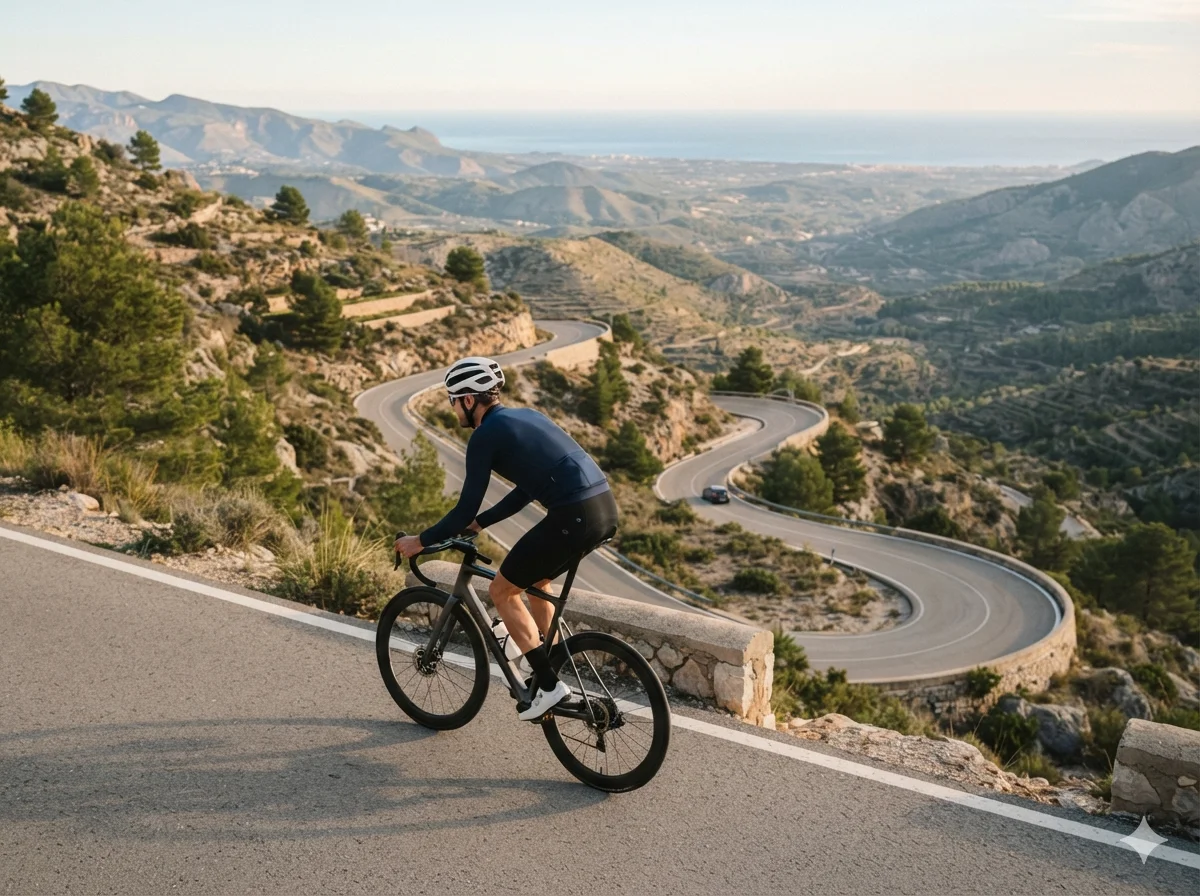
From the start, the road climbs gently through a few early hairpins under pine trees before settling into a long, near-straight stretch that hugs the hillside for close to two kilometres. This is the best part of the ride for scenery: on a clear day you can see the Mediterranean roughly 35 km away, and the hillside also shields you from any wind coming off the south. One final hairpin brings you up to the pass itself, marked by a gradient sign and a weathered “Coll de Rates” marker plastered in stickers from riders who’ve made it to the top.
At the col, a side road leads right to a restaurant with what might be the best lunch-stop view on the Costa Blanca. If you’re happy to stop there, that’s the classic ride done. If you want more, keep reading.
Surface, Traffic, and Water
Road surface is generally good tarmac the whole way up, with only occasional rough patches; most riders rate it as one of the better-maintained climbs in the area. Traffic is light. This is a quiet valley road rather than a through-route, though you should still expect the occasional car, especially near Parcent. There’s no reliable water stop between the start and the col itself, so fill your bottles before you leave. The restaurant at the top sells drinks if you need a refill for the descent.
Should You Ride to “Super Rates”?
Past the restaurant, a narrow lane continues to the true summit of the hill, an optional extension that local riders have nicknamed “Super Rates.” It’s short, but it’s brutal: a mix of broken tarmac and gravel with sustained double-digit gradients, dead-ending at a lookout point with nothing but a fire-watch post and, by most accounts, the best view of the whole ride. Because it’s a dead end, you’ll need to descend the same steep, loose surface you just climbed, so it’s really only worth it if you’re comfortable on a bike with wider tyres and don’t mind walking the odd section. Even a handful of pros, including Van der Poel and Thibau Nys, have ridden up out of curiosity rather than for training value.
If you skip it, don’t feel bad. The main climb to the col is the one that matters for Strava bragging rights, and it’s the one nearly everyone actually rides.
The Strava Battle: How Fast Is Fast?
Coll de Rates has one of the most closely watched Strava segments in professional cycling, and the record has changed hands several times over the years:
| Year | Rider | Time |
|---|---|---|
| 2018 | Jonas Vingegaard (then a Continental-level rider) | 13:02 |
| Early 2024 | Peter Øxenberg (now Ineos) | 12:38 |
| December 2024 | Tadej Pogačar (UAE Team Emirates-XRG) | 12:21 |
| December 2025 | Tadej Pogačar | 11:57, at an average speed of 32.3 km/h |
Puck Pieterse holds the women’s record at 14:45. The climb has even attracted its share of drama. A Strava account impersonating Vingegaard briefly appeared to beat Pogačar’s time this past winter before it turned out to be an obvious fake, almost certainly set from a motorbike or car rather than a bike.
For the rest of us, realistic targets look a little different. At a steady 15 km/h you’ll be at the top in around 38 minutes; push to 19 km/h and it’s closer to 30 minutes. Riding it comfortably at 11 km/h, a perfectly respectable pace for a first attempt, takes around 52 minutes. Nobody expects you to chase Pogačar’s time, and nobody will judge you for not trying.
Parcent or Tàrbena: Which Side Should You Climb?
The Parcent side is the classic, and the one described above: 6.43 km, a consistent 5.5%, sheltered from southerly wind, and the side almost every pro rides for training.
The other option is the Coll de Tàrbena, approached from the south and popular with riders based around Benidorm. It’s shorter at 5.5 km but more exposed, which makes it windier and slightly less predictable for structured efforts. That’s one reason it sees less pro traffic than the Parcent side, even though the views are just as good.
Strong riders often combine both: climb one side, descend the other, and loop back through the Jalón Valley. If that appeals, our Jalón Valley Scenic Loop route connects neatly with the Parcent approach and makes a satisfying half-day ride out of it.
Coll de Rates isn’t the only serious climb inland from the coast. Alto de Aitana, which featured as a Vuelta a España summit finish, is a longer and considerably harder option if you’re looking for a second target during the same trip.
Best Time to Ride (and When You’ll See the Pros)
Coll de Rates is rideable all year thanks to the Costa Blanca’s mild climate, but the timing changes what kind of ride you’ll get.
November through February is winter training camp season, when most WorldTour teams are based on the coast. If you want a chance of riding alongside professionals, aim for a mid-morning slot, say 10:30am to 1pm, when teams typically head out for their longer training rides. Just be aware this is also when the climb is busiest with amateur riders hoping for the same thing.
Spring and autumn offer near-identical weather with far fewer people on the road, which makes them the better choice if you’d rather ride the climb than watch other people ride it. Summer is manageable too, but with midday temperatures regularly above 30°C, an early start is worth planning around.
Etiquette: Sharing the Road With the Pros
Riding alongside professional cyclists is part of what makes Coll de Rates special, but it comes with some responsibility. Pro riders are on the coast to train, not to perform for an audience. Getting too close, tailing them for photos or video in particular, is more than just bad manners. Earlier this year, a high-profile rider was involved in a crash after being followed too closely by an amateur rider trying to film him, prompting his team to publicly ask fans for more space.
A few simple rules go a long way: keep a respectful distance, don’t draft off riders you don’t know, and remember that the same 1.5-metre passing rule that applies to cars applies to how you overtake other cyclists too. If you happen to end up next to a WorldTour rider at a junction, a nod or a hello is plenty. There’s no need to make it a moment.
Getting There and Where to Base Yourself
Parcent sits inland from the coast, roughly a 25–35 km ride from Calpe, Altea, or Benidorm depending on your route in, which makes any of the three a practical base for a Coll de Rates trip. Calpe is the most popular choice, partly because it’s the closest of the three and partly because it’s where most of the WorldTour teams themselves stay during winter camps.
If you’re travelling without your own bike, our guides to bike hire in Calpe, bike hire in Benidorm, and bike hire in Altea cover your options. Prices vary by bike type and season, with carbon road bikes costing more per day than hybrids and top-spec race bikes more again, so it’s worth comparing a couple of shops before you commit. Ask specifically for a bike set up with proper climbing gears.
If you’d rather have the whole route planned for you, our self-guided cycling tours guide is a good place to start. And if you’re staying more than a couple of nights, our roundups of cycling accommodation in Calpe and cyclist-friendly hotels in Calpe cover places set up for bike storage and early breakfasts. Both are useful if you’re planning a Coll de Rates attempt before the day heats up.
Gearing and Fitness: What You’ll Need
At a steady 5.5%, Coll de Rates doesn’t demand elite fitness. A reasonably active cyclist can complete it without drama. That said, a compact chainset (50/34) paired with a wide-range cassette (11-30 or 11-32) will make the climb far more comfortable, especially if you’re not used to sustained gradients. If you’re planning to tackle “Super Rates” too, treat it as a separate, much harder effort and budget extra recovery time before the descent.
If you’re riding a rental or a bike that’s flown out with you, it’s worth getting gears and brakes checked before you tackle a climb like this. Bike shops in Calpe can turn around a quick service the same day.
Frequently Asked Questions
How long is the Coll de Rates climb? The official Strava segment from Parcent is 6.43 km, with an average gradient of 5.5% and 275 m of elevation gain to the 896 m summit.
How hard is Coll de Rates for a beginner? It’s approachable for a reasonably fit rider. The gradient is steady rather than steep. If you’re newer to climbing, it’s a good introduction; just don’t feel obliged to add the “Super Rates” extension.
Who holds the Strava record on Coll de Rates? Tadej Pogačar set the current men’s record of 11:57 in December 2025. Puck Pieterse holds the women’s record at 14:45.
Which side should I ride, Parcent or Tàrbena? Parcent is the classic, sheltered side and the one most pros use. Tàrbena is shorter but windier and quieter, which some riders prefer.
When are professional cycling teams training on Coll de Rates? Mostly November through February, with late morning (roughly 10:30am–1pm) being the best window to spot them.
Can I ride Coll de Rates on a rental bike? Yes. Just make sure whichever bike hire shop you use sets you up with climbing gears rather than a flat-road setup.
Is there anywhere to eat near the top? Yes, there’s a restaurant right at the col with panoramic views, making it a popular stop even for non-cyclists.
Where exactly does the climb start? On the CV-715, just outside Parcent village in the Jalón (Xaló) Valley, Alicante province.
Research sources: Cyclingnews, “Why the Coll de Rates is the hottest climb in the cycling world right now” (Stephen Farrand, 27 Jan 2026); Climbfinder — Coll de Rates / Tossal dels Diners.