
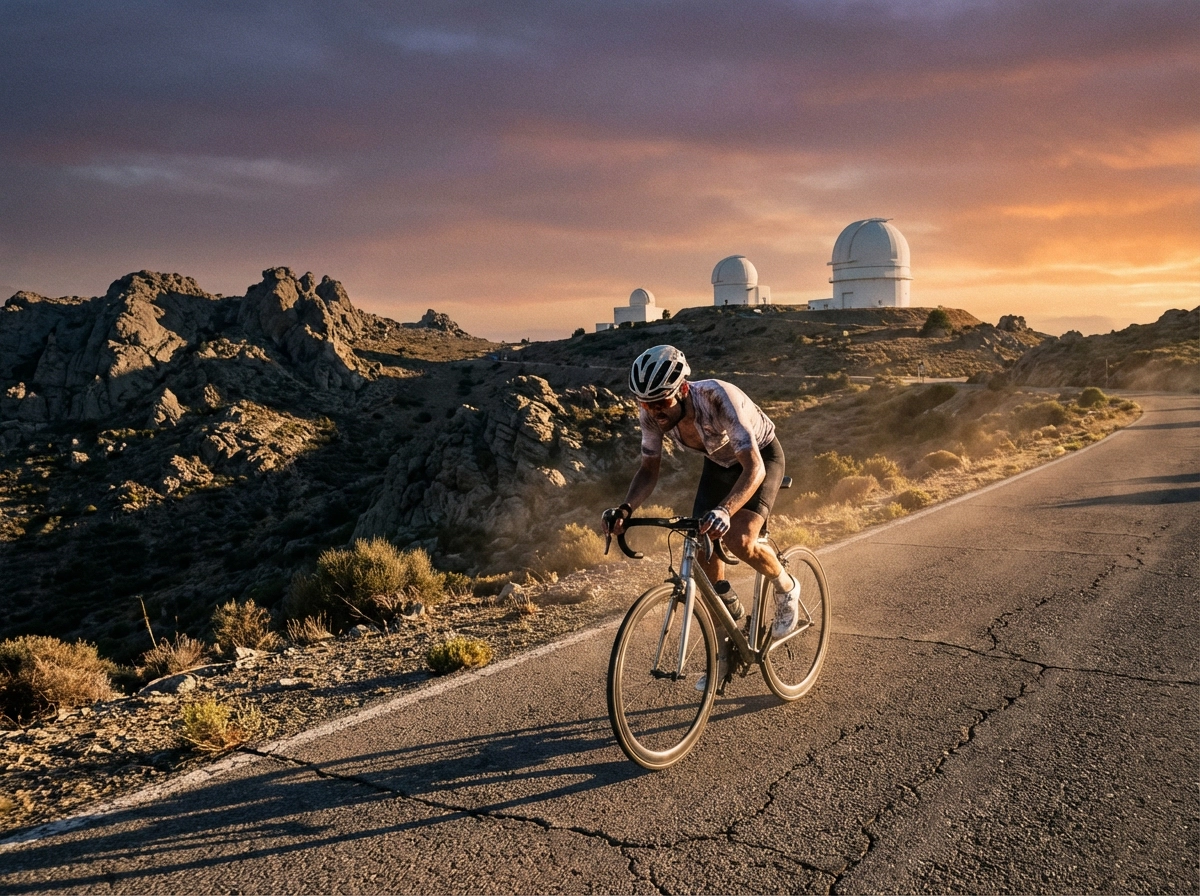
The Five Most Brutal Mountain Finishes of the 2026 Vuelta a España: Calar Alto (Stage 12)
1. Stage 12: Calar Alto – The Race-Defining High-Altitude Battle
The First Major Selection Point
What makes Stage 12 so special compared to other mountain stages? The answer lies in its perfect storm of factors that create the ideal race-splitting scenario.
Stage 12 presents riders with a journey from Vera’s semi-desert landscape – the same terrain where Clint Eastwood filmed those famous spaghetti westerns – to the astronomical observatory at Calar Alto. This isn’t just any mountain stage. It’s the first major high-altitude showdown of the 2026 Vuelta, arriving when riders are fresh enough to launch decisive attacks but experienced enough to understand the race’s rhythm.
The stage covers 166.5 kilometers with a staggering 4,460 vertical meters of climbing. But what really makes this stage brutal isn’t just the numbers – it’s how those climbs are arranged. Riders face five categorized climbs throughout the day, starting with Puerto Los Barrancos and building through Alto Cóbdar and Collado Garcia before the real business begins.
The final 31 kilometers deliver the knockout punch. First comes Alto de Velefique, a Category 1 climb stretching 13.2km at 7.3% average gradient. Just when riders think they can recover, they plummet down into a valley only to immediately start climbing again toward Calar Alto. This dual climb finale is what separates the pretenders from the contenders.
Historical Precedent: López’s Masterclass
Miguel Ángel López showed exactly what Calar Alto can do to a race in 2017. The Colombian didn’t just win the stage – he obliterated a group containing Chris Froome, Vincenzo Nibali, and Wilco Kelderman. These weren’t just any riders; they were Grand Tour winners with multiple podiums between them.
López’s attack demonstrates Calar Alto’s race-splitting capacity. It’s not merely a climb where the strongest rider wins by a few seconds. It’s a weapon that can create decisive time gaps and reshape the entire general classification in a single afternoon.
The Participants Of Vuelta A Espana 2025 showed similar attacking patterns, but 2026’s route positioning makes Calar Alto even more dangerous.
The Altitude Factor
Finishing at over 2,100 meters elevation, Calar Alto introduces oxygen deprivation into the equation. Professional cyclists are accustomed to suffering, but suffering while your body struggles to process oxygen creates a different kind of pain entirely.
The astronomical observatory at the summit isn’t just there for show – it’s positioned at that altitude because the thin air provides clearer views of space. For cyclists, that same thin air provides clearer views of who truly has what it takes to win the Vuelta.
Eastern Andalusia’s semi-desert climate adds another layer of complexity. September temperatures can still reach uncomfortable levels, especially during the day’s early climbs. Dehydration becomes as much of a tactical consideration as power output and pacing strategy.
2. Stage 20: The Queen Stage That Could Decide Everything
A Monstrous Test in Week Three
Stage 20 arrives when riders’ legs are already screaming from two and a half weeks of racing. This timing isn’t accidental – it’s deliberately positioned as the final major selection stage before the Madrid finale.
The numbers tell a story of pure brutality: 187-206.7 kilometers with over 5,000 vertical meters of climbing. Five categorized climbs dot the route, including three Category 1 ascents and a particularly nasty double ascent of Alto de Hazallanas. By the time riders reach the base of Collado del Alguacil, they’re already operating on empty.
What makes Collado del Alguacil truly special? The final climb stretches 16.7 kilometers at 6.7% average gradient, but those numbers don’t tell the whole story. The second half features “almost continuous double-digit gradients” – sustained sections where the road kicks up above 10% and simply doesn’t relent.
The Accumulated Fatigue Factor
Unlike Stage 12, which comes when riders still have relatively fresh legs, Stage 20 arrives as the penultimate stage. Every pedal stroke carries the weight of nearly three weeks of racing. Recovery becomes impossible, and the strongest climbers separate themselves through pure willpower and superior conditioning.
This stage is explicitly designed to “decide the general classification.” While Stage 12 might create the first major gaps, Stage 20 is where those gaps either get cemented or dramatically overturned.
The strategic positioning creates fascinating dynamics. Do GC contenders go conservative and try to limit losses? Or do they recognize this as their final opportunity to gain time and throw everything into one last desperate attack?
For cycling enthusiasts following the race from Costa Blanca, this stage represents the culmination of everything that makes the Vuelta A Espana 2026 Official Stage Calendar so compelling.
Tactical Complexity in the Final Week
Team dynamics shift dramatically by Stage 20. Domestiques who might have been willing to sacrifice themselves in week one are now fighting their own battles just to reach Madrid. The usual support structures begin breaking down, leaving GC contenders increasingly isolated.
This isolation makes Collado del Alguacil even more dangerous. Without teammates to control pace or chase down attacks, riders must rely entirely on their individual capabilities. The sustained double-digit gradients become a pure test of who trained hardest during the winter months.
3. The Supporting Cast: Stages 7, 9, and 14
Stage 7: Aramón Valdelinares – The Unknown Factor
Stage 7 introduces something particularly dangerous: unfamiliarity. As a new uphill finish, teams lack the detailed reconnaissance data they typically rely on for tactical planning.
The final 50 kilometers trend mostly uphill, with the last 8 kilometers averaging 6.6% gradient. While these numbers might seem modest compared to Calar Alto or Collado del Alguacil, arriving in week one means riders are still finding their racing legs.
Early-stage positioning can be deceptive. Gaps that seem small in week one often prove decisive when accumulated across three weeks of racing. A 30-second loss on Valdelinares might not seem significant, but combined with similar small losses throughout the race, it can mean the difference between a podium finish and fifth place overall.
Stage 9: Alto de Aitana – The Stepping Stone
Alto de Aitana serves as the crucial preparation for what’s coming on Stage 12. Positioned strategically before the Calar Alto showdown, it allows teams to test their legs and tactics without the extreme altitude factor.
This stage functions as a barometer. Riders who struggle on Aitana know they’re in for a difficult time on Calar Alto. Conversely, those who feel strong can start planning their attacks for the higher mountains ahead.
Stage 14: Alto de La Pandera – The Breakaway Opportunity
Alto de La Pandera offers something the other brutal finishes don’t: genuine breakaway potential. At 8.4 kilometers with 7.8% average gradient and sections reaching 12%, it’s steep enough to create selection but short enough for a well-timed attack to succeed.
Richard Carapaz proved this four editions ago, winning from a breakaway. The precedent suggests teams will view this stage differently from the pure GC battles of Stages 12 and 20.
For riders sitting just outside GC contention, La Pandera represents an opportunity to gain stage victory while the overall contenders mark each other. This dynamic can create surprising race situations and tactical complexity that benefits the strongest attackers.
Local cycling enthusiasts can appreciate these tactical nuances by exploring the Benidorm To Guadalest Scenic Ride, which offers similar climbing challenges on a smaller scale.
4. The Andalusian Heat Factor: Hidden Challenges
Semi-Desert Conditions and Dehydration Risk
Eastern Andalusia in September presents unique challenges that extend beyond pure climbing ability. The semi-desert landscape around Vera creates conditions that can catch unprepared riders off-guard.
Temperature management becomes crucial during the early climbs of Stage 12. While mornings might start comfortably, the combination of direct sunlight and sustained effort can push core body temperatures to dangerous levels. Professional teams spend considerable resources on cooling strategies, but individual riders still need to make smart tactical decisions about when to push hard and when to conserve energy.
The terrain itself contributes to the challenge. Unlike Alpine climbs with their tree-covered slopes and mountain streams, Andalusian climbs often feature exposed roads with limited natural cooling opportunities. Wind patterns can either provide relief or create additional stress depending on direction and strength.
Electrolyte Strategy as Tactical Weapon
What many cycling fans don’t realize is how dramatically heat affects electrolyte balance, and how electrolyte imbalance affects climbing performance. Riders who nail their hydration and electrolyte replacement strategy gain significant advantages over those who don’t.
Teams employ dedicated nutritionists who calculate precise intake requirements based on weather forecasts, individual sweat rates, and expected effort levels. These calculations can make the difference between a strong finish and a dramatic fade in the final kilometers.
The Self Guided Cycling Tours In Costa Blanca Safety Tips When Touring Alone provides excellent guidance for recreational cyclists facing similar heat challenges.
5. Comparative Analysis: Which Stage Will Decide the Race?
The Early Strike vs. Late Drama Debate
Professional cycling observers love debating whether early mountain stages or late mountain stages prove more decisive for overall GC. The 2026 Vuelta provides a perfect case study with its contrasting Stage 12 and Stage 20 approaches.
Stage 12’s advantage lies in timing. Riders arrive with relatively fresh legs but enough race experience to understand tactical positioning. The dual climb structure (Velefique + Calar Alto) forces early moves while providing enough distance for counterattacks. Historical precedent shows Calar Alto can create significant time gaps when riders are strong enough to exploit them.
Stage 20 counters with accumulated fatigue and desperation. By the penultimate stage, riders know exactly where they stand in GC. Those behind must attack or accept defeat, while those ahead face the psychological pressure of defending their positions when their bodies are least capable of responding to sudden accelerations.
The Data-Driven Comparison
| Stage | Total Distance | Elevation Gain | Final Climb | Timing Advantage | Tactical Complexity |
|---|---|---|---|---|---|
| 12 | 166.5km | 4,460m | 15.5km @ 6% | Fresh legs | Dual climb finale |
| 20 | 187-206.7km | 5,000m+ | 16.7km @ 6.7% | Final opportunity | Accumulated fatigue |
| 14 | Unknown | Unknown | 8.4km @ 7.8% | Breakaway potential | Mid-race positioning |
| 7 | Unknown | Unknown | 8km @ 6.6% | Unfamiliar finish | Early race dynamics |
| 9 | Unknown | Unknown | Unknown | Preparation stage | Testing ground |
Historical Patterns and Predictions
Analyzing previous Vuelta editions reveals interesting patterns. Races decided by early mountain stages tend to favor pure climbers with explosive attacking ability. Races decided by late mountain stages often favor riders with superior recovery capabilities and tactical patience.
The 2026 route design suggests race organizers want both scenarios to remain viable. This creates unprecedented strategic complexity where teams must prepare for multiple potential race-winning scenarios simultaneously.
6. Training Implications: How Teams Prepare for Altitude and Heat
Altitude Training Camp Strategies
The combination of high-altitude finishes and heat stress forces teams to make difficult training camp decisions. Traditional altitude camps focus on oxygen adaptation, but preparing for Andalusian heat requires different protocols entirely.
Smart teams split their preparation phases. Early season altitude camps in locations like Mount Teide in Tenerife or Sierra Nevada build the physiological adaptations necessary for oxygen-deprived climbing. Later camps in hot, dry locations simulate the specific stress of climbing in semi-desert conditions.
Some teams experiment with heat chambers and controlled environment training to replicate race-day conditions. While these methods can’t perfectly simulate outdoor climbing, they help riders understand their individual responses to combined heat and altitude stress.
Individual Rider Adaptations
Not all climbers respond equally to altitude and heat challenges. Teams conduct extensive testing to identify which riders maintain power output best under these conditions, and tactical plans get adjusted accordingly.
Riders with naturally higher red blood cell counts often perform better at altitude but may struggle more with heat dissipation. Conversely, riders with superior thermoregulation might excel in hot conditions but fade when oxygen becomes limited.
These individual differences explain why some riders who appear evenly matched at sea level can show dramatic performance gaps at high altitude. Team selection and tactical roles get determined partly by these physiological factors.
For cycling enthusiasts wanting to understand these challenges personally, the Mountain Biking Trails In Costa Blanca Puig Campana Mountain Trail offers excellent altitude training opportunities.
7. Tactical Evolution: How Modern Racing Changes These Climbs
Technology and Data-Driven Decisions
Modern professional cycling bears little resemblance to the sport even a decade ago. Power meters, real-time coaching communication, and sophisticated pacing strategies transform how riders approach brutal climbs like those in the 2026 Vuelta.
Teams now know precisely how much power each rider can sustain for specific durations under various conditions. This data allows for extremely precise tactical execution. Instead of relying on intuition about when to attack, riders receive specific wattage targets for different sections of each climb.
The Calar Alto stage becomes particularly interesting from this perspective. Teams can analyze the dual climb structure to identify optimal attack points on Velefique that maximize damage on the final ascent. Similarly, the sustained double-digit gradients on Collado del Alguacil allow for calculated pacing strategies that weren’t possible in earlier eras.
Communication and Team Coordination
Race radio communication allows for tactical adjustments impossible in cycling’s earlier generations. Directors can monitor weather conditions, track competitor’s power data (through publicly available tracking), and adjust strategies in real-time.
This technological advancement makes climbs like Stage 20’s Collado del Alguacil even more tactical. Teams can calculate exactly when to pull domestiques back, when to increase pace to drop specific riders, and how to manage efforts across the day’s five categorized climbs.
The Arms Race of Marginal Gains
Equipment choices become increasingly important on extreme mountain stages. Lightweight climbing wheels, optimized gearing ratios, and even clothing selections can provide meaningful advantages when margins of victory are measured in seconds rather than minutes.
Teams spend enormous resources optimizing every possible detail. Tire pressure calculations for specific road surfaces, aerodynamic clothing for sustained climbs, and cooling vest pre-loading all contribute to performance differences that can determine race outcomes.
The Introducing The Vuelta A Espana Race Around Spain provides additional context about how technology continues reshaping professional cycling tactics.
8. The Viewer’s Perspective: What Makes These Stages Special
Drama and Unpredictability
What separates truly memorable mountain stages from routine climbing stages? The answer lies in their capacity to create genuine drama and unpredictable outcomes.
The 2026 Vuelta’s five brutal finishes each offer different types of excitement. Stage 12’s dual climb structure creates multiple opportunity windows for attacks and counterattacks. The high altitude finish means riders who crack don’t fade gradually – they explode dramatically, creating visually spectacular racing.
Stage 20’s positioning as the penultimate stage adds desperate urgency to every tactical decision. Riders know this represents their final opportunity to influence the overall classification, leading to all-or-nothing attacking that produces the sport’s most memorable moments.
Geographic and Cultural Context
The route’s journey through Andalusian semi-desert to high-altitude observatories tells a story about Spain’s geographic diversity that resonates beyond cycling. International viewers get exposed to landscapes and cultures they might never otherwise experience.
Local cycling communities throughout Costa Blanca can relate to these challenges through their own riding experiences. The Jalon Valley Scenic Loop and Sierra Helada Natural Park Trail offer similar terrain variety and climbing challenges on a more accessible scale.
The Human Element
Professional cyclists are incredible athletes, but extreme mountain stages reveal their humanity in ways that flat stages or time trials cannot. Watching riders suffer through the final kilometers of Calar Alto or Collado del Alguacil creates emotional connections between viewers and competitors that transcend sport.
The combination of physical suffering and tactical complexity creates compelling television. Viewers can simultaneously appreciate the incredible athletic performance while understanding the tactical decisions that separate winners from losers.
These stages also provide opportunities for breakthrough performances from unexpected riders. The extreme nature of the climbs can neutralize some advantages that favored riders possess, allowing underdogs to compete on more equal terms.
Frequently Asked Questions
Q: Which stage is likely to be the most decisive for the overall classification?
A: Stage 12 (Calar Alto) and Stage 20 (Collado del Alguacil) both have race-winning potential, but for different reasons. Calar Alto comes when riders are fresher and can create larger time gaps, while Collado del Alguacil arrives as the final opportunity to make decisive moves. Historical patterns suggest the stage that produces the largest time gaps will ultimately determine the winner.
Q: How does altitude affect professional cyclists differently than recreational riders?
A: Professional cyclists typically have higher baseline fitness levels that help them maintain performance at altitude, but they’re also pushing much higher power outputs where oxygen limitation becomes more critical. The key difference is that pros must maintain racing pace while dealing with altitude, whereas recreational riders can adjust their effort levels as needed.
Q: What makes the dual climb structure of Stage 12 particularly challenging?
A: The psychological factor is huge – riders suffer through Velefique thinking they’re approaching the finish, only to discover they must immediately start climbing again. Tactically, it prevents riders from emptying themselves on the first climb since they know another challenge awaits. This structure favors riders with superior tactical patience and physical resilience.
Q: How do teams prepare differently for heat versus altitude challenges?
A: Altitude preparation focuses on increasing red blood cell count and improving oxygen utilization efficiency through high-altitude training camps. Heat preparation emphasizes thermoregulation, hydration strategies, and acclimatization protocols. The 2026 Vuelta’s combination of both factors requires split preparation phases that address each challenge separately.
Q: Can breakaway groups succeed on these brutal mountain finishes?
A: Stage 14 (Alto de La Pandera) offers the best breakaway opportunity due to its shorter climb and mid-race positioning. Stages 12 and 20 are likely to be controlled by GC teams due to their decisive importance. However, if GC contenders mark each other closely, a strong breakaway rider could potentially succeed through tactical patience and superior climbing ability.
Q: What role does weather play in determining stage outcomes?
A: Weather becomes crucial, especially on Stage 12 with its Andalusian heat exposure. Tailwinds on climbs can reduce natural cooling, while headwinds can provide relief but make climbing more difficult. Rain could dramatically change tactics by affecting descending speeds and creating different attack opportunities. Teams monitor weather forecasts closely and adjust strategies accordingly.