
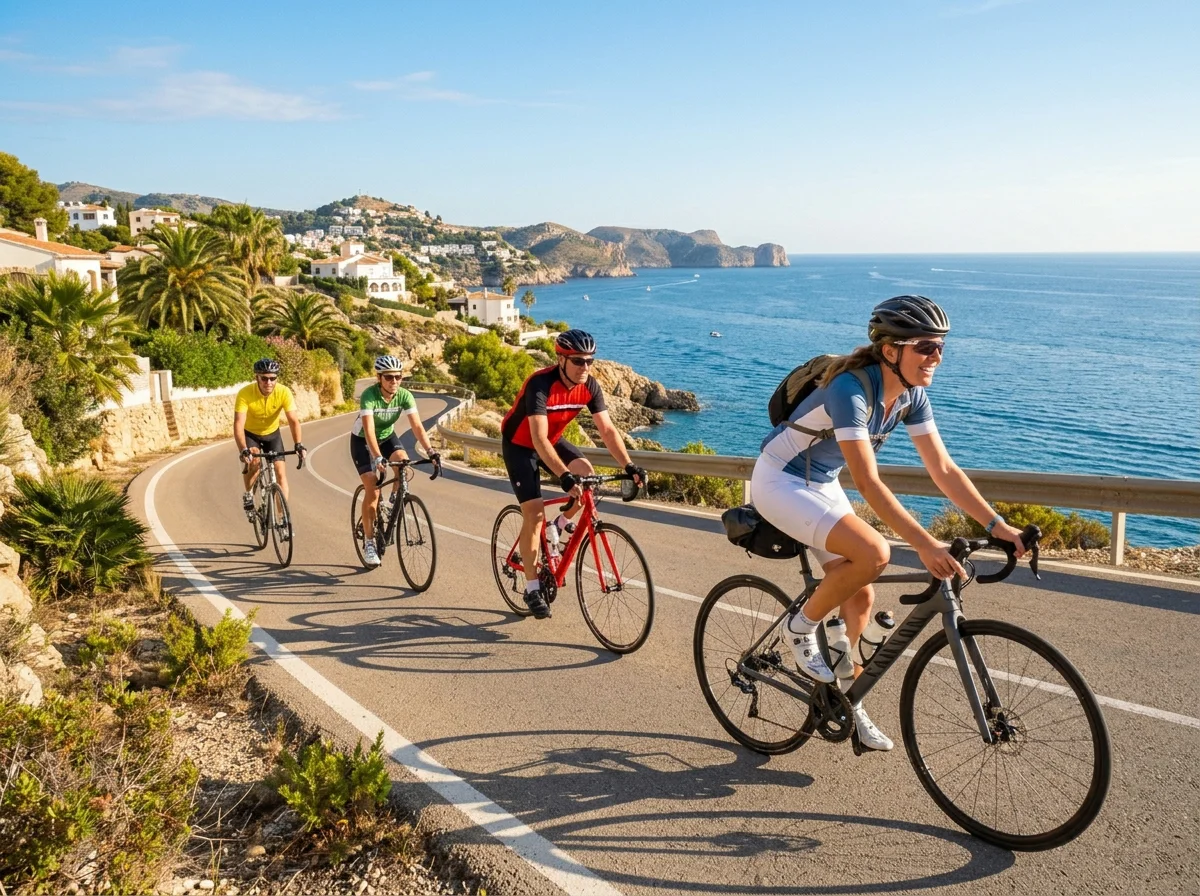
How to Rent a Bike as a Tourist on the Costa Blanca
Key Takeaways
- The Costa Blanca averages 2,953 hours of sunshine a year (AEMET, Alicante-Elche Airport, 1981-2010 normal), making it one of the best cycling destinations in Europe at almost any time of year.
- Renting locally beats travelling with your own bike: no airline fees, no damage risk, no bike cases to lug through the airport.
- Most rental shops require a passport or ID, a credit card for a deposit (typically €100), and a signed rental contract.
- Book in advance, especially for peak season (February to May). The best bikes get reserved weeks ahead.
- Prices range from around €10/day for a leisure bike to €60+/day for a top-end carbon road bike. E-bikes typically sit between €45–70/day.
Introduction
Here’s a number that still surprises people when I tell them: the Costa Blanca averages 2,953 hours of sunshine a year, according to Spain’s national weather agency AEMET (Alicante-Elche Airport, 1981-2010 normal) — among the highest totals anywhere in mainland Europe. It’s part of why professional cycling teams choose this region for their winter training camps, and why the region regularly features in the Vuelta a España.
If you’re visiting and thinking about getting out on a bike, the good news is you don’t need to bring one. The rental infrastructure here has grown enormously over the last decade. Ten years ago you’d struggle to find a decent rental bike. Now, professional teams from Belgium, the Netherlands, and Germany set up training camps here from December through March, and the local infrastructure has followed.
This guide walks you through the full rental process: how to choose the right type of bike, what documents you’ll need, what to watch out for in the small print, and where to find the best shops along the coast. Whether you’re a serious road cyclist or a family wanting to explore the seafront on something comfortable, it all works the same way.
Why the Costa Blanca Is One of Europe’s Best Places to Rent a Bike
Before getting into the practicalities, it’s worth understanding why this region makes so much sense for a cycling holiday.
The roads are good quality and offer a choice of coastal, hilly, and even mountainous rides. That variety is key. You can spend one morning on a flat coastal route and the next grinding up the switchbacks of the Coll de Rates — all within a short drive of each other.
The best months for cycling are January to May and September to November, which conveniently covers the periods when Northern Europeans most want to escape the cold. The rental shops know their audience — most are run by cyclists, for cyclists, and they understand what a serious rider actually needs from a hire bike.
I first came to the Costa Blanca about 25 years ago, arriving at the end of April. The thing that struck me immediately wasn’t the temperature — it was the light. Coming from Germany, where late April evenings are still grey and dim, the brightness here felt almost unreal. The sun is stronger, the days are longer, and the quality of the light is just different. Add to that the daytime temperatures — warm enough to ride in shorts, but not yet the punishing heat of summer — and evenings that stay mild rather than dropping to single digits, and you start to understand why cyclists from Northern Europe keep coming back.
How to Rent a Bike as a Tourist on the Costa Blanca
Renting a bike here as a tourist is straightforward, but there are a few things that catch first-timers out. Here’s the process from start to finish.
Step 1: Choose Your Shop (or Platform)
Your first decision is whether to book through a local shop directly or through an aggregator platform. Platforms like Cycle Classic Tours operate as online booking systems for road bike and e-bike rentals across Spain, including multiple Costa Blanca locations. They’re convenient for planning ahead from home. Local shops give you more flexibility and often better local knowledge.
For families and leisure riders in the southern Costa Blanca, operators like Costa Blanca Bike Hire have been running since 2005, offering Trek road bikes and mountain bikes fitted with speedometers, bottle cages, pumps, and rear bags, plus leisure bikes in adult and children’s sizes, all supplied with helmets and locks.
For serious road cyclists, the hubs are Calpe, Altea/Alfaz del Pi, Dénia, and Alicante — all with specialist shops carrying carbon road bikes and e-road bikes. Our rental directory covers the full region.
Step 2: Book in Advance
Book your bike in advance, particularly in peak season (March to end of April/mid-May). I cannot stress this enough. The good carbon bikes — the ones the rental shops genuinely maintain and set up properly — sell out weeks ahead during peak season. Peak season (February to May) sees prices jump 20–30%, so visiting in autumn gets you better deals too.
Step 3: Confirm Your Sizing and Requirements
When booking, give the shop your height and weight. Good rental shops will use this to set saddle height, handlebar position, and — if they’re really on it — recommend the right frame size. If you’re booking a guided or self-guided tour with any operator, ask what bikes they can arrange (groupset, braking, electronic/mechanical, and sizing), what’s included (pedals/helmet/tools), and whether swaps are possible if fit isn’t quite right.
Step 4: Decide on Delivery or Collection
Many shops offer free delivery to your accommodation within their local area. Allure Bike Rental, for example, delivers free of charge to addresses in Altea, La Nucia, Polop, Alfaz del Pi, Albir, Benidorm, and Finestrat, with a small surcharge for locations further out. This service is common across the region and genuinely useful — having a bike waiting at your apartment on arrival is a much better start to a cycling holiday than navigating an unfamiliar town on pick-up day.
How Do You Rent a Bike? The Practical Process
Here’s exactly what happens from the moment you arrive to the moment you hand the bike back.
1. Show your ID and credit card. A credit card and a passport or ID card are required for renting a bike. This is standard across every rental shop I know of on the Costa Blanca. No ID, no bike — so don’t leave it at the hotel.
2. Pay the deposit. A deposit of €100 is typically required, paid at collection. The bike itself is also paid for on collection. Some shops take a card pre-authorisation rather than a cash deposit; worth confirming in advance.
3. Sign the rental contract. A contract must be signed confirming the bike has been collected in good condition, that you are happy with it, and that you accept responsibility for it. Read it. Particularly the bit about damage.
4. Do your pre-ride check. Check the saddle height, tyre pressure, and — importantly — check which way around the brakes are set before riding away. In the UK, front brakes are typically on the right; in much of Europe, the setup is reversed. Sounds minor. Isn’t.
5. Ride. That’s what you came for. Riding on Spanish roads is generally a very positive experience — perhaps surprisingly so if you’re used to cycling in Northern Europe. Get away from the tourist strips and you’ll find that Spanish drivers are genuinely respectful towards cyclists. That’s not an accident: cycling is deeply embedded in Spanish culture, and drivers here grow up sharing roads with riders in a way that simply isn’t the case in many other countries. That said, a little extra caution is worth it during peak tourist periods — Easter week and the summer months bring a lot of visitors from across Europe, and not everyone behind the wheel shares the same awareness. Stick to the quieter inland roads during those periods and you’ll barely notice the difference. Overall though, Spain is one of the safer countries in Europe to ride in, and that reputation is well earned.
6. Return on time. Late returns will be charged for. A half-day rate applies for rides of 1–3 hours; a full-day rate for anything over 3 hours. If you think you’ll be late, call the shop.
7. Report any damage honestly. Damage due to negligence, accidents, or crashes must be paid for. Damage waivers exist for a reason — they typically run €5–10 per day but could save you hundreds if something goes wrong.
Which Type of Bike Should You Rent?
The right bike depends entirely on where you’re riding and what you want out of the experience. Here’s a straightforward breakdown:
| Bike Type | Best For | Typical Daily Rate |
|---|---|---|
| Leisure / Hybrid | Families, flat coastal rides, casual exploring | €10–20 |
| Road (aluminium) | Sportive riders, training rides | €20–35 |
| Road (carbon) | Serious cyclists, longer mountain routes | €35–60+ |
| E-bike | Mixed groups, riders who want to tackle hills without suffering | €45–70 |
| Mountain bike | Off-road trails, gravel tracks | €20–40 |
Tip: If you’re a mixed group — some strong riders, some less so — an e-bike for the less confident riders is the single best decision you can make. It keeps everyone together and nobody suffers up the climbs.
Operators like SolyBike in Calpe offer road racing bikes, leisure bikes, and e-bikes, all managed by professionals with mechanical assistance available. Most quality shops carry a similar range. At the premium end, specialist shops like Start With Bike in Calpe rent Giant, Liv, and Pinarello road bikes from €23/day, with bike fitting included.
For mountain bikers, our guide to affordable MTB rental on the Costa Blanca covers your options in detail.
How Much Does It Cost to Rent a Bike on the Costa Blanca?
Rental pricing on the Costa Blanca is competitive, but it varies more than you’d expect. Here’s what drives the difference.
The bike itself is the biggest factor. Hidden costs catch people out. Some shops charge extra for pedals (€5/day), GPS units (€10/day), or premium wheels (€15/day). Always ask what’s included.
The rental duration matters too. Most shops offer daily rates that reduce for weekly bookings. Road bikes from Train in Spain in Dénia, for example, are priced at €25/day for 2-4 days and €20/day for 5-6 days; their published weekly rate (€100) is specifically for training-camp bookings, so confirm current pricing directly for a standard week. Booking a full week rather than day-by-day is almost always better value.
Helmets are not always included in the headline price. Some platforms charge €3/day extra for a helmet. If you have your own, bring it.
Pedals deserve a special mention. Road cyclists travelling without their own shoes and cleats are fine — but if you have your own clipless pedals, bring them. Most bikes come fitted with flat pedals as standard, and swapping to your own is usually quick and free.
Where to Find Bike Rental Shops on the Costa Blanca
The rental scene is spread across the coast, with the highest concentration of specialist road bike shops in the north (Calpe, Altea, Alfaz del Pi) and more leisure-focused options in the south. Here’s a quick geographical breakdown:
Calpe is the cycling capital of the Costa Blanca. Our guide to the top bike rental shops in Calpe covers every option in detail.
Benidorm has a good range of shops, particularly for leisure and e-bike hire. See our Benidorm rental guide here.
Alicante is worth knowing about if you’re flying in and want the bike ready immediately. Our Alicante rental roundup includes shops that deliver directly to the airport area.
The southern Costa Blanca (Torrevieja, Mar Menor area) is flatter and well-suited to leisure and family cycling. See cycling routes around Torrevieja here.
Personally, I do most of my cycling in the south of the Costa Blanca, around the Torrevieja and Almoradí area. The stretch along the River Segura is a particular favourite — there are well-maintained cycling paths running along the riverbanks that are a pleasure to ride. From there, a whole network of flat paths follows the irrigation canals all the way from the La Pedrera reservoir down to Campoamor on the coast. No big climbs, no traffic stress — just easy, enjoyable riding through a landscape that most tourists never see. For families, mixed-ability groups, or anyone easing back into cycling after a break, this southern stretch is honestly the ideal place to start.
FAQ
Q: Do I need to bring my own helmet? A: Not necessarily. Most rental shops either include a helmet or offer one for a small daily fee (typically €3–5). That said, if you have your own that fits properly, bring it. A helmet that actually fits makes a noticeable difference on longer rides.
Q: Can I get a bike delivered to my hotel or apartment? A: Yes, and this is one of the best features of the Costa Blanca rental scene. Many shops deliver free of charge within their local area, with a small surcharge for locations further out. Confirm the delivery zone when booking.
Q: Is it cheaper to bring my own bike? A: It depends on your airline, your route, and how long you’re staying. Budget airlines typically charge €40–80 each way for a bike, plus you need a bike case or box, and you’re responsible for any damage in transit. For stays of a week or less, renting locally is usually simpler and often cheaper once you factor in the hassle. For longer trips, doing the maths is worthwhile.
Q: What happens if the bike breaks down mid-ride? A: Mechanical support separates serious shops from casual rentals. The best shops have full workshop facilities and will often drive out with replacement parts if something goes wrong mid-ride. Ask about roadside assistance before you book — it’s a good indicator of how seriously a shop takes its service.
Q: What’s the best time of year to rent a bike on the Costa Blanca? A: The best months for cycling are January to May and September to November. March and April are the most popular (and the most expensive). October and November offer quieter roads, cooler temperatures, and lower prices.
Q: Do I need to pay a deposit? A: Yes. A deposit of €100 is standard, paid at collection. Some shops accept a card pre-authorisation in lieu of cash.
Conclusion
Renting a bike on the Costa Blanca is genuinely easy once you know what to expect. Book ahead (especially between February and May), bring your passport and a credit card, check the deposit and damage conditions before you sign anything, and decide in advance whether you want delivery or are happy to collect.
The region has some of the best cycling roads in Europe — flat coastal stretches for easy mornings, mountain climbs for when you want to push yourself, and quiet inland roads where you can ride for an hour without seeing a car. The rental infrastructure matches the ambition.
If you’re still deciding on routes after sorting your bike, our complete guide to Costa Blanca cycling routes is the best place to start. And if you want to explore on your own terms, our self-guided cycling tour planning guide will help you put together a trip that actually fits your fitness level.
Sources:
- Road Cycling Holiday / CCT Bike Rental: cctbikerental.com
- Bikes Costa Blanca: bikescostablanca.com
- Epic Road Rides (Calpe cycling guide): epicroadrides.com
- Train in Spain / Cafe Ciclista (Dénia): cafeciclista.com
- Start With Bike (Calpe): startwithbike.com
- Allure Bike Rental (Alfaz del Pi): allurebikerental.com
- SolyBike (Calpe): solybike.com